
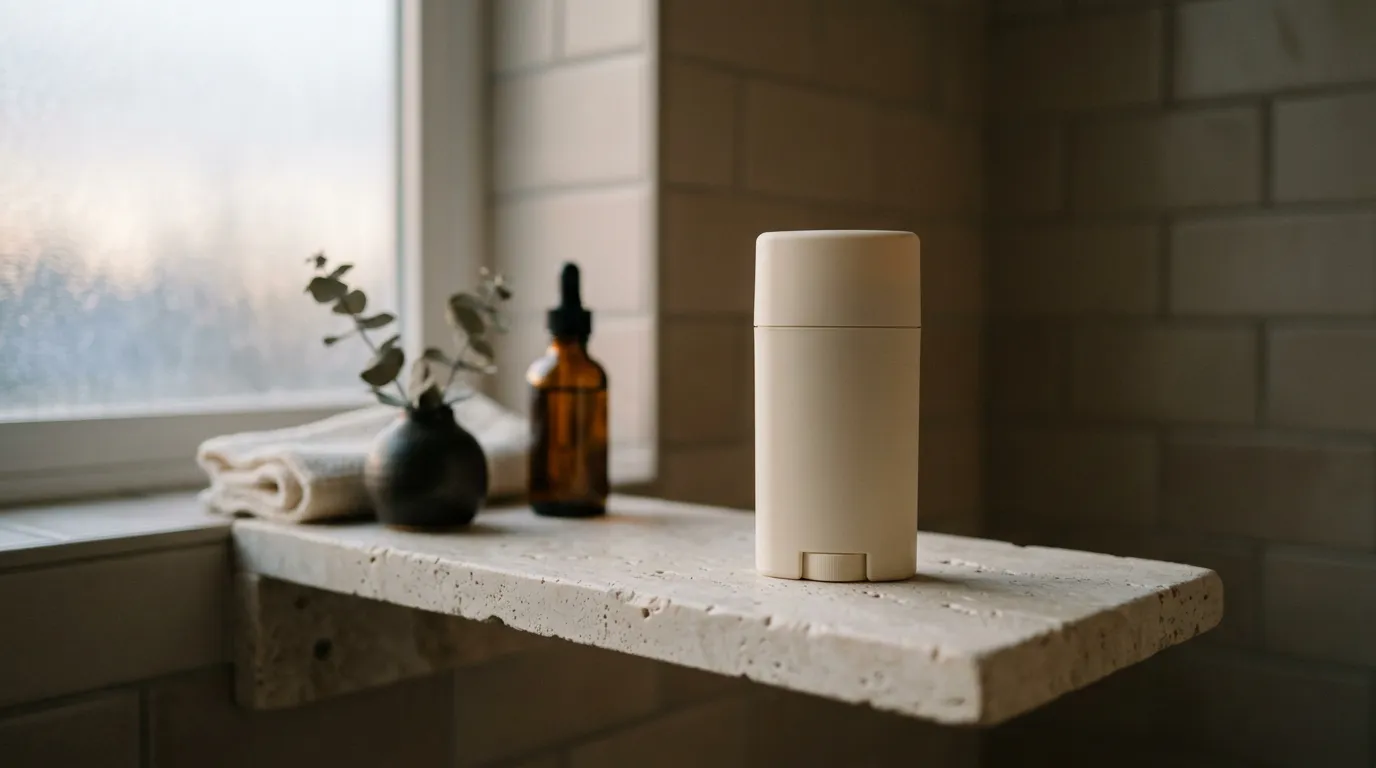
Antiperspirant: Should You Apply It at Night?
You've probably been swiping on antiperspirant in the shower every morning. Dermatologists say that's exactly backwards — here's the real timing, the classic mistake, and what to do if you forgot last night.
 Damien, founder of HALOIA11 min read
If you've been applying antiperspirant during your morning shower and wondering why you're still damp by mid-morning, the timing is the problem, not the product. Dermatologists have said for years that antiperspirant works best applied at night, right before bed, not in the morning rush. The reason comes down to basic physiology: you sweat far less while you're asleep, which gives the aluminum salts in the product time to actually plug your sweat ducts before the next day's sweat gets a chance to wash them back out. Apply the same product in the morning, straight onto skin that's about to sweat from your commute, your coffee, or the hot shower you just took, and you're asking it to build a barrier while the water is already running through. It's not a minor tweak — it's the single change dermatologists mention most often when someone says their antiperspirant "doesn't work." Most people never question the morning-shower habit because it's how deodorant has always been sold to them, as one step in a shower routine, when in reality it's the one product in that lineup that behaves nothing like the rest. Here's the mechanism behind it, the classic mistake that undoes it, and exactly what to do if last night's application never happened.
The Mechanism: What Antiperspirant Actually Does to Your Skin
Deodorant and antiperspirant get lumped together on the same drugstore shelf, but they solve two different problems. Deodorant masks odor and reduces some of the bacteria that cause it — it does nothing to the sweat itself. Antiperspirant is the one that changes how much you actually sweat: it relies on aluminum salts that dissolve into the openings of your sweat ducts and form a temporary, gel-like plug, physically blocking some of the sweat from reaching the surface of your skin in the first place. That's a mechanical fix, not a cosmetic one, and it's the reason the two products end up regulated so differently. It's also why swapping a stronger deodorant for a weaker antiperspirant, or the other way around, doesn't actually solve a sweat problem — you'd be treating the wrong half of the equation.
In the US, the FDA classifies antiperspirant as an over-the-counter drug specifically because it alters a body function, while deodorant is only ever classified as a cosmetic. That's not a marketing distinction, it's a regulatory one, and it tells you plainly which of the two products is actually built to reduce how much you sweat (FDA, OTC Drug Monograph M019).
Why Nighttime Beats Your Morning Routine
Here's the part most people never think about: for the aluminum-salt plug to actually form, the product needs a window of relatively dry, sweat-free skin to set into place. Mornings almost never give it that window. You've just showered, you're about to get dressed, eat breakfast, maybe rush to catch a train — all of it triggers a baseline level of sweat production that keeps diluting and washing out the product before it's had time to do its job. Overnight is the opposite. Your body's sweat production drops substantially while you sleep, so a product applied before bed gets several uninterrupted hours to actually plug the ducts, with the plug already in place and functional by the time your morning routine, and its accompanying sweat, kicks back in. Think of it less like putting on a product and more like letting glue set: glue applied and immediately put under load never bonds properly, and antiperspirant applied right before a day of moving, sweating, and showering is being put under load before it's had a chance to cure.
Contrary to the habit of applying it in the morning shower, dermatologists recommend applying antiperspirant at night before bed: you sweat less overnight, which gives the aluminum salts time to form an effective plug before the next morning's sweat dilutes the product (American Academy of Dermatology, via Dermatology Times).
The Classic Mistake: Applying Right After a Hot Shower
The other half of the mistake is less about the clock and more about your skin's actual state at the moment you apply. A hot shower does two things that work against antiperspirant: it leaves your skin damp, which immediately dilutes whatever you apply on top of it, and the heat itself temporarily increases blood flow and sweat gland activity, meaning your skin is primed to produce more moisture right when you're trying to seal it off. For the aluminum salts to bond and actually form their plug, skin needs to be fully dry at the moment of application, not just towel-dried, but dry enough that there's no residual dampness left in the underarm creases. Sweat sitting on the surface simply washes the product away before it ever gets the chance to work.
There's a second reason to be careful right after a shower, especially if that's also when you shave your underarms. Freshly shaved or irritated skin absorbs more of whatever you put on it, aluminum salts included, and can react to them with stinging or redness. France's food and health safety agency, ANSES, reviewed the safety data on aluminum salts in antiperspirants back in 2011 and, while it found no link to increased cancer risk, it recommended as a precaution capping aluminum concentration at 0.6% and avoiding application on irritated skin or immediately after shaving. In practice, if your shower is also your shave, the antiperspirant should wait until skin has calmed down later that evening, not go on straight out of the shower.
Morning and Night Beats Either Alone
None of this means giving up your morning application entirely. The actual dermatology recommendation isn't "switch from morning to night," it's "add night to whatever you're already doing." Applying both morning and night gives you two separate windows where the product can actually set into dry skin, instead of relying on a single daily attempt that might get undermined by a shower, a workout, or a stressful meeting later that day. In practice, that looks like antiperspirant the night before on clean, dry skin, then a lighter second application the next morning on skin that's already carrying an established plug rather than starting from zero — the morning pass tops up what the overnight application already built, instead of doing all the work by itself. It also means the morning step can be quick: you're maintaining coverage, not trying to build it from scratch in the two minutes before you're out the door.
For maximum effectiveness, skin should be dry at application time, otherwise sweat dilutes the product. Applying both morning AND night gives better results than a single daily application, according to studies cited by dermatologists (American Academy of Dermatology, via Dermatology Times).
- Apply at night, on skin that's fully dry — not towel-dried, actually dry, especially in the underarm creases.
- If shaving is part of your shower routine, wait until skin has calmed down before applying, rather than going straight on afterward.
- Add a lighter morning application on top of an already-established overnight plug, rather than relying on the morning pass alone.
- If you're still soaked by midday despite all of the above, the honest fix is usually a stronger formula, not a third daily coat of the same one.
Your Appearance Score
What's Your Appearance Score?
60 seconds. Get a score based on your habits.
How Much Strength You Actually Need
How well any given application holds up varies more than the label suggests, mostly because it depends on how much you sweat and how strong the formula actually is. A standard over-the-counter antiperspirant usually runs around 10% active aluminum-salt ingredient. For people whose sweating outpaces what that concentration can hold back, "clinical strength" formulas exist as a step up, often built on zirconium salts instead of aluminum, with up to 20% active ingredient — roughly double a standard product. That's still available without a prescription, but it's a real jump in strength, not just different packaging or a bigger price tag. It's worth trying that step up before assuming your only options are living with it or booking a dermatology appointment — a lot of people never get past the standard 10% formula simply because nobody told them a stronger, still-OTC version exists.
For bothersome but not extreme sweating, there's a step before prescription treatment: over-the-counter "clinical strength" antiperspirants, often zirconium-salt based, with up to 20% active ingredient versus roughly 10% in a standard antiperspirant (International Hyperhidrosis Society).
If You Forgot Last Night, Here's How to Catch Up
If last night happens without an antiperspirant application, don't panic, and don't compensate by piling it on straight after your morning shower — that just repeats the diluted-application mistake from a different angle. One missed night doesn't undo an established plug built up over previous nights; the ducts that were already sealed generally stay sealed for a while, so you're rebuilding a habit after a gap, not restarting a routine from zero. If your skin genuinely is dry later that day, say, mid-afternoon, well past your shower and any morning sweat, a light reapplication then is a reasonable stopgap. Just apply the same standard: skin has to be actually dry, not simply "not visibly wet," or you're back to washing the product straight off before it can do anything. Then treat that night as the one that matters, and get back to the dry-skin, before-bed habit rather than trying to cram in extra coats to make up for lost ground.
When It's More Than a Routine Problem
If you're doing everything right, dry skin, nighttime application, even a clinical-strength formula, and you're still soaked by mid-morning, the issue might not be technique at all. Dermatologists use a specific tool to sort this out: the Hyperhidrosis Disease Severity Scale (HDSS), which rates the impact of sweating on a simple 1-to-4 scale.
Sweating a lot isn't automatically hyperhidrosis. Dermatologists use the Hyperhidrosis Disease Severity Scale (HDSS), rating impact from 1 (sweating never noticeable) to 4 (intolerable sweating that always interferes with activities). Level 3-4 is where it moves beyond mere discomfort into needing real medical treatment (Solish et al., Dermatologic Surgery, 2007).
If you land at level 3 or 4, a regular deodorant almost never cuts it, and a standard clinical antiperspirant might not either. The care path that follows usually has a clear order: start with higher-concentration, often prescription-strength, aluminum-salt antiperspirants; if that's still not enough, the recognized second-line option is botulinum toxin injections, which temporarily block the nerve signals that trigger sweat gland activity in the treated area. Both are established, evidence-backed treatments, not a last resort you should feel awkward bringing up with a dermatologist — sweating that reaches level 3 or 4 on the HDSS is a legitimate medical complaint, not a personal failing in your routine.
Since a nightly habit means more consistent, longer-term aluminum exposure than an occasional swipe, it's a fair question to ask whether that's actually fine to do every night. The research says yes. Concerns linking aluminum salts to breast cancer have circulated since the early 2000s, but no health agency has found a proven link.
Despite persistent concerns, no health agency has found a proven link between aluminum salts in antiperspirant and breast cancer. The US National Cancer Institute concludes no scientific evidence links these products to breast cancer, a conclusion confirmed by a 2024 meta-analysis of more than 7,000 participants (National Cancer Institute).
France's ANSES reached the same conclusion back in 2011, specifically for skin exposure through deodorants and antiperspirants. A separate, older worry about Alzheimer's disease holds up no better under scrutiny: despite concerns dating back to studies from the 1960s, large-scale research has never been able to replicate those original findings, and leading organizations now consider the causal claim a myth unsupported by current research. None of that means ignoring ANSES's precautionary advice on concentration and irritated skin is a good idea, but it does mean the nightly habit itself isn't the safety trade-off it can feel like.
The pattern across nearly all of this is the one that shows up in almost every part of a grooming or skincare routine: consistency at the right moment beats intensity at the wrong one. A stronger antiperspirant applied at the wrong time still undersells itself, the same way a genuinely good habit underperforms if it never becomes routine enough to stick. Anchoring one small change to a part of the evening that's already fixed, brushing your teeth, washing your face, is a far more reliable fix than trying to remember an extra step during a rushed morning.
If sweat and body odor are just one of several things you're trying to get a handle on, alongside skin, energy, or how your body actually responds to what you eat, HALOIA's free appearance quiz gives you a quick baseline read on where your current habits stand, so you know which small change, like this one, is actually worth building first.
This article is for information only and is not a substitute for medical advice. For any question about your health, a treatment or a supplement, consult a qualified professional.
Improve your appearance by eating better
Build real confidence by tracking your diet. Download HALOIA and start your tracking.

Go further
The 4 Real Causes of Facial Water Retention
Puffy face again? There are only four real culprits, and they leave different clues. Here's how to tell them apart instead of guessing.

Text Neck: The Real Risk of Your Phone
Your head weighs about 5kg. Tilt it forward to check your phone and your neck can end up carrying nearly 27kg instead — the weight of an 8-year-old, hanging off your cervical spine for hours a day.
Leg Lengthening Surgery: Cost and Risks
It's a real orthopedic procedure, not a shortcut: a bone is surgically cut and pulled apart by about a millimeter a day. Here's what it actually costs, what can go wrong, and what's worth trying before you get anywhere near an operating table.