

Can You Still Grow Taller After 20?
If you're past your early twenties, the "grow taller" methods flooding your feed can't do what they claim. Here's what actually determines your height, and what genuinely still changes how tall you look.
 Damien, founder of HALOIA10 min read
Short answer: no, not once your growth plates have closed. For most men that happens somewhere between 18 and 19, occasionally as late as 21; for most women it happens a bit earlier. After that point, no exercise, stretch, supplement, sleep routine, or "growth hack" you'll find online can add height, because the biological structure that makes bones lengthen has permanently shut down. That's not an opinion, it's how skeletal growth physically works. The question keeps trending anyway, fueled by dating-app profiles, filtered photos, and testimonials for products that quietly rely on how much your height already fluctuates in a normal day. But the full picture is more useful than a flat no: how growth plates work in the first place, when they actually close, why the methods sold online don't do anything, what genuinely changes how tall you look day to day, and the one real (and drastic) medical option that does exist for people set on gaining real centimeters as adults.
How Your Bones Actually Get Longer
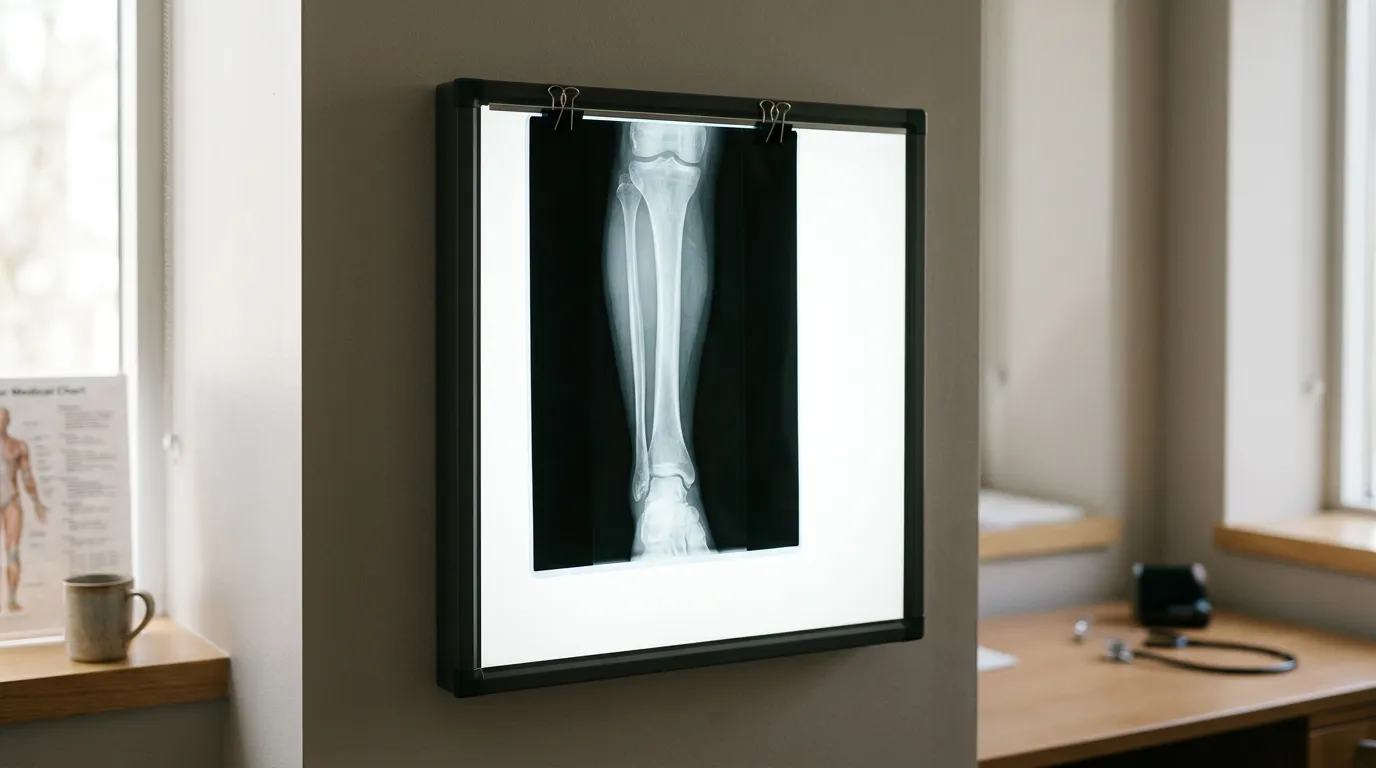
Height comes almost entirely from your long bones, mainly the femur and tibia in your legs, plus the spine. Near each end of these bones sits a layer of cartilage called a growth plate (the medical term is epiphyseal plate). During childhood and adolescence, cells in that cartilage layer keep dividing and gradually turn into new bone, which is what pushes the bone's total length up year after year. It's not a slow, steady climb: growth accelerates sharply during puberty, driven by a surge of growth hormone and sex hormones, then decelerates as that hormonal wave settles.
Here's the part that surprises most people: it's actually sex hormones, especially estrogen (present in both men and women, just at different levels), that eventually trigger the growth plates to fuse solid. Once that cartilage layer is fully replaced by bone, there's no soft tissue left for new bone to form from. At that point the long bones are structurally finished, not "resting," not "capable of restarting under the right conditions," just finished. This is why the timing of puberty, not effort or willpower, is what ultimately decides when your height stops moving.
Height isn't just leg bones, either: your spine contributes roughly a third of total height, stacked from 33 vertebrae separated by intervertebral discs. Those discs are made mostly of water and act as cushions, which is exactly why they compress under gravity through the day and rebound overnight, the same mechanism behind the 1-2 cm swing referenced later in this article. It's worth keeping in mind before spending money on anything promising quick height gains: a method that produces a visible change within days is almost certainly working on that soft, reversible disc cushioning, not on bone.
Twin studies summarized by Scientific American show that genetics accounts for roughly 80% of the variation in adult height between people, with the remaining share tied to nutrition and health during childhood and adolescence, which is also why no amount of effort in your twenties can rewrite a process that was mostly decided in your teens.
When Do Growth Plates Actually Close?
In men, growth plates gradually convert from cartilage to solid bone from late adolescence into the early twenties, with complete closure typically landing around 18 to 19 years old, and occasionally stretching to 21, according to the Cleveland Clinic. In women, the same fusion process tends to finish earlier, generally by the late teens, tracking the fact that female puberty itself typically starts and ends sooner. Genetics sets the ceiling for how tall you'll end up, but the exact timing of when you hit it depends on your own puberty timeline, which is also why two people the same age can be at completely different points in the process: one still gaining height, the other already done for good.
Where the "You Can Still Grow" Confusion Actually Comes From
If growth plates are this final, why does the myth survive so well? A few honest reasons. First, closure timing isn't identical for everyone: a late bloomer who was still growing at 20 or 21 becomes the anecdote that gets repeated as "proof" that anyone can, when really that person's plates just hadn't fused yet. Second, that daily 1-2 cm swing between morning and evening height is large enough that someone who measures themselves right after trying a new stretch or supplement, at a favorable time of day, will genuinely see a bigger number and assume it worked. Third, inversion tables and hanging routines do produce a real, visible effect, it's just spinal decompression, not bone growth, and it quietly reverses by the next morning. None of that is evidence the methods work; it's evidence that normal biological noise is easy to mistake for progress when you want to believe it.
Why the "Grow Taller After 20" Methods Sold Online Don't Work
Search "how to grow taller as an adult" and you'll find supplement stacks, stretching routines, inversion tables, and sleep protocols all promising real centimeters. None of them can reopen a growth plate that has already fused, that's not how the biology works, no matter how the product is marketed. Here's what each one is actually doing:
- Height supplements (calcium, vitamins, "growth blends"): once the growth plates have fused, no vitamin, mineral, or herbal ingredient can restart bone lengthening, there's no scientific mechanism by which they could.
- Inversion tables and spinal stretching devices: these temporarily decompress your intervertebral discs, creating an apparent gain of a few millimeters up to about 2 cm. It's real, but it's reversible and fades within hours, not new bone.
- Hanging and stretching exercises: same mechanism as inversion tables. They relieve spinal compression, they don't lengthen bone, and any perceived gain disappears by the next day.
- Growth hormone treatment: even a real, medically administered growth hormone treatment cannot lengthen bones once the growth plates are fused. It's reserved for confirmed hormone deficiencies in people who are still growing, and in adults it can improve bone density or muscle mass, but not height.
Your own measured height already varies by about 1-2 cm between morning and evening, purely from gradual intervertebral disc compression through the day (documented by Han et al. in research on disc height and posture). That natural daily swing is bigger than most "overnight height gain" claims, which tells you something about how those claims get their testimonials.
Your Appearance Score
What's Your Appearance Score?
60 seconds. Get a score based on your habits.
What Can Legitimately Change How Tall You Look
None of this means your actual height is the only thing that determines how tall you appear, it's just the only thing that's fixed. Posture is the biggest lever you actually control: a hunched back, rounded shoulders, and a forward-leaning head can compress the spine enough to make you look 2-3 cm shorter than you really are, according to Harvard Health. Standing tall, shoulders back, chin level, weight evenly through both feet, recovers that visual height instantly. It doesn't add bone length, but it removes a self-inflicted deficit that's costing you centimeters for free.
Beyond posture, styling choices do real, immediate work: well-fitted clothing (nothing pooling at the ankle or drowning your frame), a single dominant vertical line instead of chopping your silhouette in half with contrasting colors, higher-rise trousers, and shoes with a bit of a stacked sole all shift how tall you read to someone else at a glance. None of it is dishonest, it's the same logic as good lighting for a photo. And if you're chasing that "did I actually get taller" feeling, measure yourself at the same time of day, ideally right after waking up, before the day's disc compression sets in and quietly shaves off that 1-2 cm.
Body composition plays a quieter role too: carrying less excess fat around the midsection tends to make your proportions read leaner and your legs look longer relative to your torso, even though the underlying skeleton hasn't changed at all. It's the same visual principle stylists use, elongated lines draw the eye up and down instead of side to side. None of this is about faking a number on a chart; it's about making sure posture, fit, and proportion aren't quietly working against a height that's already there.
The One Real Medical Option, and Its Real Limits
There is exactly one method that genuinely adds height to an adult skeleton: surgical limb lengthening, medically known as distraction osteogenesis. A surgeon cuts the bone (usually the femur or tibia), then a fixator device very gradually pulls the two segments apart, about 1 mm per day, while new bone tissue fills the growing gap. It was originally developed to correct leg-length discrepancies from injury or disease, and is now also performed for purely cosmetic height gain, per reporting from ScienceAlert on the recent boom in height surgery.
It works, but it's not a shortcut: cosmetic limb lengthening typically adds roughly 5 to 15 cm, at a cost of $75,000 to $150,000 per bone segment in the US, according to reporting on patients undergoing the procedure. It also means months of intensive rehabilitation on a fixator, plus real risks: infection, nerve damage, joint stiffness, and chronic pain that can outlast the recovery period itself. It's a legitimate medical procedure performed by real surgeons, not a scam, but it's major, expensive, elective surgery, not a supplement-aisle fix, and that distinction is worth taking seriously before looking into it.
If you're seriously considering it, that seriousness should extend to who performs it: this is orthopedic surgery, not a cosmetic procedure to shop around for on price alone. A credible surgeon will walk you through the actual complication rates for your specific case, require in-person imaging and consultations rather than a video call and a deposit, and never pressure you toward a decision on a tight timeline. Anyone doing the opposite is a red flag regardless of how polished their marketing looks.
If You're Still a Teenager, This Actually Matters
If your growth plates haven't fused yet, the equation is different. During adolescence, roughly 70% of daily growth hormone secretion happens during sleep, especially deep sleep, so chronic sleep deprivation at that age can genuinely slow growth velocity. Getting enough protein, calcium, and vitamin D, alongside consistent sleep, helps a teenager reach the height their genetics already set as a ceiling. What none of that does is push past that ceiling: overfeeding or piling on supplements won't make a teenager taller than their genetic potential allows, it just supports the process that's already running. Growth spurts also don't arrive on a fixed calendar: some teenagers shoot up early and finish sooner, others start later and keep going into their late teens, which is normal variation, not a sign that anything is wrong or that a growth window can be stretched by trying harder.
The Honest Bottom Line
If you're past your early twenties, your skeletal height is set, and most people even lose a centimeter or more between ages 30 and 50, and more after that, as intervertebral discs keep compressing and bone density gradually declines with age. That's not a reason to chase a method that doesn't work; it's a reason to put your energy where it actually pays off.
There's also a less scientific but very real cost to chasing a method that was never going to work: the people who end up most frustrated are usually the ones who spent months tracking a process that had nothing to track, which quietly reinforces the idea that their body is failing them rather than that the product's claim was false from the start. Redirecting that same discipline toward something that actually responds to effort tends to be a better trade, both for your wallet and for how you feel about your own progress.
Height is one of the only parts of how you look that's genuinely locked in by your early twenties, which is exactly why it's not where HALOIA focuses. Skin clarity, body composition, posture, and the day-to-day habits that shape how put-together you look are all still very much in your control, and they respond to real changes much faster than people expect. HALOIA's free appearance quiz gives you a baseline read on where those levers actually stand for you right now, so you can put effort into the parts of your appearance that are genuinely still moving instead of chasing centimeters that stopped being available years ago.
This article is for information only and is not a substitute for medical advice. For any question about your health, a treatment or a supplement, consult a qualified professional.
Improve your appearance by eating better
Build real confidence by tracking your diet. Download HALOIA and start your tracking.

Go further

The 4 Real Causes of Facial Water Retention
Puffy face again? There are only four real culprits, and they leave different clues. Here's how to tell them apart instead of guessing.

Text Neck: The Real Risk of Your Phone
Your head weighs about 5kg. Tilt it forward to check your phone and your neck can end up carrying nearly 27kg instead — the weight of an 8-year-old, hanging off your cervical spine for hours a day.
Leg Lengthening Surgery: Cost and Risks
It's a real orthopedic procedure, not a shortcut: a bone is surgically cut and pulled apart by about a millimeter a day. Here's what it actually costs, what can go wrong, and what's worth trying before you get anywhere near an operating table.