
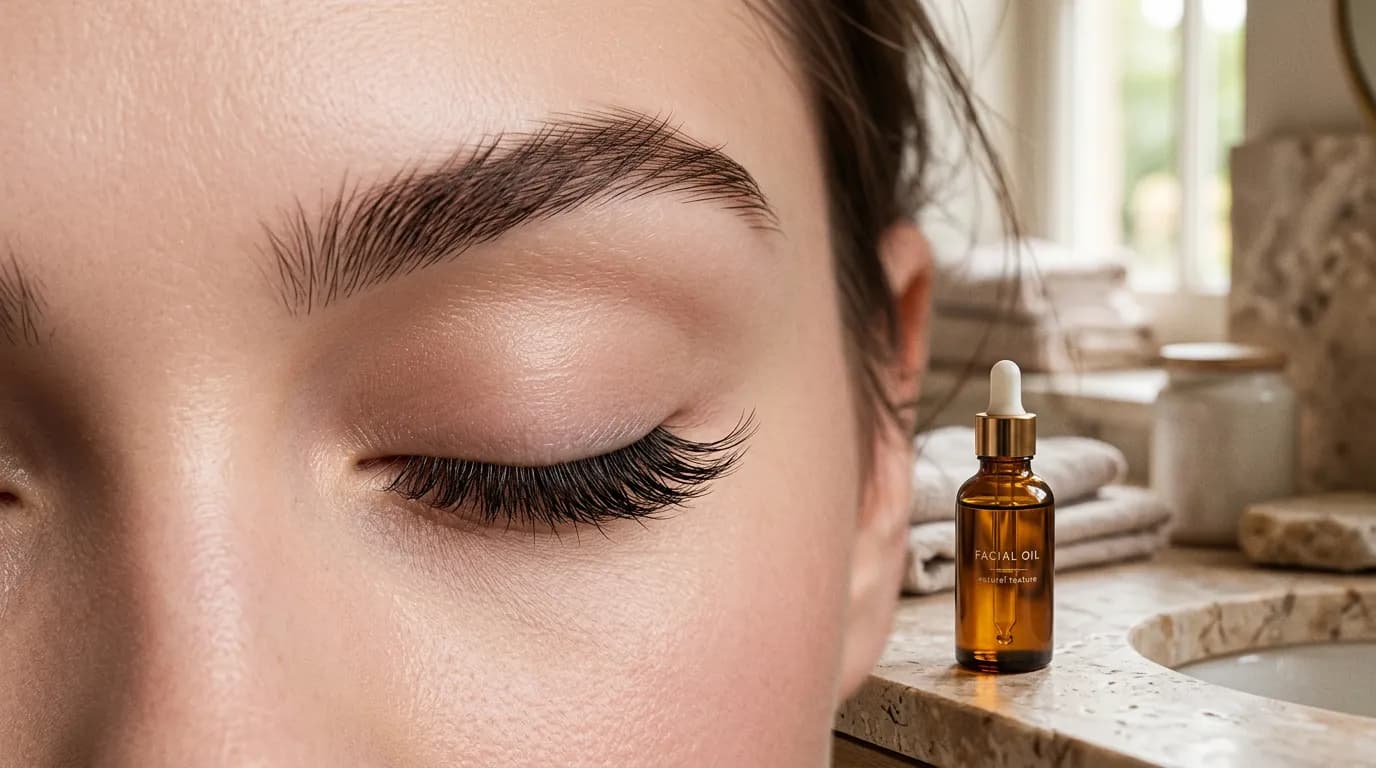
Castor Oil to Grow Your Lashes and Brows?
Castor oil is everywhere in lash-growth routines, but here's how much of that is proven versus wishful thinking, and what actually has clinical evidence behind it.
 Damien, founder of HALOIA10 min read
Does castor oil actually grow longer eyelashes and thicker eyebrows, or is this one more skincare-shelf myth that refuses to die? Here's the honest answer: it might do something for you, but the evidence behind it is thin, and nowhere near the level of proof we have for actual growth treatments. A 2024 literature review on eyelash-growth ingredients, published in the Journal of Cosmetic Dermatology, puts castor oil in the bucket of ingredients that are "promising but understudied" — researcher shorthand for "we don't actually know, because nobody's run the trial." Compare that to bimatoprost, a prescription ingredient backed by an actual randomized clinical trial, and the evidence gap becomes obvious fast. This isn't a takedown of castor oil, and it isn't a sales pitch for a prescription drug either. It's a clear-eyed look at what each option can really promise you, what it can't, and where your money and patience are best spent.
Where the Castor Oil Hype Actually Comes From
Castor oil has been a beauty-cabinet staple for over a century, long before anyone thought to test it in a lab. It's thick, glossy, rich in ricinoleic acid, and it makes hair look conditioned and shiny almost instantly — exactly the kind of visible, same-day feedback that keeps a home remedy alive across generations. It's also had a long parallel life as a folk remedy for everything from constipation to inducing labor to "thickening" scalp hair, which gave it a reputation as a general-purpose growth tonic long before eyelashes specifically entered the picture. Add a wave of viral "before and after" lash videos, and you've got a routine that spreads faster than the science needed to back it up. The problem isn't that castor oil is dangerous or useless. The problem is that "my lashes look glossier" and "my lashes are structurally longer because new hair grew" are two completely different claims, and most testimonials quietly conflate them. A coated, smoothed-down lash catches the light better and looks fuller in a selfie — that's a real, immediate effect. Whether it's doing anything to the hair follicle underneath is a separate question, and it's the one the research hasn't answered yet.
What the Research Actually Says About Castor Oil
Here's the part most castor oil posts skip: there's no large, well-designed clinical trial showing it grows longer or thicker lashes or brows. What exists is a mix of small studies, anecdotal reports, and reasoning based on ricinoleic acid's mild anti-inflammatory and conditioning properties. Some researchers hypothesize it may calm minor irritation at the lash line, which in theory could reduce hair loss from inflammation, but that's a mechanism borrowed from other uses of the oil, not something demonstrated for lashes specifically. That's not nothing, but it's also not proof of hair growth. When researchers who study this exact question sat down and reviewed the ingredients marketed for eyelash growth, they didn't rank castor oil alongside the ingredients with clinical backing. They put it in a separate, lower tier of its own.
A 2024 review of eyelash-growth serum ingredients in the Journal of Cosmetic Dermatology classifies castor oil as "promising but understudied" — a category reserved for ingredients with a plausible mechanism but no solid trial data, far behind the evidence level for proven options like bimatoprost.
Bimatoprost: The Ingredient With Real Clinical Proof
If you want to see what real evidence looks like for lash growth, bimatoprost is the benchmark. It's a prostaglandin analog originally developed as a glaucoma eye drop; doctors noticed patients using it were also growing longer, thicker eyelashes as a side effect, and it eventually got approved specifically for that use (sold under the brand name Latisse in the US). Unlike castor oil, bimatoprost has actually been through a randomized, placebo-controlled trial — the gold standard for proving a treatment works instead of just correlating with it.
In a randomized trial of 19 people, nightly bimatoprost applied at the lash base for 6 weeks increased lash length by an average of 2.0 mm, compared to 1.1 mm with a placebo — a statistically significant difference, published in Ophthalmology in 2010.
Later research also found it works off-label on sparse eyebrows, producing thicker, longer, darker regrowth in several studies, even though the FDA has only approved it for lashes, not brows. That's a meaningfully different evidence tier than "promising but understudied."
Castor Oil vs. Bimatoprost: Comparing the Evidence Gap
- Evidence level: castor oil has small studies and anecdotal support; bimatoprost has a randomized, placebo-controlled trial showing a measurable, statistically significant difference over placebo.
- Regulatory status: castor oil is an unregulated cosmetic ingredient; bimatoprost is an FDA-approved, prescription-only drug for lashes, used off-label for brows.
- Mechanism: castor oil mostly conditions and coats the hair shaft; bimatoprost is thought to extend the hair's active growth phase at the follicle itself.
- Cost and access: castor oil costs a few dollars and needs no prescription; bimatoprost requires a doctor's prescription and typically runs $100 or more per month.
- Risk profile: castor oil's main downside is mild irritation for some people; bimatoprost carries a rare but real risk of permanent eye-color change.
None of that makes castor oil pointless or bimatoprost automatically the right call for everyone. It means the two sit in genuinely different categories: one is a low-cost, low-risk grooming habit with a plausible but unconfirmed effect, and the other is an actual medical treatment with a documented benefit and a documented, if rare, cost. Treating them as interchangeable options on the same shelf is where most of the confusion, and most of the disappointment, comes from.
Where Over-the-Counter Lash Serums Fit In
Castor oil and bimatoprost aren't the only two options on the shelf. A wide middle tier of over-the-counter lash serums, usually built around peptides, biotin, or panthenol, sits somewhere between the two. These formulas are typically better tested than a single kitchen-cabinet oil, since brands run their own in-house trials, but they're still nowhere near the independent, peer-reviewed, placebo-controlled standard that bimatoprost cleared. The honest way to think about them: more formulated and often more expensive than castor oil, but still resting on manufacturer-funded data rather than the kind of trial that changed how ophthalmologists treat sparse lashes. If you're going to spend money on a serum instead of a five-dollar bottle of oil, it's worth asking whether the brand can point to an independent study, not just a glossy before-and-after gallery on their own website.
Your Appearance Score
What's Your Appearance Score?
60 seconds. Get a score based on your habits.
Why the Belief Outpaces the Proof
If castor oil's evidence is this thin, why does almost everyone swear by it? Partly because lashes and brows matter more to how we're perceived than most people realize, which makes any promised fix feel worth trying no matter how weak the data. Eyebrow thickness alone is one of the strongest single cues people use to judge how masculine a face reads, ahead of cheekbone shape or eye size. Sparse eyebrows also make a face measurably harder to read for emotion, a real cost most people feel intuitively even if they can't name it. That social weight primes people to notice any improvement, real or not. Add the coating effect (glossier, smoother-looking lashes from the oil itself), the ritual of nightly application (which people associate with "it must be working because I'm doing something"), and selectively-lit before/after photos, and you get a myth that self-reinforces without ever needing to be objectively true.
Eyebrow thickness is one of the strongest single facial traits used to judge how masculine a face is perceived to be, more so than cheekbone shape or eye size — and sparse eyebrows measurably reduce how easily a face reads for emotion, which helps explain why any promised brow fix spreads fast, tested or not.
If You Still Want to Try Castor Oil: How to Do It Without Risk
There's a reasonable middle ground here: castor oil probably won't transform your lashes, but it's low-risk enough that trying it isn't a bad bet, as long as you keep your expectations and your technique in check. The goal isn't to talk you out of it — it's to make sure that if you do try it, you're doing it in a way that can't hurt you and gives you an honest read on whether it's actually helping, instead of a placebo effect you'll never be able to separate from the real thing.
- Patch test first on your inner forearm for 24 hours before it goes anywhere near your eyes.
- Use a cold-pressed, hexane-free castor oil, and apply a small amount with a clean spoolie, not your fingers.
- Apply at night, at the lash line only, and wipe off excess so it doesn't migrate into your eye overnight.
- Give it 8 to 12 weeks before judging anything, and take same-angle, same-lighting photos every 2 weeks so you're not relying on memory.
- Stop immediately if you notice redness, swelling, or itching, and never apply it if you already have an eye infection or recent eye surgery.
One related habit worth flagging separately: castor oil routines often get paired with at-home lash or brow tinting for a more dramatic before-and-after. That's a different and riskier gamble. No dye is actually FDA-approved for permanent eyebrow or eyelash tinting; only silver nitrate up to 4% is allowed, and only for professional salon use. Regular hair dye repurposed for lashes or brows has caused chemical burns and, in rare cases, vision loss. If you want darker, fuller-looking brows or lashes, keep that goal separate from a growth oil, and leave tinting to a licensed professional using a product actually meant for the eye area.
The Proven Alternative and Its Real Trade-offs
Bimatoprost is the closest thing to a guaranteed answer here, but "proven" doesn't mean "risk-free," and it's worth knowing the trade-off before asking a doctor for a prescription.
A rare but documented side effect of long-term bimatoprost use is irreversible iris darkening, linked to increased melanin production. A published case describes an iris changing from hazel to brown over one year in a patient who used it on only one side, reported in JAMA in 2015.
That side effect is uncommon, and it's tied to sustained use near the eye rather than being a guaranteed outcome. But it's exactly the kind of real, documented trade-off that a genuinely tested product comes with — and one that an untested option like castor oil simply has no data on either way. Undocumented isn't the same as safe, it just means nobody's looked closely enough yet.
When Lash or Brow Loss Isn't Just Cosmetic
Before reaching for any growth product, it's worth ruling out why the hair is thinning in the first place. Progressive eyebrow or eyelash loss can be purely local, from rubbing or aggressive plucking, but it can also be an early signal of something systemic: a thyroid disorder, an iron, zinc, or biotin deficiency, alopecia areata, or lupus. Persistent, unexplained loss deserves a real medical opinion before it deserves a serum, since no amount of castor oil or bimatoprost will fix hair loss whose actual cause is a nutrient deficiency or an underlying condition. Repeated eye rubbing and trichotillomania, a compulsive hair-pulling habit, are also common but often-overlooked mechanical causes worth ruling out first, since no oil or serum fixes a habit. If you've been applying something nightly for months with zero change, that absence of any result, not even the glossier-lash effect, is itself a signal worth mentioning to a doctor rather than switching to a stronger oil or a different serum and waiting another few months.
Most of what shows up on your face, including how well your hair grows, traces back to what's actually going on inside your body, not just what you put on top of it. Deficiencies in iron, zinc, and biotin are on the short list of things that can quietly stall lash and brow growth, and they're also things a topical oil can't fix no matter how long you leave it on overnight. That's the piece most lash-growth routines skip entirely: they treat the follicle as the whole problem, when for a lot of people the follicle is just reacting to what's missing further upstream, in the diet. HALOIA's meal scoring tracks whether your real diet is actually covering those bases, so you know whether the answer is an oil in a bottle or something on your plate. If you want a faster starting point than trial and error, HALOIA's free appearance quiz gives you a baseline read on where your skin, hair, and habits currently stand.
This article is for information only and is not a substitute for medical advice. For any question about your health, a treatment or a supplement, consult a qualified professional.
Improve your appearance by eating better
Build real confidence by tracking your diet. Download HALOIA and start your tracking.

Go further

The 4 Real Causes of Facial Water Retention
Puffy face again? There are only four real culprits, and they leave different clues. Here's how to tell them apart instead of guessing.

Text Neck: The Real Risk of Your Phone
Your head weighs about 5kg. Tilt it forward to check your phone and your neck can end up carrying nearly 27kg instead — the weight of an 8-year-old, hanging off your cervical spine for hours a day.

Leg Lengthening Surgery: Cost and Risks
It's a real orthopedic procedure, not a shortcut: a bone is surgically cut and pulled apart by about a millimeter a day. Here's what it actually costs, what can go wrong, and what's worth trying before you get anywhere near an operating table.