
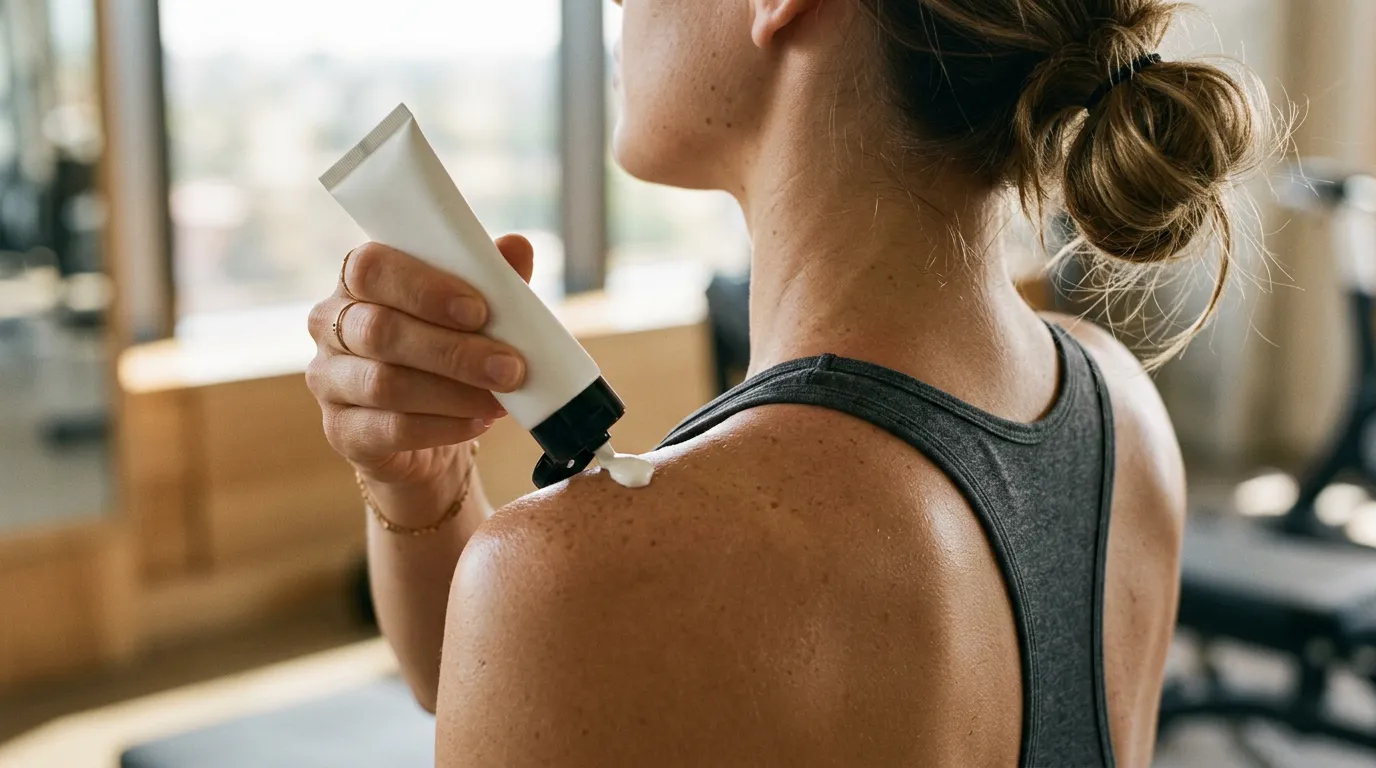
Daily Sunscreen: 24% Fewer Visible Wrinkles
One of the most solidly proven anti-aging strategies isn't a serum. It's using sunscreen every day instead of just on sunny vacations. Here's what the 24% actually means, and how to not waste it.
 Damien, founder of HALOIA11 min read
Here's a number worth sitting with before you spend another dollar on an anti-aging serum: people who wore broad-spectrum SPF 30+ sunscreen daily showed 24% less visible skin aging after 4.5 years than people who only wore it when they remembered, or when it was sunny. Not 24% fewer sunburns. Twenty-four percent less visible aging, measured directly on skin, over a period long enough that it isn't noise. Out of everything sold in the skincare aisle claiming to fight wrinkles, sagging, and dullness, daily sunscreen is one of the very few things with a controlled trial behind it rather than a marketing claim. It's also one of the cheapest: a $12 tube of broad-spectrum SPF 30 beats most $80 serums on the actual evidence, which is a strange thing to have to say out loud, but the marketing budgets on either product don't reflect that gap at all. This piece is about what that study actually measured, why "daily" is doing almost all the work in that 24% and "occasional" barely counts, what SPF and how much of it you actually need, the application mistakes that quietly cancel the whole effect out, whether any of this applies if you have deeper skin and rarely burn, what pairs well with sunscreen instead of competing with it, and a routine simple enough to actually stick to for years, not weeks.
What the study actually measured
The comparison wasn't sunscreen versus no sunscreen. It was daily use versus discretionary use, meaning people who already owned sunscreen and used it, just inconsistently, the way most people who "wear sunscreen" actually behave. That's the detail that makes the 24% figure so useful: it isn't measuring the gap between protected and unprotected skin, which would be a huge and somewhat obvious number. It's measuring the gap between two groups who both believed they were doing the responsible thing, and it's telling you that the group who did it every single day looked meaningfully younger 4.5 years later than the group who did it "most of the time." Visible aging in a trial like this isn't a vague impression, it's assessed through standardized clinical grading of fine lines, roughness, pigmentation, and skin texture, compared against baseline photographs. That's a slow, cumulative outcome, which is exactly why the daily habit matters more than any single application ever could. You're not being graded on your best day. You're being graded on your average day across four and a half years.
Why daily consistently beats occasional
Photoaging is not caused by extreme exposure on a handful of memorable days. It's caused by cumulative, low-grade UV exposure on all the ordinary days you never think to protect against: the walk to your car, the fifteen minutes at a red light with the sun through the windshield, the errands you ran at lunch, the desk that happens to sit near a window. UVA rays, the wavelength most responsible for collagen breakdown and photoaging, penetrate clouds and glass and don't require a clear blue sky or a beach to do their work. "Occasional" sunscreen users are almost always protecting themselves on the days they've mentally flagged as sun-exposure days, vacations, beach trips, visibly sunny afternoons, and going unprotected on the other 300-plus days a year, which is precisely where most of the cumulative UVA dose actually lands. Daily use closes that gap not because any individual day of protection is dramatic, but because it removes the hundreds of small, unflagged exposures that occasional use structurally misses. This is the same logic that makes consistency beat intensity in almost every health behavior, training, diet, sleep, except here you can watch it play out on your own face over years instead of taking it on faith.
Daily use of broad-spectrum sunscreen (SPF 30 minimum) is the most solidly proven strategy for preventing sun-related skin aging: in a randomized trial of 903 Australian adults followed for 4.5 years, skin aging was 24% lower in the daily sunscreen group than in the group applying it at their own discretion. (Hughes et al., Annals of Internal Medicine, 2013.)
The SPF and the amount most people get wrong
SPF 30 is the practical floor, not a compromise. By the math dermatologists use to explain SPF, SPF 30 filters out roughly 97% of UVB rays and SPF 50 filters out roughly 98%, a one-point difference that matters far less than most people assume, according to the American Academy of Dermatology. What actually swings that percentage in real life isn't the number on the bottle, it's the amount you put on and how often you put more on. The clinical standard used to test SPF ratings in a lab is about 2 milligrams per square centimeter of skin, which in practice for a face and neck works out to roughly a quarter teaspoon, more than most people intuitively apply. Rub in a thin, invisible layer and you're not wearing SPF 30, you're wearing something closer to SPF 10 or 15 in practice, because SPF ratings assume a specific thickness that almost nobody hits by eyeball. "Broad-spectrum" on the label matters just as much as the number: it means the product is tested against both UVA and UVB, and a high SPF without broad-spectrum coverage still leaves the collagen-degrading UVA rays mostly unchecked. Mineral filters (zinc oxide, titanium dioxide) and chemical filters (avobenzone, octinoxate, and similar) both meet broad-spectrum standards when formulated correctly, the choice between them comes down to skin sensitivity and texture preference, not effectiveness, so "mineral is safer" or "chemical works better" is mostly a marketing framing rather than a meaningful difference for daily anti-aging use. One more detail almost nobody checks: sunscreen degrades, both the active filters and the base formula, so a tube that's been open for over a year or left baking in a hot car is delivering a lower effective SPF than the number on the label, regardless of how much you apply.
- Use SPF 30 or higher, labeled broad-spectrum, every single day, not just when it looks sunny outside.
- Apply about a quarter teaspoon (roughly a nickel-sized amount) for the face and neck alone, most people apply less than half of that.
- Reapply every 2 hours during real sun exposure (outdoor work, a walk, time by a pool), sunscreen from 8am doesn't cover you at 2pm.
- Put it on as the last step of a morning skincare routine, after moisturizer, before makeup or SPF-tinted product, so it isn't diluted or broken up by other layers going on top.
- Don't skip it on cloudy or cold days, up to 80% of UV rays pass through cloud cover, and UVA doesn't care about temperature.
The application mistakes that quietly cancel out the effect
Most people who "wear sunscreen daily" and still see photoaging progress aren't lying to themselves about frequency, they're making one of a small number of application mistakes that silently erase most of the benefit. The most common is simply applying too little, the thin-layer problem above, which is less a mistake of judgment than a mistake of habit: nobody measures a quarter teaspoon every morning, so the amount drifts down over months. The second is missing spots that get real sun exposure but rarely get product: ears, the back of the neck, the hairline, the tops of the feet in sandal weather, the backs of hands, which age visibly faster than most people notice because they're driving, walking, or reaching for coffee with them exposed all day. The third is treating a moisturizer or foundation with SPF built in as a full substitute, when in practice people apply far less of a tinted product than they would a dedicated sunscreen, and the coverage ends up thinner than the label's SPF number implies. And the fourth, arguably the biggest one at scale, is simply forgetting reapplication exists: sunscreen isn't a coat of paint that lasts all day, sweat, touching your face, and just time degrade it, and the 2-hour window is a real clinical guideline, not an overcautious suggestion.
Your Appearance Score
What's Your Appearance Score?
60 seconds. Get a score based on your habits.
"I don't really burn" — sunscreen on medium to deep skin tones
One of the most persistent and least accurate beliefs about sunscreen is that it's mainly for fair skin that burns easily. Melanin does provide some natural UV protection, roughly the equivalent of a low SPF, generally cited around SPF 13 for deeply pigmented skin, but that's a fraction of the SPF 30+ threshold that actually moves the needle on visible aging, and it offers essentially no protection against UVA-driven collagen breakdown or against hyperpigmentation, which shows up more prominently and takes longer to fade on medium and deep skin tones than on fair skin. Not burning isn't the same as not aging: people with more melanin are statistically less likely to get sunburned, which has fed a real and understandable belief that sun protection is optional for them, but dermatology's actual objection isn't to the belief being illogical, it's that photoaging and UV-triggered dark spots don't require a burn to happen, the same way the underlying skin-cell damage from sun exposure doesn't require visible redness. The practical friction has historically been formulation, not need: older mineral sunscreens left a visible white or gray cast on deeper skin tones, which is a real and legitimate reason people stopped using them, not a sign the product wasn't needed. That problem is largely solved now. Tinted mineral formulas and modern chemical sunscreens go on clear across skin tones, so the fix isn't skipping sunscreen, it's picking a formula that doesn't leave a cast, which takes about one trip through a few product reviews to sort out.
What actually pairs well with it
Sunscreen is the floor, not the whole routine, and it stacks well with one ingredient in particular for the goal most people actually have when they start caring about this: not just preventing new damage, but improving how skin already looks. Topically applied vitamin C, used in the morning underneath sunscreen, stimulates collagen production and adds a layer of protection against the UV-driven damage that sunscreen alone doesn't fully block, making the two a genuinely complementary pair rather than redundant products competing for the same job. The catch with vitamin C is formulation, not the ingredient itself: it needs to be reasonably fresh, properly stabilized, and concentrated enough to actually penetrate skin, which is why a vitamin C serum that's oxidized (turned yellow-brown, smells off) has largely stopped doing anything useful and is worth replacing rather than using out of habit.
Topically applied vitamin C stimulates collagen production and protects against sun damage, a well-recognized anti-aging ingredient, though its main practical challenge is formulation: it needs to be stable and concentrated enough to penetrate skin properly. (Al-Niaimi & Chiang, Journal of Clinical and Aesthetic Dermatology, 2017.)
A routine realistic enough to actually run for 4.5 years
The 24% figure didn't come from a group of people with an elaborate ten-step routine, it came from people who did one thing consistently for years. That's the actual takeaway: complexity is the enemy of the habit that produces results here, not a sign of doing it right. A realistic version looks like this: cleanse, a vitamin C serum if you're using one, moisturizer, then a quarter-teaspoon of broad-spectrum SPF 30+ as the literal last step before you leave the house or sit near a window, every morning, regardless of the forecast. Keep a travel-size tube somewhere you'll actually see it again at midday, a bag, a desk drawer, your car, since reapplication is the step almost everyone drops first once the initial motivation fades. The goal isn't a perfect routine, it's a boring one you don't have to think hard about, because the entire mechanism behind that 24% is what happens on the days you weren't thinking about your skin at all.
This is the same principle behind how HALOIA approaches appearance in general: the changes that actually move how your skin looks over months and years come from small, consistent, trackable habits, not from an occasional big effort followed by long gaps. If you want a clear, current read on your skin, habits, and routine before changing anything, HALOIA's free appearance quiz gives you that baseline in a few minutes.
This article is for information only and is not a substitute for medical advice. For any question about your health, a treatment or a supplement, consult a qualified professional.
Improve your appearance by eating better
Build real confidence by tracking your diet. Download HALOIA and start your tracking.

Go further
The 4 Real Causes of Facial Water Retention
Puffy face again? There are only four real culprits, and they leave different clues. Here's how to tell them apart instead of guessing.

Text Neck: The Real Risk of Your Phone
Your head weighs about 5kg. Tilt it forward to check your phone and your neck can end up carrying nearly 27kg instead — the weight of an 8-year-old, hanging off your cervical spine for hours a day.

Leg Lengthening Surgery: Cost and Risks
It's a real orthopedic procedure, not a shortcut: a bone is surgically cut and pulled apart by about a millimeter a day. Here's what it actually costs, what can go wrong, and what's worth trying before you get anywhere near an operating table.