
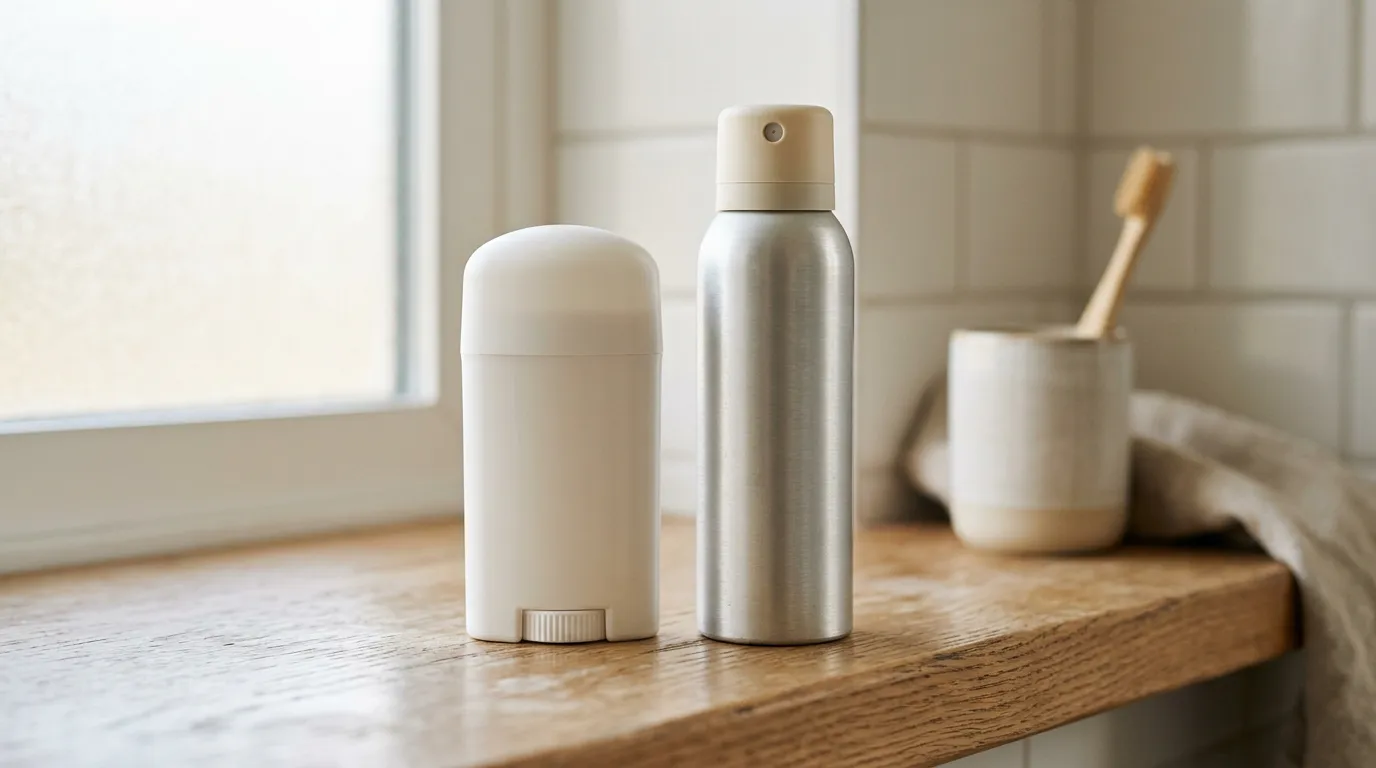
Deodorant vs Antiperspirant: Not the Same Thing
You've probably used the two words interchangeably for years. They're not the same product, they don't solve the same problem, and using the wrong one explains a lot of "nothing works for me" frustration.
 Damien, founder of HALOIA11 min read
Deodorant and antiperspirant get used interchangeably, and half the sprays in the drugstore aisle blur the line even further by branding themselves as both at once. But mechanically, they solve two different problems. Deodorant masks odor and cuts down on the bacteria that cause it. Antiperspirant uses aluminum salts to form a temporary plug inside your sweat ducts, reducing how much you actually sweat in the first place. The US doesn't treat them as equivalent either: the FDA regulates antiperspirant as an over-the-counter drug because it alters a body function, while deodorant is classified only as a cosmetic. If your real problem is smell, deodorant alone can solve it. If your real problem is visible sweat marks, soaking through a shirt by mid-morning, or sweating through a job interview, you need the aluminum salts — no amount of extra deodorant substitutes for that.
What each one is actually doing, chemically
Deodorant works on the surface, in two ways at once: it covers existing odor with fragrance, and most formulas also include an antimicrobial ingredient, usually alcohol, that reduces the bacteria living on your skin. That matters because body odor comes from those bacteria breaking down sweat, not from sweat itself, which is close to odorless when it first reaches your skin. What deodorant never touches is the volume of sweat you produce. That part is entirely the antiperspirant's job. Antiperspirants use aluminum salts, most often aluminum chloride or aluminum zirconium compounds, which react with the moisture inside your sweat ducts to form a small, gel-like plug. That plug temporarily blocks the duct, so less sweat physically reaches the surface of your skin. Less sweat also means less raw material for odor-causing bacteria to feed on, which is why a good antiperspirant produces a mild deodorant effect as a side benefit — but a deodorant never produces the reverse. It can't reduce sweat, because it was never built to interact with the sweat duct at all. The plug itself isn't permanent either; it wears off gradually over the course of the day as skin cells turn over and new sweat pressure builds behind it, which is the entire reason antiperspirant is a once-or-twice-daily habit rather than a one-time fix.
Deodorant masks odor or reduces odor-causing bacteria but doesn't block sweat itself. Antiperspirants use aluminum salts that form a temporary plug in sweat ducts to actually reduce how much you sweat (Cleveland Clinic, Antiperspirant vs. Deodorant).
Why the FDA draws a hard line between them
This isn't a marketing distinction dreamed up by a brand's copywriting team. In the US, antiperspirant is legally a drug, and deodorant is legally a cosmetic — two entirely different regulatory categories with different testing and labeling obligations. A product only earns drug status because it changes an actual body function, in this case how much a sweat gland secretes. A cosmetic, by definition, only affects appearance or surface odor, never underlying physiology. That single classification line explains a pattern you've probably noticed without naming it: every antiperspirant lists an "active ingredient" and a percentage on the back, the same format you'd see on a pain reliever or an allergy pill, while deodorant packaging almost never does. It's not a stricter product because it's fancier. It's a stricter product because it's doing something a cosmetic legally isn't allowed to claim.
In the US, antiperspirants are classified by the FDA as over-the-counter drugs because they alter a body function, while deodorants are classified only as cosmetics — a formal, regulatory sign that they don't operate at the same level (FDA, OTC Drug Monograph M019).
Deodorant only, antiperspirant only, or both
Most people are using the wrong tool for their actual complaint, not because they don't care, but because nobody ever explained the mechanism this plainly. Here's the decision broken down by what you're actually trying to fix.
- Your only issue is smell, and you don't sweat visibly or heavily: a standard deodorant is genuinely enough. Adding an antiperspirant on top of that adds sweat reduction you don't need.
- You get visible sweat marks, soak through shirts, or sweat through stressful moments (interviews, presentations, first dates): you need the aluminum salts. Deodorant alone will never touch this, because it isn't designed to reduce sweat volume at all.
- You want both odor control and reduced sweat, which is most people most of the time: many mainstream products already combine both actives in one formula — check the label for an aluminum compound listed as the active ingredient alongside a fragrance and antimicrobial agent.
- You're switching to a "natural" or aluminum-free deodorant: understand that it is a deodorant, full stop, regardless of how it's marketed. It can smell great and reduce bacteria, but it will not reduce how much you sweat, because it contains no active ingredient that interacts with the sweat duct.
The ingredients worth actually knowing
Reading the back of the bottle gets a lot less confusing once you know what to look for. On an antiperspirant, scan for an "Active Ingredients" box, almost always aluminum chloride, aluminum chlorohydrate, or aluminum zirconium tetrachlorohydrex gly, usually followed by a percentage. That percentage is the entire story of how strong the product is: a standard over-the-counter antiperspirant typically sits around 10% active ingredient, while products marketed as "clinical strength" push that up to as much as 20%, using zirconium-salt formulas specifically designed for people whose regular antiperspirant stopped being enough. On a deodorant, there's no active-ingredient box at all — instead you're looking at alcohol (the antimicrobial doing the actual bacteria-reduction work), fragrance, and sometimes sodium bicarbonate or other odor absorbers in "natural" formulas. Sodium bicarbonate absorbs some moisture and neutralizes odor on contact, which is why it can feel like it's working almost like an antiperspirant, but it doesn't form the aluminum-salt plug, so it never reduces sweat output the way an actual antiperspirant does.
For bothersome but not extreme sweating, there's a step before a prescription: over-the-counter "clinical strength" antiperspirants, often zirconium-salt based, with up to 20% active ingredient versus roughly 10% in a standard antiperspirant (International Hyperhidrosis Society).
Your Appearance Score
What's Your Appearance Score?
60 seconds. Get a score based on your habits.
When it's more than normal sweating: hyperhidrosis
Sweating a lot on a hot day or during a hard workout isn't hyperhidrosis — that's your body doing exactly what it's built to do. Dermatologists distinguish the two using something called the Hyperhidrosis Disease Severity Scale, which rates the actual impact of sweating on your daily life rather than the raw amount produced. A score of 1 means sweating is never even noticeable; a score of 4 means it's intolerable and consistently interferes with normal activities, work meetings, social situations, holding a pen. It's really only at level 3 to 4 that you've crossed from ordinary discomfort into something worth treating medically rather than managing with a stronger stick of deodorant. If that's you, the escalation path is well established and doesn't start with prescriptions: regular antiperspirant first, then a higher-concentration, often prescription-strength aluminum salt formula if that's not enough, and only after that, botulinum toxin injections as a second-line treatment for genuinely resistant cases. Going straight to a specialist isn't usually the first move — trying a genuinely stronger antiperspirant correctly is.
Dermatologists use the Hyperhidrosis Disease Severity Scale (HDSS), rating impact from 1 (sweating never noticeable) to 4 (intolerable sweating that always interferes with activities). Level 3 to 4 is where it moves beyond mere discomfort into needing real medical treatment (Solish et al., Dermatologic Surgery, 2007).
The aluminum-cancer myth, addressed directly
This is the question that stops a lot of people from using an antiperspirant at all, so it's worth answering plainly rather than dancing around it: no major health agency has found a proven link between the aluminum salts in antiperspirants and breast cancer. The concern has circulated since the early 2000s, largely because some breast tumors happen to form in the upper-outer part of the breast, near the armpit, which felt like circumstantial evidence to a lot of people even though correlation of location isn't evidence of cause. The US National Cancer Institute has reviewed the research and concludes there's no scientific evidence linking these products to breast cancer, a conclusion reinforced by a 2024 meta-analysis covering more than 7,000 participants that found the same thing. In France, the health agency ANSES reached the same conclusion as early as 2011, though it still recommends a precautionary cap on aluminum concentration at 0.6% and avoiding application on irritated skin or immediately after shaving, when the skin barrier is temporarily compromised. The same lack of evidence applies to a second recurring concern, Alzheimer's disease: despite worries tracing back to studies from the 1960s, larger and more rigorous research has never been able to replicate those original findings.
Concerns about aluminum salts and breast cancer have circulated since the early 2000s, but no health agency has found a proven link: the National Cancer Institute concludes no scientific evidence connects these products to breast cancer, confirmed by a 2024 meta-analysis of over 7,000 participants (National Cancer Institute).
The application mistake that wastes half the product
Almost everyone applies antiperspirant in the morning shower, right when they're about to head out the door and start sweating for the day. Dermatologists recommend the opposite: apply it at night, before bed. You sweat less overnight, which gives the aluminum salts uninterrupted time to actually form that plug inside the duct before the next morning's sweat has any chance to dilute or wash away the product. Applying it fresh out of a hot shower, onto skin that's still slightly damp, undercuts the same mechanism — the salts need to bond with a mostly dry duct, not compete with active moisture. For maximum effectiveness, skin should be completely dry at the moment of application, and studies cited by dermatologists show applying both at night and again in the morning outperforms a single daily application, particularly for anyone dealing with heavier-than-average sweating. It's a small habit change, but it's the single easiest fix for someone who insists their antiperspirant "just doesn't work," when in most cases it was simply never given the conditions to work in the first place.
Contrary to the habit of applying it in the morning shower, dermatologists recommend applying antiperspirant at night before bed: you sweat less overnight, giving the aluminum salts time to form an effective plug before the next morning's sweat dilutes the product (American Academy of Dermatology, via Dermatology Times).
How to actually choose
Strip away the marketing and the decision is genuinely simple. Ask yourself what you're actually trying to fix: smell, sweat volume, or both. If it's smell alone, a deodorant handles it, and there's no benefit to adding aluminum salts you don't need. If it's sweat volume, marks, soaking, or that specific stress-sweat that shows up before something important, you need an antiperspirant, applied at night, on dry skin, consistently — not just on the days you remember it might matter. If your sweating genuinely disrupts your daily life at an HDSS level of 3 or higher, that's the signal to move up to a clinical-strength or prescription formula rather than assuming you're simply using the wrong scent. And if the aluminum-cancer question has been quietly keeping you from using an antiperspirant at all, the actual research doesn't support that hesitation. One more practical note: format (stick, roll-on, gel, or spray) is purely a texture and drying-time preference, not a mechanism difference — a gel or spray antiperspirant with the same aluminum percentage as a stick works identically, so pick whichever one you'll actually reapply consistently, since the plug only forms if the product gets used in the first place.
None of this is only about a drugstore aisle decision, either. Sweat and body odor are also shaped by what's happening inside your body day to day — hydration, alcohol, red meat, and how your gut microbiome is doing all move the needle on how your sweat actually smells before any product even gets involved. That's the same territory HALOIA tracks through your real meals rather than your bathroom shelf: log what you're actually eating and drinking, and it flags the patterns, low water intake, heavy drinking nights, protein-heavy stretches, that a stronger antiperspirant can't fix on its own.
If you want a quick baseline before changing anything, HALOIA's free appearance quiz gives you a starting read on your habits in a couple of minutes.
This article is for information only and is not a substitute for medical advice. For any question about your health, a treatment or a supplement, consult a qualified professional.
Improve your appearance by eating better
Build real confidence by tracking your diet. Download HALOIA and start your tracking.

Go further
The 4 Real Causes of Facial Water Retention
Puffy face again? There are only four real culprits, and they leave different clues. Here's how to tell them apart instead of guessing.

Text Neck: The Real Risk of Your Phone
Your head weighs about 5kg. Tilt it forward to check your phone and your neck can end up carrying nearly 27kg instead — the weight of an 8-year-old, hanging off your cervical spine for hours a day.

Leg Lengthening Surgery: Cost and Risks
It's a real orthopedic procedure, not a shortcut: a bone is surgically cut and pulled apart by about a millimeter a day. Here's what it actually costs, what can go wrong, and what's worth trying before you get anywhere near an operating table.