
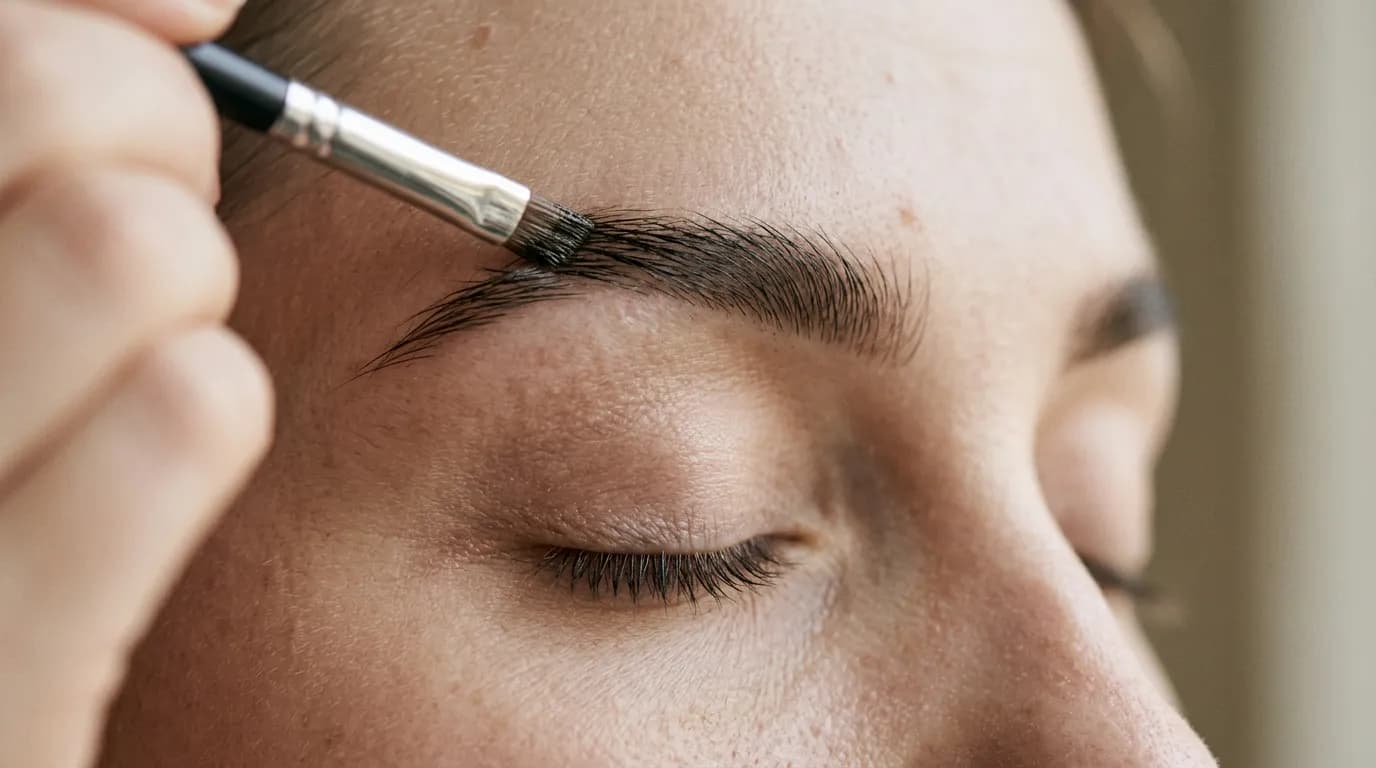
Tinting Lashes and Brows at Home: The Real Risk
Before you reach for a home tinting kit or a leftover box of hair dye, here's what the FDA actually allows near your eyes — and what's happened when people didn't wait for a professional.
 Damien, founder of HALOIA9 min read
If you're thinking about darkening your lashes or brows at home with a dye kit, or a leftover box of hair color, here's the plain version: no eyelash or eyebrow dye is FDA-approved for that use, full stop. The only ingredient cleared for it is silver nitrate, at a maximum concentration of 4%, and only in the hands of a trained professional in a salon setting. Regular hair dyes repurposed for lashes or brows, including some products marketed directly for that use, have caused documented chemical burns and, in rare cases, permanent vision loss. This isn't a scare tactic, and it's not a reason to panic if you've already done it once and nothing happened. It's the actual regulatory and safety record, and it's worth understanding clearly before you reach for a kit again, or for the first time.
Why the at-home trend keeps coming back
The appeal is easy to understand. Darker, fuller-looking lashes and brows cut down on daily makeup, and a home kit costs a fraction of a recurring salon visit. There's also a real perceptual reason brows and lashes get this much attention: they carry a lot of the information a face communicates. Faces read as more or less expressive largely through how visible the brows and lashes are, and that's not a minor detail people are imagining.
Add to that the fact that lash and brow tinting is genuinely useful for people with naturally light or fine lashes and brows, who see a real, visible difference from a single tint rather than a subtle one, and it's easy to see why the category keeps growing online. The demand is legitimate. The problem isn't wanting the result, it's that the fastest, cheapest way to get it is also the one route that skips the one safeguard the entire procedure depends on: the right chemical, at the right concentration, applied by someone trained to stop the moment something looks wrong.
Eyebrows do more perceptual work than most people realize. In a study of more than 2,000 participants, thicker, more defined eyebrows were rated as more masculine and dominant, while other research on facial expression has found that sparse or faint eyebrows make a face read as less expressive and harder to interpret emotionally. That's a real reason people chase definition here, not vanity for its own sake. But wanting darker lashes and brows doesn't change what's actually safe to put next to your eyes.
No dye is FDA-approved for this, except one, and only in a salon
This is the fact that matters most, so it's worth stating precisely: silver nitrate at a concentration of 4% or lower is the only substance cleared for tinting eyebrows or eyelashes, and it's cleared strictly for professional, in-salon application. Every other dye product used for this purpose, including ordinary hair dye and any at-home kit marketed for lash or brow tinting, sits outside FDA approval for this specific use. That's true no matter what the packaging implies about being "salon-grade" or "gentle." A product being sold online is not the same thing as a product being cleared for use that close to your eyes.
The core fact, straight from the FDA via the American Academy of Ophthalmology: only silver nitrate at up to 4% is approved for tinting eyebrows or eyelashes, and only for professional application. Regular hair dyes repurposed for this use have caused chemical burns and, in rare cases, vision loss. That's not a worst-case outlier scenario dredged up for effect; it's the specific safety history behind why the approval is this narrow in the first place.
What "chemical burns and vision loss" actually means
The skin around the eyes is thinner and more permeable than scalp skin, and the eye itself has no tolerance for the oxidizing dye chemicals formulated for hair color. Hair dyes are tested and approved for scalp contact, not for sitting a few millimeters from the cornea for the several minutes a tint needs to develop. When a dye not designed for this use runs, seeps, or is applied without the right barrier, it can reach the eye directly, and the result documented in ophthalmology literature ranges from chemical burns on the surrounding skin to corneal injury severe enough to affect vision, in some reported cases permanently. This is exactly why the approved version of this procedure is built around trained, controlled application rather than a box of instructions written for your scalp.
None of this requires the product to be defective or the person applying it to be careless in any obvious way. A few extra seconds of contact time, a slightly heavier application near the lash line, or a small amount of product migrating while the eyes water, which is a normal reaction to having anything near them, is enough to turn a routine tint into an eye injury. That margin for error is exactly what professional technique is built to close, and exactly what a home application, done solo in a mirror, can't fully guarantee.
Salon tinting versus a boxed kit at home: what's actually different
A licensed professional working within the approved concentration applies a barrier around the eye area first, uses a formula and timing dosed for that specific use, and is trained to recognize the early signs of a reaction and stop immediately. None of those safeguards come standard with a home kit. Instructions written for scalp application were never designed for use a few millimeters from your eye, and self-applying next to your own eye means you can't fully see what you're doing while you're doing it, which is a meaningful problem for a product where a few seconds of contact is what separates a tint from an injury.
There's also a regulatory wrinkle worth knowing: because of the FDA's stance, several U.S. states restrict or outright prohibit licensed estheticians from offering lash and brow tinting as a professional service. That gap in availability is part of why home kits exist in the first place, and it's an understandable reason to look for a workaround. It doesn't change what the product itself is capable of doing near your eyes.
How to spot a risky product before you buy it
Since the honest answer is "don't do this at home," the more realistic goal is knowing what makes one product more dangerous than another if you're evaluating what's already in your bathroom cabinet or in a cart online. A few signals are worth checking before anything goes near your eyes.
- Any claim that a product is "FDA-approved for lash or brow tinting" is itself a red flag. No dye holds that approval for this use, so a product asserting otherwise is either misinformed about its own regulatory status or deliberately misleading you.
- Check the ingredient list for para-phenylenediamine (PPD) or other coal-tar dye derivatives common in hair color. These are the ingredients tied to the documented burn and vision-loss reports, and they're formulated for scalp use, not for tissue near the eye.
- A legitimate hair dye always instructs a 48-hour patch test before full use, because these chemicals can trigger allergic reactions. If a product marketed for lash or brow tinting skips that instruction, or frames itself as gentle enough not to need it, that's a sign it wasn't designed with eye-area safety in mind.
- Look for fine print that contradicts the marketing: a product photographed being applied to lashes but labeled, in the actual directions, for hair or scalp use only, or carrying a generic warning against contact with eyes, is telling you the truth in the fine print and selling you something different in the photo.
Your Appearance Score
What's Your Appearance Score?
60 seconds. Get a score based on your habits.
The "natural alternative" trap
A common workaround is skipping dye entirely and reaching for a "natural" oil instead, most often castor oil, which shows up constantly in lash and brow content as a growth-and-darkening fix. The problem is that oils don't pigment hair the way a dye does, so anyone expecting a visible color change is going to be disappointed. And when a gentle option doesn't deliver the payoff people are looking for, some move on to something stronger, including a dye that was never meant to go near their eyes.
Castor oil is probably the most recommended "natural" fix for thin lashes and brows online, but a 2024 review of the evidence in the Journal of Cosmetic Dermatology places it among ingredients that are "promising but understudied," nowhere near the level of evidence behind actual regulated options. It won't dye your lashes darker, and its growth effect isn't well established either, which is part of why people chasing a visible, defined change skip past it toward stronger, riskier products.
What actually works without the same risk
- Long-wear tinted mascara or brow gel, formulated and tested for exactly this purpose, holds color for a few days rather than weeks. Lower payoff, but the stakes of a bad reaction are far lower too, since it's not sitting on your lash line for a full tint cycle.
- A licensed salon appointment, where lash and brow tinting is legally offered, is the only path that uses the FDA-approved concentration under trained, professional application.
- A brow gel or tint pen designed for daily use fills in sparse areas without any chemical processing time near the eye at all.
If length or thickness, not color, is the actual goal, there's a separate and genuinely regulated option worth knowing about: bimatoprost, sold under the brand name Latisse, is a prescription treatment approved by the FDA for eyelash growth. It's a different product solving a different problem than tinting, but it's a useful comparison for what real approval looks like.
For comparison, here's what real FDA clearance looks like: bimatoprost, a prescription lash-growth treatment, was tested in a randomized trial where six weeks of nightly use increased lash length by an average of 2.0mm, versus 1.1mm with a placebo, a real, measured, statistically significant effect. It even carries a known rare side effect of its own: irreversible darkening of the iris in some long-term users. The point isn't that bimatoprost is risk-free. It's that its risks are studied, disclosed on the label, and monitored by a prescribing doctor, which is exactly what's missing from a home tinting kit.
If you've already tinted at home, or something feels off
If you've already used a home kit and everything looks and feels fine, that's genuinely good news, not a signal that the product is safe to repeat without concern. If anything feels off, though, treat it seriously and quickly rather than waiting it out.
- Redness, swelling, or a burning sensation around the eye that doesn't fade within an hour or two.
- Any blurred vision, watering that won't stop, or sensitivity to light.
- Discharge, crusting, or pain that gets worse rather than better.
Any of those warrants an ophthalmologist or urgent care visit, not a wait-and-see approach. Chemical exposure near the eye is not something to self-treat with rinsing and hoping.
It's also worth separating two different problems that get treated the same way. If what's actually bothering you isn't color but progressively thinner brows or lashes, that's a different question with a different answer. Persistent, unexplained loss can come from something local, like rubbing or over-plucking, but it can also signal a thyroid disorder, an iron, zinc, or biotin deficiency, alopecia areata, or another underlying condition. That's worth a dermatologist visit, not a stronger dye or an unregulated growth serum bought off a review site.
This is the kind of decision where the actual evidence and the marketing claims point in completely different directions, and it's a pattern that shows up everywhere in appearance and wellness content, not just eye makeup: a product's popularity online says nothing about whether a regulator ever actually cleared it for the way it's being used. HALOIA is built around the same instinct: separating what's actually backed by evidence, whether that's what you eat, how you sleep, or how you take care of your skin, from whatever trend is loudest that week, so you're not left guessing which parts of your routine are actually doing anything.
If you want a broader, evidence-based read on your skin, diet, and habits before you change anything else, HALOIA's free appearance quiz is a good place to start.
This article is for information only and is not a substitute for medical advice. For any question about your health, a treatment or a supplement, consult a qualified professional.
Improve your appearance by eating better
Build real confidence by tracking your diet. Download HALOIA and start your tracking.

Go further

The 4 Real Causes of Facial Water Retention
Puffy face again? There are only four real culprits, and they leave different clues. Here's how to tell them apart instead of guessing.

Text Neck: The Real Risk of Your Phone
Your head weighs about 5kg. Tilt it forward to check your phone and your neck can end up carrying nearly 27kg instead — the weight of an 8-year-old, hanging off your cervical spine for hours a day.
Leg Lengthening Surgery: Cost and Risks
It's a real orthopedic procedure, not a shortcut: a bone is surgically cut and pulled apart by about a millimeter a day. Here's what it actually costs, what can go wrong, and what's worth trying before you get anywhere near an operating table.