
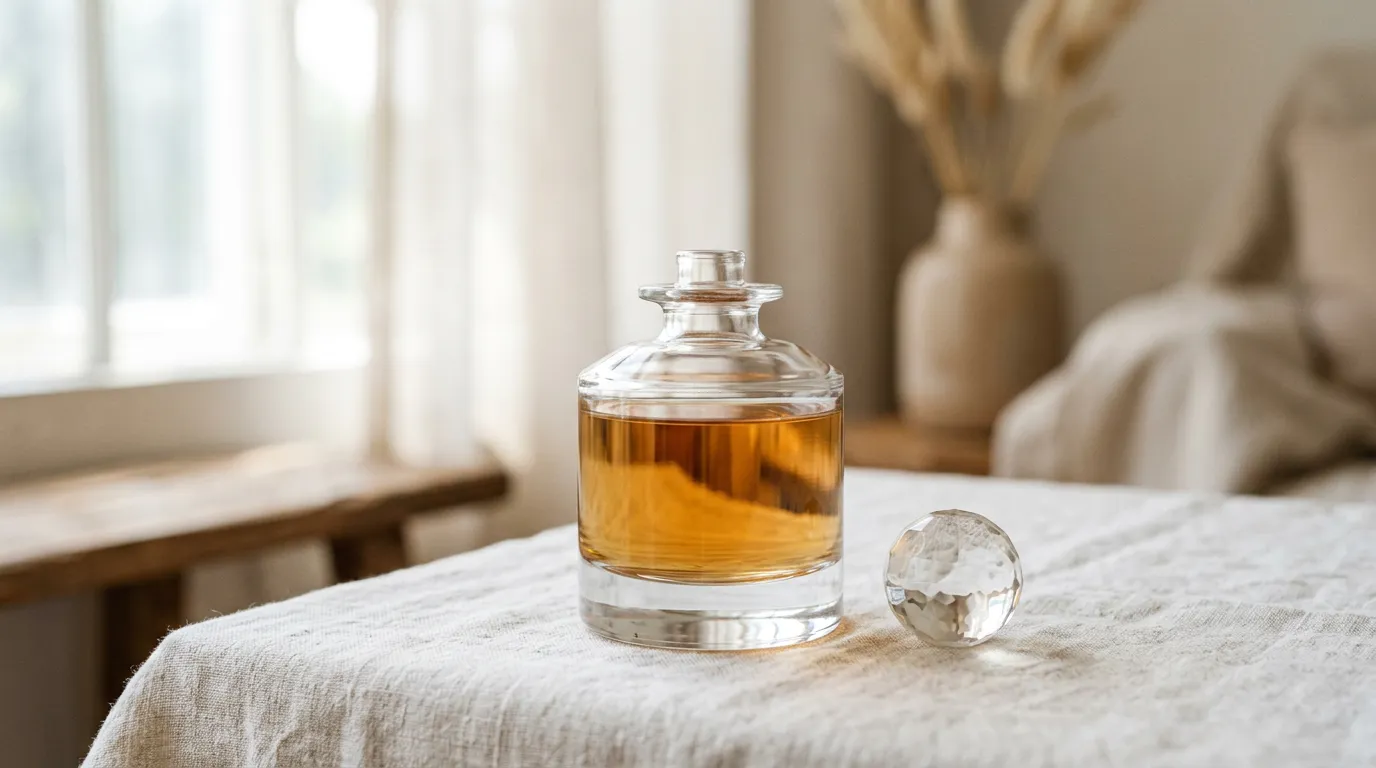
Does Perfume Really Make You More Attractive?
A real study found that fragrance changes how attractive and confident people rate you, independent of your actual body odor. Here's what the research actually shows, why it works, and the mistakes that quietly cancel it out.
 Damien, founder of HALOIA11 min read
Yes, but not for the reason most people assume. A 2021 study found that applying fragrance to someone measurably raises how attractive and self-confident observers rate them, and the more interesting part is what happened in the control condition: differences in natural body odor alone, with no fragrance added, didn't move the rating at all. That's a more useful finding than "perfume makes you attractive," because it points at what's actually doing the work. It isn't that fragrance is masking or upgrading how you smell. It's that adding a scent changes something about how you're perceived and, as you'll see below, how you carry yourself. Here's what the research actually measured, the psychological mechanism behind it, why the specific bottle matters less than most people think, and the application habits that quietly undo the whole effect.
What the study actually measured
The research, led by Croijmans and colleagues and published in PLoS One in 2021, is worth understanding precisely because the popular version of it ("perfume = attractive") flattens the actual design. Observers rated people on attractiveness and self-confidence under different conditions: with fragrance applied, without it, and across natural variation in each person's own body odor. Two results came out of it. First, fragrance reliably pushed both ratings up: scented came across as more attractive and more self-assured than unscented, consistently enough to be a real effect rather than noise. Second, and this is the part that gets lost, variation in a person's underlying body odor by itself, when no fragrance was involved, didn't predict the ratings. In other words, this wasn't primarily a study about covering up a bad smell or amplifying a good one. It was a study showing that the presence of a chosen scent is doing something to social perception that a person's raw, natural odor mostly isn't. That distinction matters for anyone deciding whether fragrance is "worth it": the evidence points to added scent as a genuine, separate lever, not just a patch over body odor you're worried about. It also reframes a common worry: if you're self-conscious about how you naturally smell, the data suggests fragrance isn't primarily doing damage control on that front, it's adding something that wasn't there to begin with, which is a more encouraging way to think about it than "masking a problem."
Why a scent can move a rating that has nothing to do with smell
The mechanism isn't really about odor quality, it's about how the brain processes sensory information together rather than in separate channels. Attractiveness judgments are usually treated as a visual thing, a snap read of a face. But smell can genuinely intrude on that read. In experiments where people rated attractiveness while a pleasant fragrance was present in the room, faces scored higher than the identical faces judged without the scent, showing that the brain blends olfactory and visual input before it settles on a verdict rather than judging looks in isolation. That's a structural reason fragrance can shift how attractive you seem even though a bottle of Eau de Parfum has, on its own, nothing to do with your bone structure or skin. It's also why fragrance is worth treating as part of the same system as grooming and presentation, not a separate, optional add-on: the senses aren't voting independently, they're being combined into one impression.
In experiments measuring attractiveness judgments of faces, a pleasant ambient fragrance raised the score given to the same face compared to no fragrance present — evidence that smell can genuinely intrude on and shift a visual judgment, not just accompany it (Capparuccini, Berrie & Mazzatenta, Perception, 2010).
The other half: confidence changes how you actually behave
There's a second mechanism working alongside the perceptual one, and it runs through you rather than through the observer. If you feel like you smell good, you tend to act like it: posture shifts, eye contact holds a beat longer, you're a little more willing to start a conversation instead of hanging back. Observers are picking up on that behavior as much as on the scent itself, which is part of why the effect shows up as "more confident," not just "smells nicer." A controlled trial testing this self-perception link found a striking behavioral difference: women using a fragrance were far more likely to report an increase in affectionate and intimate behavior over the following weeks than women using an unscented placebo, with no measurable difference in how often they were approached by others. That detail is the whole point: the scent didn't change how often men came up to them, it changed what the wearers themselves did once they felt confident. A separate trial repeating the setup in postmenopausal women found the same pattern, which suggests the effect isn't limited to a narrow age group.
In a controlled trial, 74% of women wearing an enriched fragrance reported an increase in affectionate and intimate behavior over the study period, versus 23% wearing an unscented placebo — with no difference in how often men approached them either way, pointing to a self-confidence effect rather than an external "attraction" signal (McCoy & Pitino, Physiology & Behavior, 2002).
Why the bottle everyone recommends might do nothing for you
If fragrance is genuinely doing something for perceived attractiveness and confidence, the obvious next question is which one to buy. That question is slightly wrong. The same fragrance rarely smells identical on two people, because skin chemistry actively reshapes it before it ever reaches anyone's nose. Skin pH, which sits naturally around 4.5 to 5.5 but varies person to person, changes how a fragrance develops: more acidic skin sharpens and speeds up the top notes, while more neutral skin softens them and pushes the scent toward its base faster. Skin oil level matters just as much: sebum forms a thin lipid layer that captures scent molecules and releases them gradually, so naturally oily skin holds a fragrance noticeably longer than dry skin does, all else equal. Even body temperature plays a role, since warmer skin speeds up evaporation and intensifies the deeper base notes (musk, amber, vanilla) more than the lighter opening ones. None of this is marketing copy, it's why a scent your friend swears is a signature can read as flat or off on you within an hour. The practical implication: "what's popular" is a reasonable starting point for narrowing options, but "what actually works on your specific skin" only gets answered by testing on skin, not on a card or a friend's recommendation alone.
Skin pH, oil level, and temperature all independently reshape how a fragrance develops on a given person — more acidic or oilier skin holds and alters scent differently than dry, neutral skin — which is the main chemical reason the same bottle never smells quite the same on two people (The Essence Vault; Scento, skin chemistry and fragrance longevity).
Your Appearance Score
What's Your Appearance Score?
60 seconds. Get a score based on your habits.
The application habits that quietly cancel the effect
Most of the ways people undercut their own fragrance aren't about the bottle at all, they're small, repeated habits at the point of application or storage. A few show up constantly enough to be worth fixing first, before spending more money chasing a "better" scent.
- Rubbing your wrists together after spraying: the friction mechanically breaks down the most fragile molecules, which are exactly the top notes responsible for that first impression. Spray and let it air-dry instead.
- Judging a fragrance off the paper blotter in-store: a blotter never smells like it does on skin, which genuinely transforms the composition through temperature, pH, and natural oils. Test on skin and wait 30 minutes to an hour before deciding.
- Reapplying constantly because you "can't smell it anymore": that's olfactory fatigue, a normal effect where the brain stops consciously registering a familiar scent. It changes nothing for you, but it oversaturates everyone around you, which reads as overdone rather than attractive.
- Storing it in the bathroom: humidity and heat swings from hot showers can degrade the formula in as little as 3 to 6 months, and direct light does similar damage by breaking down the scent molecules over time. A closet or drawer between 13-21°C holds up far longer.
How to actually choose and wear one
Concentration is the first real decision, and it's not just about how long a fragrance lasts, it's about how you want to show up. From lightest to strongest: Eau de Cologne (2-5% fragrance oil, roughly 2-4 hours of wear), Eau de Toilette (5-15%, 4-6 hours), Eau de Parfum (15-20%, 6-8 hours), and Extrait or Parfum (20-40%, 8 hours or more). A useful thing to know before you shop: these labels are market convention, not a binding legal standard, so two brands can use the exact same term for meaningfully different actual concentrations. Higher concentration doesn't automatically mean more noticeable in the first few minutes, either. An Eau de Toilette diffuses quickly into the air, giving strong initial projection, while a richer Extrait stays closer to the skin but lasts far longer, which is a genuinely different social effect depending on whether you want to be noticed on entry or want something more intimate that lasts through a long evening. Where you spray it matters almost as much as what you spray: pulse points (the neck, inner wrists, behind the ears, inner elbows, behind the knees) run warmer because blood flows closer to the skin surface there, which activates a steadier release throughout the day. One underused trick from professional application: a thin layer of unscented moisturizer before spraying creates a slightly oily base that slows evaporation and can genuinely add 2 to 3 hours of wear, especially if your skin runs dry.
A few reliable starting points, not a ranking
If you don't already have a signature and want somewhere concrete to start testing (on skin, not the blotter), fragrance communities consistently point to a handful of options across budget and occasion. For an everyday, wear-almost-anywhere option, Bleu de Chanel Eau de Parfum is a woody aromatic regularly praised for strong longevity and moderate sillage that works equally in an office or an evening. Dior Sauvage is one of the most widely worn fresh-spicy fragrances for a reason: broad appeal and a long-wearing Eau de Parfum, with the richer Parfum version reserved by most wearers for winter and evenings specifically. If budget matters, Montblanc Explorer gets cited repeatedly as strong value for a woody chypre profile, and Armaf Club de Nuit Intense Man has built a real reputation as a close, far cheaper alternative to fragrances costing ten times as much. For warm weather, Acqua di Giò remains the reference aquatic-fresh option for daily wear, and for evenings or dates specifically, Versace Eros and La Nuit de l'Homme both show up again and again as go-to choices with a sweeter or spicier signature built to be noticed. None of this replaces testing on your own skin for a few hours before committing to a bottle, but it's a reasonable shortlist instead of guessing from a shelf of hundreds.
One honest caveat before you start experimenting: true fragrance allergies are less common than people assume, affecting fewer than 3% of people, and the industry body IFRA sets strict safety limits on the raw materials allowed in commercial fragrance specifically to keep that number low. In the EU, any allergen above a small labeling threshold has to appear on the packaging, so if you do notice irritation, checking the ingredient list is a faster way to find the actual cause than swearing off fragrance altogether. So the bigger risk to your results isn't your skin reacting badly, it's picking something that clashes with your own chemistry or wearing it in a way (over-application, rubbing it in, letting it degrade in a hot bathroom) that undercuts the exact effect you're going for. Fragrance is one input into a bigger picture that includes your skin, your energy, and how put-together you look overall, and it works best stacked with those, not as a stand-alone fix. That's the same logic behind HALOIA's approach to appearance: no single product or habit does the whole job, but tracking the real levers, meals, sleep, skin, and yes, the small grooming choices, gives you an honest read on what's actually moving the needle instead of guessing one bottle at a time.
This article is for information only and is not a substitute for medical advice. For any question about your health, a treatment or a supplement, consult a qualified professional.
Improve your appearance by eating better
Build real confidence by tracking your diet. Download HALOIA and start your tracking.

Go further
The 4 Real Causes of Facial Water Retention
Puffy face again? There are only four real culprits, and they leave different clues. Here's how to tell them apart instead of guessing.

Text Neck: The Real Risk of Your Phone
Your head weighs about 5kg. Tilt it forward to check your phone and your neck can end up carrying nearly 27kg instead — the weight of an 8-year-old, hanging off your cervical spine for hours a day.

Leg Lengthening Surgery: Cost and Risks
It's a real orthopedic procedure, not a shortcut: a bone is surgically cut and pulled apart by about a millimeter a day. Here's what it actually costs, what can go wrong, and what's worth trying before you get anywhere near an operating table.