
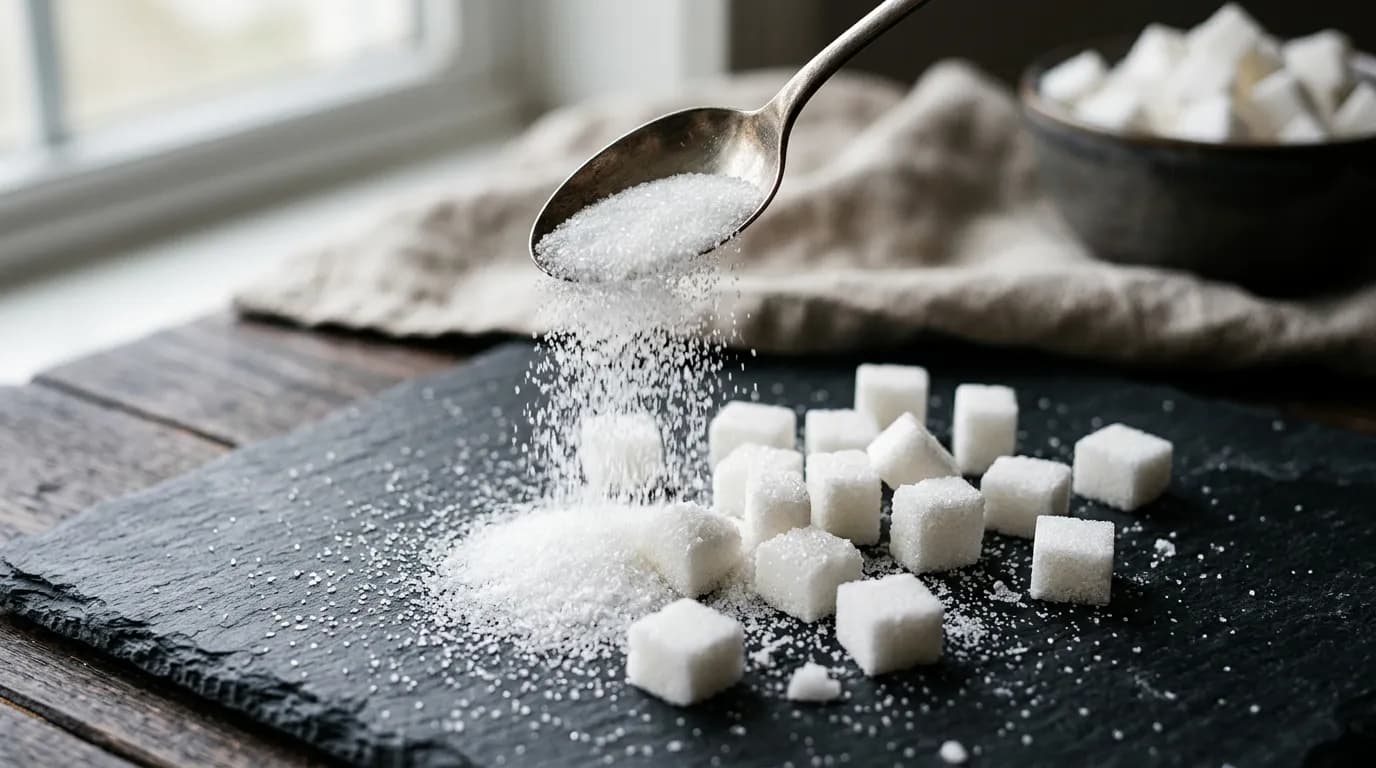
Does Sugar Really Speed Up Your Skin's Aging?
Everyone says sugar "ages" your skin, but few explain why. Here's the actual mechanism, the foods and cooking methods that matter most, and how long before any of it shows.
 Damien, founder of HALOIA10 min read
Short answer: yes, but not the way most wellness content makes it sound. Sugar doesn't wrinkle your face overnight, and it isn't uniquely evil compared to other refined carbs. What it does is fuel a slow, well-documented chemical process called glycation, where sugar molecules bind to the collagen and elastin that keep skin firm and elastic. The compounds this creates, called advanced glycation end products (AGEs), make skin proteins stiffer and less able to repair themselves. This is a real mechanism studied in dermatology research, not a wellness-industry talking point. But the timeline is longer than a skincare ad would have you believe, the foods involved go beyond a spoonful of sugar in your coffee, and how you cook your food matters almost as much as what's on your plate. Part of why the topic gets so muddled online is that "sugar ages your skin" gets repeated as a slogan without anyone explaining the actual chemistry, so it ends up sounding either like a scare tactic or like something you can casually ignore. Neither is accurate. Here's what the research actually says: the mechanism, the foods and cooking methods that matter most, how long before any of it is visible, and what's realistic to change.
The real mechanism: what glycation actually does to your skin
When blood sugar runs high, some of that sugar reacts directly with proteins in your body, including the collagen and elastin fibers in your skin's dermis. This reaction produces advanced glycation end products, AGEs for short. Once collagen is glycated, it cross-links with neighboring fibers and becomes stiffer and less flexible, which is part of why skin loses bounce and starts to sag over the years. A useful mental image: healthy collagen is like a loosely woven net that can flex and spring back. Glycated collagen is closer to that same net after the fibers have started fusing together at random points, it still holds a shape, but it can't move the way it used to. Excess dietary sugar promotes this AGE formation, and these compounds bind directly to skin proteins, reduce their resistance, and slow down wound healing, according to a review in Skin Therapy Letter. That last point matters beyond aesthetics: skin with more AGE buildup heals slower, so blemishes, scars, and irritation stick around longer than they would otherwise. This isn't a fringe theory, either. It's the same category of process behind long-term skin and vascular complications in diabetes, where chronically high blood sugar accelerates AGE accumulation throughout the body, and it's part of why clinicians treating diabetic patients pay close attention to skin healing and elasticity as an early marker. You don't need diabetes for the mechanism to apply, though: it runs on a spectrum, driven by how much sugar and refined carbohydrate you eat over years, not by any single dessert.
It's not just sugar, how you cook matters too
Here's the part most "sugar ages your skin" content skips entirely: AGEs don't only form inside your body from blood sugar. You also eat them directly, and how you cook your food changes how many you're getting. High-heat, dry cooking methods, grilling, frying, and roasting, generate dietary AGEs in the food itself, while boiling and steaming largely don't. A piece of chicken grilled until charred carries a meaningfully different AGE load than the same chicken poached in broth. You've actually seen the underlying chemistry before, even if you never connected it to skin: it's the same browning reaction, called the Maillard reaction, that turns bread crust golden, gives seared steak its crust, and darkens coffee beans during roasting. That reaction is a flavor feature in cooking and a skin-aging liability when it happens repeatedly inside a body that's also running high on blood sugar. That's why the same amount of added sugar can matter more or less depending on the rest of your plate: a diet built around grilled meats, roasted vegetables, and sugary drinks stacks dietary and blood-sugar-driven AGEs on top of each other, while a diet leaning on steamed, boiled, or braised food keeps one of those two sources much lower, even if some sugar is still in the mix.
Research published in Skin Therapy Letter found that excess dietary sugar promotes the formation of advanced glycation end products, compounds that bind to skin proteins, reduce their resistance, and slow wound healing, and that high-heat cooking (grilling, frying, roasting) adds dietary AGEs on top of that, unlike boiling or steaming. In practice, the cooking method on your plate is a second, independent lever alongside how much sugar you eat. (Nguyen & Katta, Skin Therapy Letter, 2015.)
Which foods are actually the biggest offenders
- Sugary drinks (soda, sweetened coffee, energy drinks): the most concentrated, fastest-absorbed source of the refined sugar that fuels internal AGE formation, with no fiber to slow it down.
- Pastries and baked goods: they combine refined sugar with the dry, high-heat baking that also generates dietary AGEs directly in the food, a double hit.
- Caramelized and deeply browned foods: the same browning reaction that makes seared or caramelized food taste better is chemically related to AGE formation.
- Fried and grilled meats: high-heat, dry cooking is independently linked to higher dietary AGE content, on top of whatever sugar is elsewhere in the meal.
- "Healthy" cereals and granola: often marketed around fiber or protein but frequently loaded with added sugar and lightly toasted at high heat.
- Sauces and condiments with hidden sugar: ketchup, BBQ sauce, and sweetened dressings add to your daily sugar load without ever registering as "dessert."
None of these foods are individually disqualifying, and none of this means treating dessert like a hazard. What actually drives visible AGE buildup is the cumulative pattern: a diet where most meals combine refined sugar with high-heat cooking, day after day, for years, ages skin faster than one where those two things show up occasionally. Think in terms of your average week rather than any single meal. A grilled dinner on Saturday or a birthday cake once a month isn't the problem the research is describing; a daily default of soda, fried food, and baked snacks is.
How long before any of this actually shows on your skin
This is where most claims quietly fall apart. Internal blood markers of glycation can move in as little as four weeks with a consistent dietary change, but visible skin firmness lags much further behind, because AGEs accumulate in structural collagen and elastin over years, not weeks, and that collagen isn't replaced quickly. In practical terms: a few weeks of high sugar intake won't visibly age your face by next month, and a few weeks of cutting back won't undo years of buildup either. What actually changes the trajectory is the sustained pattern over months and years, the same way sun exposure or smoking do. Nobody expects a week without sunscreen to cause a visible wrinkle, or a week of daily sunscreen to erase one that's already there, and glycation works on the same kind of slow accumulation curve. If you're looking for a fast before-and-after, glycation isn't going to give you one. If you're looking at where your skin will be in five or ten years, it's one of the more controllable levers you have, precisely because it's driven by daily habits rather than genetics or sun exposure you can't fully undo.
What's myth and what's the real mechanism
Myth: any sugar at all is actively damaging your skin in real time. Reality: the mechanism is dose-dependent and cumulative, closer to sun exposure than to an allergic reaction. Myth: cutting sugar for a week "detoxes" your skin. Reality: nothing detoxes in a week, glycation is a slow chemical process, not a toxin your body flushes out. Myth: sugar is the only dietary driver of skin aging, so fixing it fixes everything. Reality: it's one mechanism among several, glycation runs alongside a separate, well-documented inflammation pathway. Diets heavy in ultra-processed food are fairly consistently linked to higher CRP, the standard blood marker of systemic inflammation, and inflammation independently affects skin conditions like acne, rosacea, and dullness through its own route, not through AGEs. The honest picture is that sugar matters through one specific, well-understood mechanism, glycation, and it's genuinely worth managing, but it's not the single dial that controls how your skin ages.
A 2025 review of 24 studies in Nutrients found that high ultra-processed food intake was fairly consistently linked to higher CRP levels, confirmed in 11 of the 17 analyses done in adults. Since most ultra-processed food is also where most added sugar hides, cutting back on it works on both the glycation pathway and this separate inflammation pathway at the same time. (Ciaffi et al., Nutrients, 2025.)
Your Appearance Score
What's Your Appearance Score?
60 seconds. Get a score based on your habits.
Why this affects some people more than others
Glycation isn't a fixed rate that applies equally to everyone eating the same diet. How much sugar reaches your bloodstream and how long it stays elevated depends on individual insulin sensitivity, which varies with genetics, muscle mass, sleep, and stress, not just food choices. Two people can eat an identical dessert and see different blood sugar spikes because of factors that have nothing to do with willpower. This is also why skin that's already under stress from another source, chronic inflammation, sun damage, or a condition like rosacea or acne, tends to show the effects of glycation sooner: the same AGE load lands on a system with less buffer left. None of this changes the practical advice, but it explains why one friend can eat however they want with seemingly no visible effect while another notices changes faster. Genetics sets the baseline; diet still moves the needle from wherever that baseline sits.
The diet that actually lowers glycation markers
The clearest evidence-backed lever isn't a single supplement or a sugar-free month, it's an overall dietary pattern. A Mediterranean-style diet, low in refined sugar and high in fiber and polyphenols, measurably reduces blood AGE markers after at least four weeks of consistent adherence. In practice that pattern looks less like a restrictive diet and more like a default: olive oil instead of processed seed oil blends, vegetables and legumes as the base of most meals, fish and lean protein over processed and cured meat, and fruit instead of packaged desserts most of the time. The word doing the most work in the research is consistent: researchers found that sustained adherence moved the marker, not a one-off clean week followed by a reset. That matches everything else in this article, glycation responds to pattern, not to a single dietary event in either direction.
A 2025 review in Nutrition Reviews found that following a Mediterranean-style diet, low in refined sugar, high in fiber and polyphenols, measurably reduced blood AGE markers after at least four weeks of consistent adherence. Consistency, not a one-off change, made the difference. (Oliveira et al., Nutrition Reviews, 2025.)
How to cut back without cutting out sugar completely
- Swap one high-heat cooking method a day: steam, boil, poach, or braise instead of grilling, frying, or roasting, even just for one meal.
- Target sugary drinks first: they're the single easiest source to cut, and the one with the least nutritional trade-off.
- Read labels for hidden sugar in savory food: sauces, dressings, and bread often carry more added sugar than the obvious desserts do.
- Don't aim for zero: the evidence points to dose and consistency, not elimination. A treat once in a while inside an otherwise low-sugar, low-ultra-processed pattern isn't what drives AGE buildup.
- Give any change at least four weeks before judging it, that's the earliest point the research shows any measurable shift, and skin changes trail even that.
None of this requires tracking every gram of sugar for the rest of your life. It requires knowing, on average, whether your actual meals lean toward the sugar-plus-high-heat pattern or away from it, which is exactly the kind of pattern that's hard to see from memory and easy to miss meal by meal. HALOIA's meal scoring logs what you actually eat and flags that pattern automatically, instead of asking you to mentally track glycemic load and cooking method on top of everything else.
If you want a starting point before changing anything, HALOIA's free appearance quiz gives you a baseline read on your skin, diet, and habits as they stand right now.
Sources
This article is for information only and is not a substitute for medical advice. For any question about your health, a treatment or a supplement, consult a qualified professional.
Improve your appearance by eating better
Build real confidence by tracking your diet. Download HALOIA and start your tracking.

Go further
The Best Breakfast for Clear Skin in Your 20s
Forget "eat clean" advice with no specifics. Here's the exact breakfast structure that keeps blood sugar stable and gives your skin what it needs to repair overnight's damage.

Ashwagandha: Its Real Effect on Stress and Training
Ashwagandha gets credited for almost everything. Two claims actually hold up in controlled trials — stress/cortisol and strength/muscle — and they don't have the same evidence behind them. Here's the honest breakdown.

Who Should Never Fast?
Intermittent fasting is safe for most healthy adults — but not for everyone. Here's exactly who should skip it, and why, according to the research.