
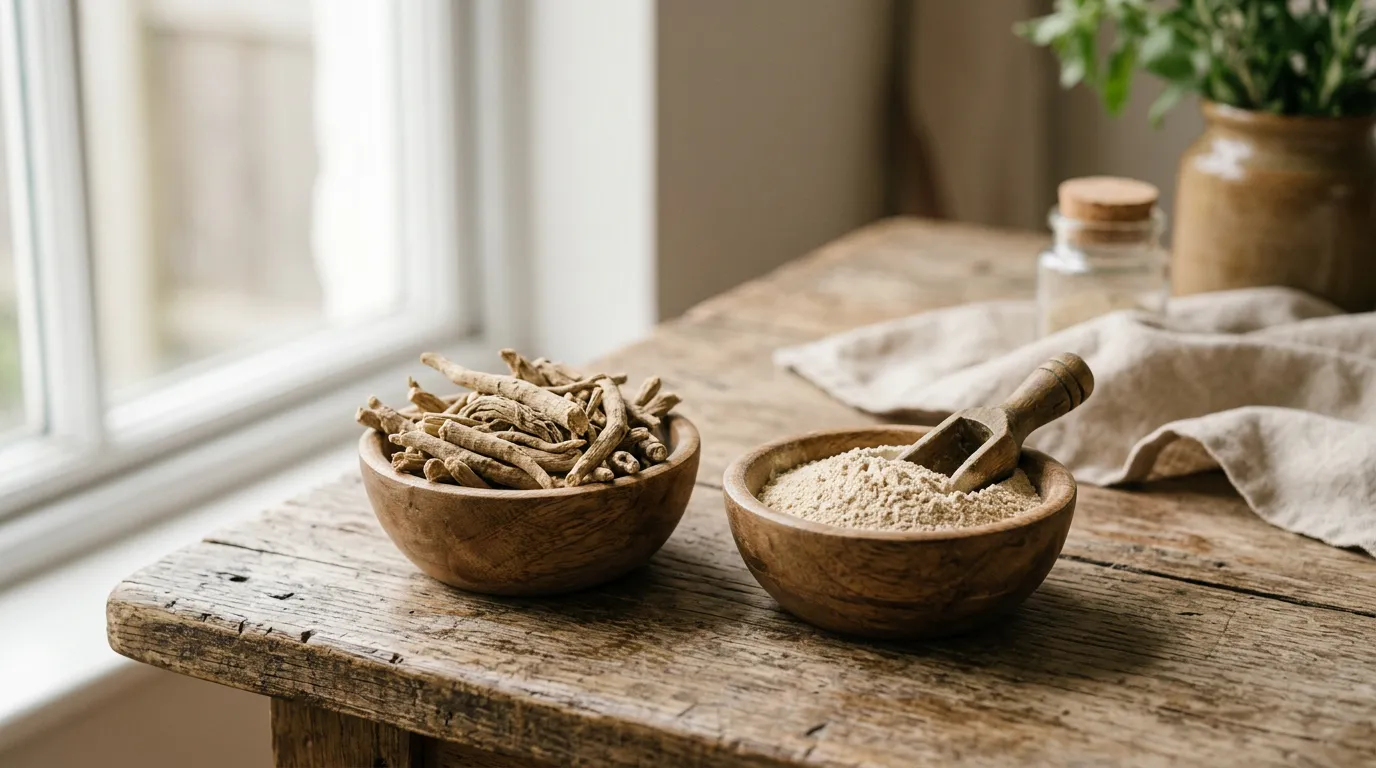
Ashwagandha: Its Real Effect on Stress and Training
Ashwagandha gets credited for almost everything. Two claims actually hold up in controlled trials — stress/cortisol and strength/muscle — and they don't have the same evidence behind them. Here's the honest breakdown.
 Damien, founder of HALOIA11 min read
Ashwagandha went from a niche Ayurvedic herb to one of the most talked-about supplements online, and predictably, the claims outpaced the evidence. It gets marketed as a stress reliever, a strength enhancer, a sleep aid, a hormone booster, sometimes all four on the same label. Two things about it are actually true and backed by controlled human trials: it measurably lowers perceived stress and cortisol, and it can modestly improve strength and muscle size when paired with resistance training. Those are two separate effects, studied in two separate bodies of research, with different levels of evidence behind each one — and neither is a personalized dosing plan you should copy off a supplement label. Here's what the actual research says about each, and where the evidence starts getting thin.
What Ashwagandha Actually Is (And Why It's Called an Adaptogen)
Ashwagandha (Withania somnifera) is a root extract used in Ayurvedic medicine for centuries, and in modern supplement science it's classified as an adaptogen — a term for compounds thought to help the body regulate its stress response rather than target one specific symptom. The working theory is that adaptogens act on the hypothalamic-pituitary-adrenal (HPA) axis, the hormonal system that governs how much cortisol your body releases under stress, nudging it toward a steadier baseline instead of pushing it sharply in one direction. That's a mechanistic story, not a guarantee of results on its own — plenty of compounds have a plausible mechanism and a disappointing track record once you actually test them in humans.
What sets ashwagandha apart from most "adaptogen" products on a supplement shelf is that it actually has controlled human trials behind both of its headline claims, which is rarer than the wellness industry would have you believe. Most ingredients sold under the adaptogen umbrella have thin or nonexistent human data — a rodent study here, a mechanism paper there, and a lot of marketing copy filling the gap. Ashwagandha is one of the few where independent research groups have run real randomized, placebo-controlled trials on people, not just cells in a dish or mice in a lab.
The "adaptogen" label itself is worth a note of caution, though. It's a category name coined outside of mainstream pharmacology, not a formally regulated claim with a fixed scientific definition, and it gets attached to a wide range of plants with wildly different amounts of research behind them — some well-studied, some almost entirely untested in humans. That's part of why it matters to evaluate ashwagandha on its own specific trial data rather than on the reputation of the broader adaptogen category it's filed under. A compound can be a legitimate adaptogen by the loose definition of the term and still have weak or nonexistent supporting research; ashwagandha happens to be one of the exceptions with real data to point to, which is the actual reason it's worth discussing instead of dismissing outright.
That's also exactly why it's worth treating ashwagandha's claims separately rather than as one blanket "it's good for you." The stress-and-cortisol research and the strength-and-training research come from different trials, testing different outcomes, in different populations, using different protocols. Lumping them together is the kind of vague marketing that makes it hard to tell what a supplement is actually good for, and for whom — so we're going to look at each claim on its own.
The Stress and Cortisol Effect: What the Research Actually Shows
This is ashwagandha's best-supported use, by a clear margin. It's not resting on one promising study — it's backed by a synthesis of multiple independent trials pointing the same direction, which is about as solid as supplement evidence gets outside of something like creatine.
A 2024 meta-analysis pooling 9 randomized controlled trials (Arumugam et al., Explore) found that ashwagandha supplementation reduced perceived stress, anxiety, and serum cortisol compared to placebo. That's a real, measurable effect on the body's stress hormone, not just a subjective "I feel calmer" response — and pooling 9 independent trials is a meaningfully stronger form of evidence than any single study on its own. The same review flags a real limitation, though: safety data beyond a few months of continuous use is still limited.
What that finding doesn't tell you is how large the effect feels in practical, day-to-day terms, or whether it holds up over months and years of use rather than the shorter windows most trials run (typically 8 to 12 weeks). It's also worth remembering that cortisol is a normal, necessary hormone — the goal isn't to drive it to zero, it's a problem specifically when it stays chronically elevated under ongoing stress. The research supports ashwagandha as something that can blunt that chronic elevation, not as a way to erase stress from your life or as a substitute for actually addressing what's causing it, whether that's workload, sleep debt, or a genuinely difficult season. A supplement changing a hormone level on a lab panel and a person feeling meaningfully less stressed in their actual life are related but not identical claims, and the trials are better positioned to measure the first than the second.
The Strength and Muscle Effect: What the Research Actually Shows
This is the claim that gets ashwagandha into gym supplement stacks, and it's not baseless — but it rests on a noticeably thinner body of evidence than the stress research. The core trial here, published in 2015, put healthy men through 8 weeks of resistance training while supplementing with ashwagandha root extract, comparing them against a placebo group following the identical training program.
In an 8-week trial (Wankhede et al., Journal of the International Society of Sports Nutrition, 2015), 600mg/day of ashwagandha root extract combined with resistance training produced significantly greater strength gains than placebo, along with a measurable increase in arm and chest muscle size. It's one of the few "trendy" supplements with actual strength-training data behind it, not just a stress or sleep claim repackaged into a muscle-building pitch.
The catch: this is functionally one well-designed trial anchoring the claim, not a stack of meta-analyzed literature the way the stress research is. A single study, even a well-run one, can go on to be replicated and confirmed by other labs, or it can turn out to be an outlier — that's true of any individual trial in exercise science, and it's exactly why researchers treat one strong result as promising rather than settled. The effect also only showed up on top of an actual structured resistance training program; nobody in that trial built strength or muscle from the supplement alone while skipping the gym. If your training itself is inconsistent, this isn't the lever that fixes that gap, and it was never tested as one.
Your Appearance Score
What's Your Appearance Score?
60 seconds. Get a score based on your habits.
Who Is Officially Advised Against Taking It in France
Before any benefit matters, there's a safety line worth knowing, and it's stricter than most labels suggest. In an opinion published on 19 April 2024 (referral 2021-SA-0077), ANSES, France's food safety agency, advised against ashwagandha for pregnant and breastfeeding women, for anyone under 18, for people with endocrine disorders (thyroid disorders and hyperandrogenism in particular), for people with liver or heart conditions, and for anyone on a treatment that depresses the central nervous system. The same opinion points to the sedative effect (drowsiness) seen in clinical trials and advises against taking it before driving or operating machinery, or alongside central-nervous-system depressants. The root is also on list B of the French pharmacopoeia, the list of medicinal plants whose potential adverse effects are considered to outweigh the expected benefit. None of that erases the trial results above, but it does mean this isn't a supplement to try casually, and it puts a doctor ahead of a research summary like this one.
ANSES advises against ashwagandha for pregnant or breastfeeding women, under-18s, people with endocrine disorders (notably thyroid disorders and hyperandrogenism), people with liver or heart conditions, and people on a treatment that depresses the central nervous system, and advises against use before driving or operating machinery. The root is listed on list B of the French pharmacopoeia. (ANSES opinion, referral 2021-SA-0077, 19 April 2024.)
How Strong Is the Evidence, Really
Put side by side, these are two different confidence levels wearing the same herb's name. The stress-and-cortisol claim is backed by a meta-analysis synthesizing nine separate randomized trials — the kind of convergent evidence that's genuinely hard to argue with, even accounting for the fact that effect sizes vary somewhat study to study and that supplement research, like most nutrition science, isn't immune to funding bias or publication bias favoring positive results. The strength-and-muscle claim rests on a much smaller pool of trials, with the 2015 study serving as the most-cited anchor point; it's encouraging and it was well-designed, but it hasn't been independently confirmed across nearly as many separate research groups as the stress literature has.
Replication is the whole point of how science builds confidence over time: one lab finding an effect is a lead worth following, several unrelated labs finding the same effect independently is what turns a lead into something closer to a settled fact. That's the exact gap between these two ashwagandha claims right now. It doesn't mean the strength research is wrong — plenty of now-accepted findings started as a single strong trial before more studies caught up to confirm them. It means a reasonable reader should hold the strength claim a little more loosely than the stress claim, and shouldn't be surprised if a future, larger trial finds a smaller effect, a larger one, or no effect at all once tested in a different population or with a different extract.
The evidence-quality gap is the real story here: nine independent randomized trials converging on the same stress-and-cortisol finding sits in a different tier of proof than one well-designed 8-week strength trial. Both are legitimate data points worth taking seriously. They're just not equally settled — one is close to scientific consensus, the other is closer to "promising, and worth more replication" than to established fact.
What We Still Don't Know
A handful of open questions the current research doesn't answer yet. Long-term safety past a few months of continuous, daily use hasn't been well studied — most trials run 8 to 12 weeks, so there isn't good data on what a year or more of ongoing use looks like for the average healthy adult. Extract standardization also varies by brand and by the specific root-to-leaf ratio and extraction method used, which means a positive result from one branded extract in a trial doesn't automatically transfer to a different product carrying the same generic "ashwagandha" label on the front. Most trial participants were also relatively healthy adults without a diagnosed anxiety disorder or a clinical stress condition, so how ashwagandha performs for someone with an actual diagnosis, as opposed to ordinary day-to-day stress, is a different question the existing trials weren't designed to answer. None of this means the research is bad — it means it's earlier-stage than the confident marketing copy on most bottles would suggest.
- Long-term safety beyond a few months of continuous use isn't well established yet — the trials simply haven't run that long.
- It can interact with thyroid medication, sedatives, and blood pressure or blood sugar medication, so it's worth flagging to a doctor if you take any of those.
- It's generally advised against during pregnancy and breastfeeding — this isn't an area with reassuring safety data.
- Extract quality and standardization vary a lot between brands, so results from one product don't guarantee the same from another.
Who Ashwagandha Actually Makes the Most Sense For
Based on what the trials actually tested, ashwagandha has its clearest case in two specific situations: someone dealing with ongoing, everyday stress who wants a supplement with real cortisol data behind it rather than a vague "calm blend" with no research to speak of, and someone already following a structured, consistent resistance training program who's looking for a modest edge layered on top of training that's already dialed in. It's not a substitute for sleep, for actually managing an overloaded schedule, or for a training program that isn't happening in the first place — the strength trial tested it as an addition to consistent training, not as a replacement for it.
It's also not the right starting point for someone dealing with a diagnosed anxiety disorder, a mood disorder, or a real clinical condition — that's a conversation for a doctor, not a decision to make from a supplement aisle or a research summary like this one. And it's probably not worth reaching for if your actual bottleneck is somewhere else entirely: someone sleeping five hours a night, skipping training sessions, or eating in a way that doesn't support recovery isn't going to get meaningfully more out of an adaptogen than out of fixing the more basic thing that's already broken. The honest takeaway is that ashwagandha is one of the rare "trendy" supplements where the hype and the actual evidence overlap, at least partially. That's worth something in a category full of ingredients backed by a single rodent study and a marketing budget. But "evidence exists" and "this is guaranteed to work for you at some specific dose" are two different claims, and the second one belongs in a conversation with a doctor who knows your health history, not something to reverse-engineer from a research paper or a blog post.
This is also exactly the kind of thing that's genuinely hard to judge from the inside. Did your stress actually drop, or did your week just get easier for unrelated reasons? Is your strength up because of the supplement, your training consistency, your sleep, or some combination of all three? HALOIA tracks your training load, recovery signals, and daily logs together, so instead of guessing whether something you added actually changed anything, you can see it against everything else that's moving at the same time.
Sources
This article is for information only and is not a substitute for medical advice. For any question about your health, a treatment or a supplement, consult a qualified professional.
Improve your appearance by eating better
Build real confidence by tracking your diet. Download HALOIA and start your tracking.

Go further
The Best Breakfast for Clear Skin in Your 20s
Forget "eat clean" advice with no specifics. Here's the exact breakfast structure that keeps blood sugar stable and gives your skin what it needs to repair overnight's damage.

Who Should Never Fast?
Intermittent fasting is safe for most healthy adults — but not for everyone. Here's exactly who should skip it, and why, according to the research.

Your Skin Takes 6 Weeks to React to Your Diet
Diet changes don't show up overnight, and that's exactly why most people quit too soon. Here's the real six-week timeline and how to actually track whether it worked.