
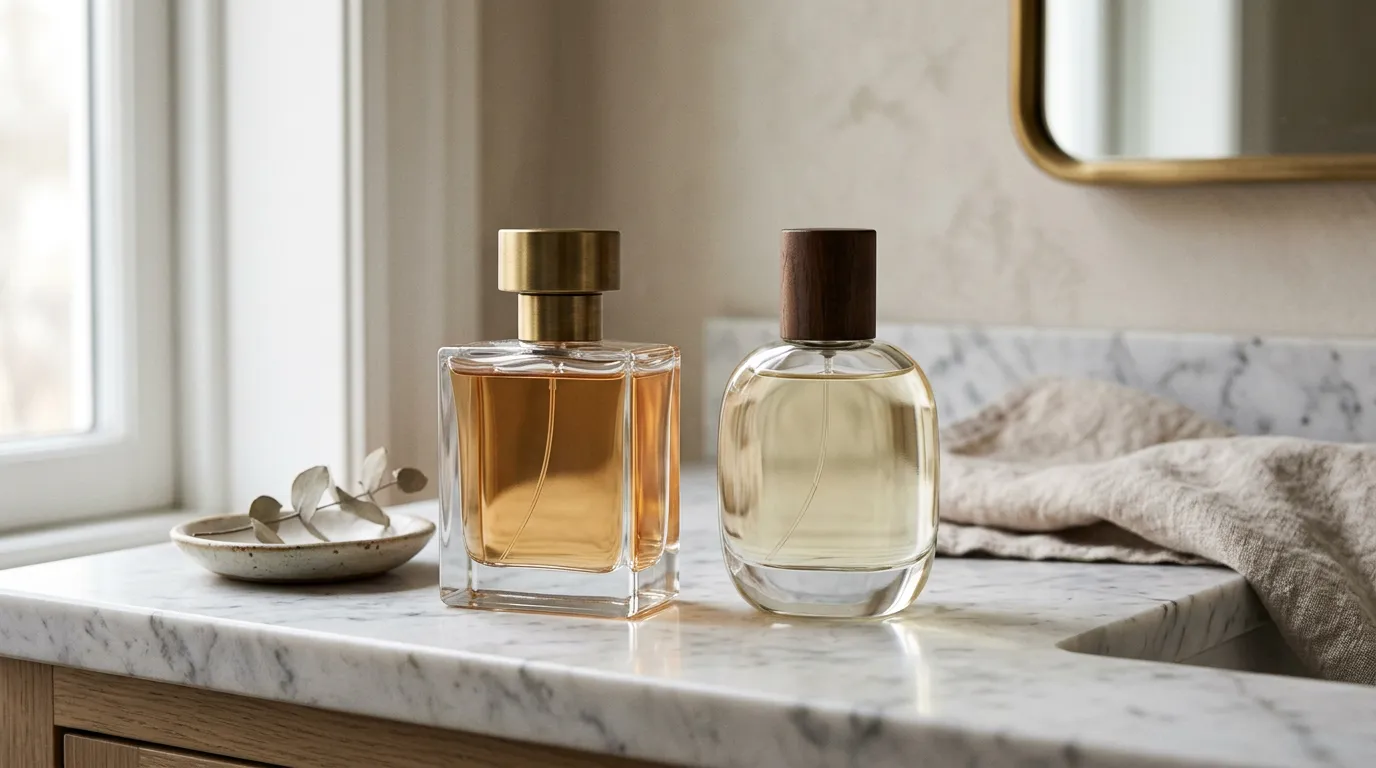
EDT or EDP: Which One Should You Choose?
"Just buy the stronger one" is the wrong way to pick between an EDT and an EDP. Here's what the concentration levels actually change, why the same bottle smells different on two people, and how to buy smarter.
 Damien, founder of HALOIA11 min read
If you're standing in front of two versions of the same fragrance trying to decide between the Eau de Toilette and the Eau de Parfum, the honest answer isn't "always buy the EDP, it's stronger." The real decision comes down to two separate things: how much actual perfume oil is in the bottle (concentration), and whether you want people to notice the second you walk into a room or you'd rather wear something quieter that holds up for hours (projection vs. longevity). Get those two variables straight, and the rest, EDT for the office, EDP or Extrait for a date, stops being a guess based on which bottle looked nicer on the shelf.
What EDT and EDP actually mean
Perfumery runs on four standard concentration tiers, and almost every fragrance house uses the same rough scale, even though the names sound interchangeable if nobody's ever explained them to you. Eau de Cologne sits at the bottom: 2-5% perfume oil diluted in alcohol and water, built for a light 2-4 hour refresh rather than an all-day scent. Eau de Toilette (EDT) steps up to 5-15% and roughly 4-6 hours of wear, which is why it's the default for daytime and office use. Eau de Parfum (EDP) concentrates further to 15-20% and 6-8 hours, and Extrait de Parfum, sometimes just labeled Parfum, tops out at 20-40%, with 8-plus hours from a single application. One caveat worth knowing before you compare bottles across brands: these percentages are market convention, not a single legal standard enforced the same way everywhere, so two different houses can put the same "Eau de Parfum" label on formulas with meaningfully different actual concentrations.
- Eau de Cologne: 2-5% oil, 2-4 hours of wear — a light splash, not a scent built to survive past lunch.
- Eau de Toilette (EDT): 5-15% oil, 4-6 hours — the daytime and office default.
- Eau de Parfum (EDP): 15-20% oil, 6-8 hours — the most common "do everything" pick.
- Extrait / Parfum: 20-40% oil, 8-plus hours — the richest tier, and usually the most expensive per bottle.
These four concentration tiers, and the percentage ranges behind them, come from long-standing market convention rather than one regulator's rulebook — which is exactly why an "Eau de Parfum" from one house can smell noticeably stronger than another house's version carrying the identical label.
Projection vs. longevity: the trade-off nobody explains
Here's the part that trips up most people buying their first EDP thinking it will just be a "louder" version of the EDT they already own: concentration and immediate impact aren't the same axis. An Eau de Toilette's lower oil content means more alcohol, and alcohol evaporates fast, pushing scent molecules into the air quickly. Right after spraying, an EDT can smell just as noticeable, sometimes more, than an EDP in the first twenty minutes, simply because it's diffusing into the room faster. An Extrait, by contrast, is richer in oils and lower in alcohol, so it clings closer to the skin instead of throwing off into the air; it takes longer to reveal itself, but keeps doing that for most of the day. So the real question isn't "which one is stronger," it's "do I want to be noticed the second I walk into a room, or do I want something quieter that lasts through a full workday without a reapplication." Neither answer is wrong. They're just different jobs, and buying an EDP purely for a louder first impression is often the wrong tool for that goal, since the lighter EDT will actually hit harder on arrival.
Higher concentration doesn't automatically mean stronger immediate sillage: an EDT diffuses its molecules into the air quickly for strong projection right on application, while a richer, oil-heavy Extrait stays closer to the skin but lasts far longer. The choice comes down to instant impact versus a quieter, longer-lasting scent, not simply which one is "stronger."
One more variable: your own skin changes the answer
Before you commit to a concentration, it helps to know that skin chemistry, not just the percentage on the label, decides how any of these four tiers actually plays out on you. Skin is naturally slightly acidic, and how acidic, how oily or dry, and how warm it runs all shift how fast a fragrance moves from top notes to base notes and how long it clings on. That's why a friend's glowing review of a specific EDP isn't a guarantee it will read the same way on your skin, and it's a big part of why the smartest move, once you've narrowed a purchase down to a concentration and a family you like, is testing the actual bottle on your own skin rather than buying on reputation alone.
The price-per-ml math worth knowing
Concentration should be part of your price comparison, not an afterthought, since a 40% Extrait and a 5% Cologne aren't the same product even sold at wildly different prices. But concentration alone doesn't explain the real spread in the market, brand and distribution costs move the number more than the oil inside the bottle does. Armaf Club de Nuit Intense Man is the fragrance community's most-cited proof of that: at roughly $27-30 a bottle, it's a woody spicy scent frequently described as a close alternative to Creed Aventus, a niche fragrance running $300 and up, and it still delivers 8-12 hours of wear. Zara's Vibrant Leather sits in a similar bracket, a woody-leather scent the community rates as one of the best value options on the market and, again, close in spirit to Aventus at a fraction of the cost. On the mid-tier end, Montblanc Explorer is regularly flagged as excellent value for money, a woody chypre with 6-8 hours of longevity and real versatility, without a luxury-house price tag. None of this makes the expensive names a scam. Bleu de Chanel Eau de Parfum and Dior Sauvage both earn their reputations as reliable, well-performing fragrances. It means price and quality decouple more than most shoppers assume, and checking concentration plus real-world longevity before paying a premium for a name on the box is worth the extra two minutes.
- Armaf Club de Nuit Intense Man (~$27-30): woody spicy, 8-12h wear, widely cited as the closest budget alternative to $300+ Creed Aventus.
- Zara Vibrant Leather (very affordable): woody-leather, rated one of the best value-for-money options on the market.
- Montblanc Explorer (mid-tier): woody chypre, 6-8h wear, praised for value without a luxury-house price tag.
- Bleu de Chanel EDP and Dior Sauvage EDP (premium): consistently well-reviewed all-rounders — with these, part of what you're paying for is consistency and brand, not just the oil concentration.
Your Appearance Score
What's Your Appearance Score?
60 seconds. Get a score based on your habits.
Which one to buy for which occasion
Concentration should follow context, not the other way around. For the office or daily wear, a lighter EDT in a fresh or citrus family works better than a heavy EDP, both because you don't want to fill a shared space with a scent that lingers after you've left the room, and because fresh, aquatic profiles like Acqua di Giò or the citrus-forward Neroli Portofino are built for exactly that lighter, daytime register. For a date night or evening out, you want more projection and a scent that reveals depth over hours, which points toward an EDP or a spicier, woodier profile: Versace Eros, with its sweet-woody vanilla-vetiver base, and Yves Saint Laurent's La Nuit de l'Homme are both community-cited date-night references precisely because their sillage reads as seductive without being aggressive in a closer setting. Winter and formal evenings are where Extrait earns its price: the Parfum concentration of Dior Sauvage, the richest tier in that line, is specifically recommended for cold weather and evenings, thanks to 10-plus hour wear and a deeper, warmer amber-woody base than the EDT or EDP versions of the same fragrance. If you'd rather own one bottle that covers most of the year instead of building a full rotation, look for something the community rates as genuinely versatile, like Prada's Luna Rossa Ocean Le Parfum, an aromatic fougère rated 9.2/10 by the Fragrantica community for being fresh, powdery, and ambery all at once. Climate is worth factoring in too, separate from occasion: heat speeds up evaporation, so a fragrance you own in EDT already tends to feel more present in summer than the exact same concentration does on a cold winter day, which is one more reason a heavy Extrait can feel like overkill in July even at an evening event.
- Office / daily wear: EDT, fresh or citrus family (Acqua di Giò, Neroli Portofino) — light enough not to fill a shared room.
- Date night: EDP, sweet-woody or spicy profile (Versace Eros, La Nuit de l'Homme) — more projection, seductive without being aggressive.
- Winter / formal evening: Extrait or Parfum concentration (Sauvage Parfum) — deeper base notes, 10-plus hours of wear.
- One bottle for most of the year: a fragrance the community rates as genuinely versatile, like Luna Rossa Ocean Le Parfum.
The buying mistakes that waste your money
Most of the money wasted on fragrance gets wasted at checkout, not from a bad bottle. The first mistake is assuming "Eau de Parfum" automatically means more noticeable, when an EDT's higher alcohol content can actually project harder in the first twenty minutes, the opposite of what most people expect when they pay more for the "stronger" version. The second is comparing percentage numbers across brands as if they were standardized: since these tiers are market convention rather than one enforced rule, one house's Eau de Parfum and another's can carry meaningfully different actual concentrations despite the identical label. The third is buying the wrong tier for the context: an Extrait is overkill, and often wasted, in a small shared office, and an Eau de Cologne bought for a long formal evening will fade before dinner is over. The fourth is paying a brand-name premium without checking whether a cheaper option in the same family delivers comparable longevity, since concentration and real-world wear time, not the name on the box, are what you're actually paying for. And the fifth is trusting a friend's or an influencer's glowing review of exactly how a fragrance performed on them: skin chemistry varies enough from person to person that the same bottle can read completely differently once it's on you instead of them.
- Assuming EDP always projects harder than EDT — an EDT's higher alcohol content can throw scent into the air faster in the first twenty minutes.
- Comparing percentage labels across brands as if standardized — a 15% EDP from one house and an 18% EDP from another aren't guaranteed to perform the same.
- Buying the wrong tier for the context — an Extrait in a small shared office, or an Eau de Cologne for a long formal evening, both work against you.
- Paying a brand-name premium without checking real-world longevity — a $30 bottle can outlast a $150 one depending on concentration and formula.
- Trusting someone else's review of how a fragrance performed on them — skin chemistry varies enough that the same bottle can read differently on you.
None of this is vanity for its own sake. Fragrance is one of the few appearance levers that's been tested directly against how people are perceived, not just how they feel wearing it. In one study, researchers had observers rate people's attractiveness and apparent self-confidence with and without fragrance applied, and the effect showed up independent of the person's natural body odor underneath — fragrance moved the perception score on its own, not because it was masking anything. That puts a $30 bottle of EDT in the same category as sleep, skin, and diet: a genuinely measurable lever for how put-together you come across, not just a nice-to-have.
Applying fragrance measurably raises how attractive and self-confident observers rate someone, even when the person's natural body odor underneath makes no difference on its own — fragrance functions as a real, independent driver of social perception, not just a mask for how someone already smells.
HALOIA doesn't track your fragrance collection, it tracks the levers with the most evidence behind them for how you actually look and feel day to day: your meals, your sleep, your skin. But the underlying idea is the same one that makes picking between an EDT and an EDP worth five minutes of thought instead of a guess off the shelf, small, consistent choices compound into how put-together you look, and most of them get less attention than they deserve. If you want a fast, no-guessing read on where your own habits currently stand, HALOIA's free appearance quiz is a good place to start.
This article is for information only and is not a substitute for medical advice. For any question about your health, a treatment or a supplement, consult a qualified professional.
Improve your appearance by eating better
Build real confidence by tracking your diet. Download HALOIA and start your tracking.

Go further
The 4 Real Causes of Facial Water Retention
Puffy face again? There are only four real culprits, and they leave different clues. Here's how to tell them apart instead of guessing.

Text Neck: The Real Risk of Your Phone
Your head weighs about 5kg. Tilt it forward to check your phone and your neck can end up carrying nearly 27kg instead — the weight of an 8-year-old, hanging off your cervical spine for hours a day.
Leg Lengthening Surgery: Cost and Risks
It's a real orthopedic procedure, not a shortcut: a bone is surgically cut and pulled apart by about a millimeter a day. Here's what it actually costs, what can go wrong, and what's worth trying before you get anywhere near an operating table.