
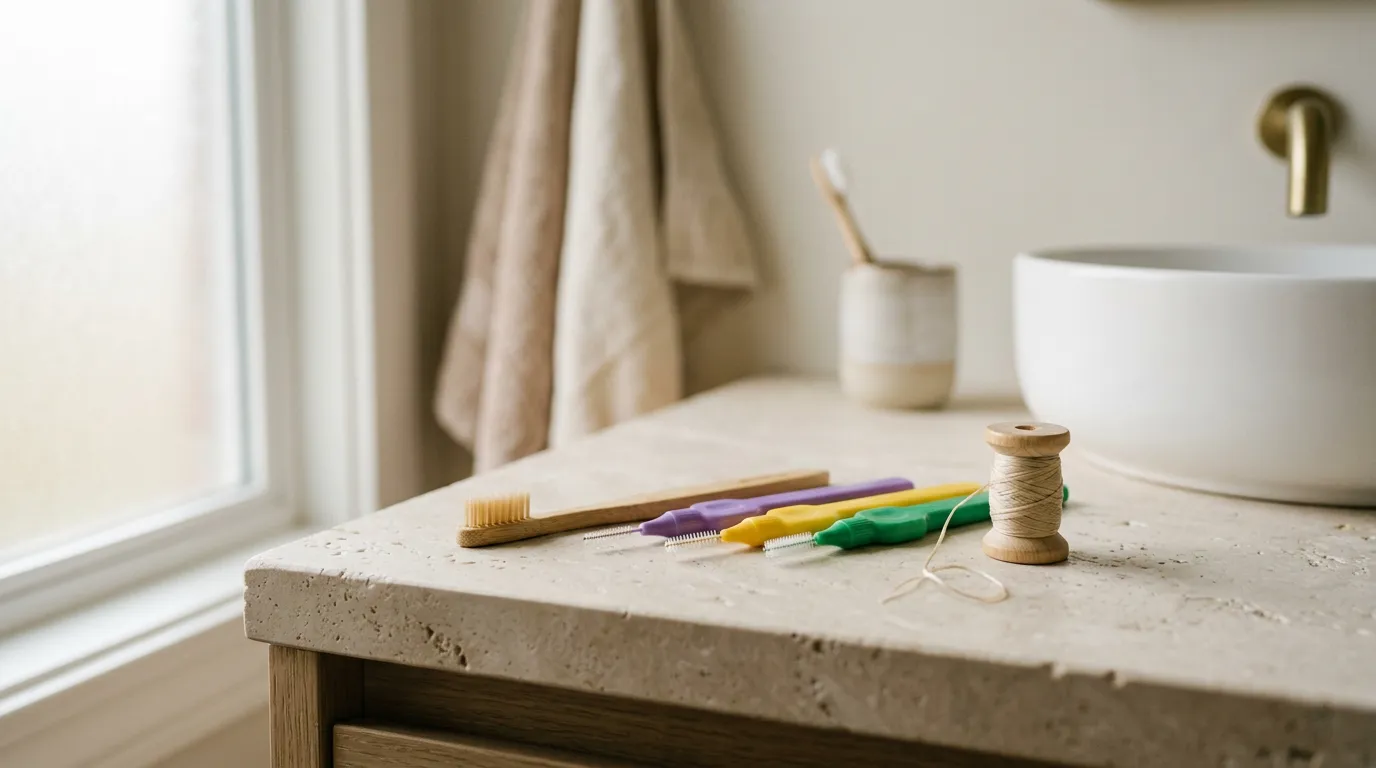
Interdental Brushes or Floss: Which to Choose?
You've probably been told floss is non-negotiable. The largest review of the evidence says the little brush next to it in the drugstore aisle actually cleans better for most people — here's when each one wins.
 Damien, founder of HALOIA13 min read
Short answer: for most people, interdental brushes beat floss. The largest review of the evidence on record, covering 35 clinical trials and nearly 4,000 participants, found that interdental brushes are probably more effective than floss at reducing both plaque and gum inflammation. That's not a marginal edge — it's enough that dental researchers now treat the small bottle-brush-shaped tool as the better default, not just a niche alternative for people who find floss annoying. Floss still has a real job to do, in the tighter contacts a brush physically can't fit through, and used correctly it beats doing nothing at all. Here's what the research actually shows about each tool, why brushes tend to win on pure mechanics, and how to build a routine you'll actually keep past week two.
Why the gap between your teeth matters more than you think
Most people's oral hygiene routine stops at brushing, and most plaque-related problems start exactly where a toothbrush can't reach: the interproximal space, the tight gap between two teeth. Bristles clean the flat front and back surfaces reasonably well, but they don't bend around a curved tooth or slide into a millimeter-wide gap the way a floss strand or a tiny brush can. That gap is also where gum tissue is most exposed and most vulnerable, which is why it's usually the first place inflammation shows up, long before it's visible anywhere else in the mouth.
About 46% of American adults over 30 have some form of periodontal disease — gum inflammation or recession — and it tends to start quietly in exactly the spots a toothbrush glosses over. It affects men more than women, and it's often silent early on, which is part of why interdental cleaning gets treated as optional right up until it isn't. (Source: Eke et al., Journal of Periodontology, 2015)
This is also why "I brush twice a day" isn't actually the full picture dentists are asking about. Brushing handles maybe 60% of your tooth surfaces. The rest — the sides facing your neighboring teeth — depends entirely on whatever interdental tool you use, or don't.
What the biggest review of the evidence found
For years, the standard advice was simple: floss daily, brush twice a day, done. Then a large 2019 Cochrane review — the same rigorous, independent evidence-grading system used across most of modern dentistry and medicine — pooled 35 trials and nearly 4,000 participants comparing different interdental cleaning tools against each other and against brushing alone. The conclusion surprised a lot of people who'd been handed a spool of floss since childhood: interdental brushes came out ahead of floss for reducing both plaque and gingivitis.
Across those 35 trials and almost 4,000 participants, the review found interdental brushes were probably more effective than floss at cutting plaque and gum inflammation. The word "probably" reflects moderate-certainty evidence, which in dental research is actually a fairly strong signal — most oral hygiene comparisons don't clear that bar at all. If the gap between your teeth is wide enough for one to fit, a brush is the better default tool, not just a backup option. (Source: Worthington et al., Cochrane Database of Systematic Reviews, 2019)
That doesn't mean floss got banned from anyone's bathroom. It means the tool that got the marketing push for decades — the free spool at every dentist's checkout — isn't automatically the best-performing one once you actually measure plaque and gum health with controlled trials instead of habit.
Why floss doesn't always come out on top
Floss has an image problem it partly earned on its own. A separate Cochrane review focused specifically on flossing, pooling 12 trials and over 1,000 participants, rated the evidence that floss reduces plaque as weak and unreliable. That's a very different statement from "floss doesn't work," even though headlines a few years back collapsed the two into the same story. What the review actually found was a body of small, short, inconsistently designed studies that made it hard to draw a firm conclusion either way — plus a modest, real reduction in gingivitis that did show up consistently at the 1, 3, and 6-month marks.
The reference review on flossing covered 12 trials and more than 1,000 participants and rated the evidence for plaque reduction as weak and unreliable, largely because the underlying trials were small and short. A modest gingivitis benefit still appeared at 1, 3, and 6 months. The honest read isn't "floss is useless" — it's "we don't have great data on it," which is a very different problem from a tool that flatly fails to work. (Source: Sambunjak et al., Cochrane Database of Systematic Reviews, 2011)
There's also a real-world factor no trial fully captures: floss is technique-dependent in a way a brush isn't. Snap it down onto the gum instead of gently sliding it into the gap, skip the curve-and-hug motion against each tooth, or reuse the same soiled section gap after gap, and you can floss daily for years while barely disturbing the plaque that actually matters. An interdental brush is far more forgiving of a slightly sloppy technique, which is a quiet part of why it performs better in practice, not just in theory.
Why a small brush often cleans better than a thin string
The mechanical difference comes down to shape. A tooth's surface where it meets its neighbor isn't flat — it curves outward near the contact point and dips inward again below it, where the gum forms a small triangular peak called the papilla. A taut piece of floss is a straight line; it can hug that curve if you actively shape it into a C against each tooth, but it's easy to let it snap straight through the middle of the gap instead, cleaning the contact point while barely touching the curved surfaces on either side.
An interdental brush is a small cylinder of bristles on a wire, and cylinders naturally make contact with concave and convex surfaces alike as they pass through. Push one through a gap and the bristles are already touching the curved sides of both teeth and brushing along the gumline, without you having to consciously angle anything. It's doing with its shape what floss can only do with deliberate technique — which is a big part of why it's more forgiving for the average person's actual, imperfect routine.
When floss is still the better tool
None of this makes floss obsolete. Interdental brushes come in a range of sizes, but they still need physical space to pass through without forcing — and some gaps genuinely don't have it. The right approach isn't picking a side and sticking to it everywhere in your mouth — it's checking each gap. Try the smallest interdental brush size first; if it won't pass through without force, that's floss's job for that particular spot, and that's completely normal even within the same mouth. Floss is the correct tool, not a fallback, in a few specific situations:
- Young, tightly packed teeth with no gum recession — often not enough room between contacts for even the smallest brush size to fit without scraping the gum or enamel.
- Under a fixed bridge, where a floss threader is usually the only tool that reaches the space beneath the false tooth.
- Around some orthodontic wires and brackets, where a brush can catch or bend the hardware.
- Very tight natural contacts common with unworn, undamaged adult teeth, before any recession has opened up room.
It's also worth knowing this isn't a permanent assignment. Gum recession and mild bone changes that come with age gradually open up interdental spaces that used to be too tight for anything but floss, which is a big part of why interdental brushes get recommended more often to people over 35 or 40 than to teenagers. What was the wrong tool for your mouth five years ago might be the better one now, so it's worth rechecking your gaps with a small brush every so often rather than assuming the answer never changes.
Your Appearance Score
What's Your Appearance Score?
60 seconds. Get a score based on your habits.
How to actually use an interdental brush
Interdental brushes are sold in sizes, usually color-coded, running from roughly 0.4mm to over 1mm in bristle diameter. The right size is the smallest one that passes through the gap with a little resistance — if it slides through with zero contact against your teeth, it's too small to actually clean anything; if you have to force it, it's too big and you should size down.
Insert it at a slight angle, following the natural curve of the tooth, and push it straight through the gap in one motion rather than sawing it back and forth. A single pass in and out is usually enough per gap; you're not trying to scrub, just to physically disrupt the plaque film sitting against both tooth surfaces and along the gumline. Angle it gently toward the gum papilla for a second before withdrawing, since that's where inflammation tends to start. No toothpaste or water is needed — the mechanical contact is what does the work. Most people can rinse and reuse the same brush for a full day before the bristles start to splay and it's time for a fresh one.
Don't be surprised if you end up needing two sizes in the same mouth. The gaps between your front teeth are usually narrower than the ones between your molars, so a single size that fits perfectly up front can feel loose and useless in the back, or a size that's right for your molars won't pass through the front gaps at all. Most interdental brush packs are sold as a multi-size set for exactly this reason — buying a single size and forcing it everywhere is the single most common reason people give up on the tool after a week.
Work through every gap once, ideally in the same order each time (front to back, or back to front) so you don't lose track of which side you've already done. Doing this after brushing, right before bed, means the fluoride from your toothpaste gets a clearer path to the surfaces you just opened up, instead of sitting on top of a layer of plaque.
How to actually use floss correctly
If a gap is too tight for any brush size, technique is what decides whether floss actually does anything. Pull off about 18 inches, wind most of it around your middle fingers, and hold a short, taut section between your thumbs and index fingers. Guide it gently between the teeth with a back-and-forth sawing motion rather than snapping it straight down onto the gum, which is both uncomfortable and skips the part of the gap that actually matters.
Once it's through the contact point, curve the floss into a C-shape against the side of one tooth and slide it up and down two or three times, following the tooth's curve down to just below the gumline, not just across the visible contact. Repeat against the neighboring tooth before moving to the next gap. The part almost everyone skips: use a fresh section of floss for each gap, not the same few inches dragged through your whole mouth, which just relocates plaque from one spot to the next instead of removing it.
The routine that actually sticks
If you've tried floss for years and it's never stuck, an interdental brush is worth trying before assuming interdental cleaning just isn't for you — the size range means there's almost always one that fits comfortably, and the learning curve is close to zero. A water flosser is another legitimate option worth knowing about, especially if manual dexterity or consistency has been the real blocker.
In a 2023 randomized controlled trial, a water flosser used alongside regular brushing reduced gum bleeding, inflammation, and plaque slightly more than floss combined with brushing did, over 4 weeks, with no adverse effects reported. It's not a magic upgrade, but it's a genuinely credible alternative for anyone who has simply never gotten floss to work for them long-term.
Cost and convenience are part of the real decision too, not just plaque scores:
- Interdental brushes: a few dollars a pack, lasts weeks, fits in a pocket, about 90 seconds a day once you know your sizes.
- Floss: even cheaper and the most travel-friendly of the three, but demands more hand dexterity and patience to do properly every day.
- Water flosser: costs more upfront and needs a sink and a few minutes — better suited to a bathroom counter than a gym bag or a carry-on.
The actual routine that moves the needle is smaller than most people expect: brush twice a day, clean between your teeth once a day with whichever tool actually fits your gaps, and give it a few weeks before judging whether your gums feel less sensitive or bleed less when you brush. Gum tissue responds slowly and then noticeably — most people who stick with daily interdental cleaning for two to three weeks stop seeing pink in the sink, which is usually the first sign it's working.
Your smile is one of the most visible, fastest things people register about you, and it's built the same way the rest of your appearance is: from small daily habits that don't look like much on any single day but compound hard over months. That's the same logic behind everything HALOIA tracks — not one perfect day, but the pattern underneath it. If you want a clearer read on where your habits, diet, and appearance actually stand right now, HALOIA's free appearance quiz gives you that baseline before you change anything.
This article is for information only and is not a substitute for medical advice. For any question about your health, a treatment or a supplement, consult a qualified professional.
Improve your appearance by eating better
Build real confidence by tracking your diet. Download HALOIA and start your tracking.

Go further
The 4 Real Causes of Facial Water Retention
Puffy face again? There are only four real culprits, and they leave different clues. Here's how to tell them apart instead of guessing.

Text Neck: The Real Risk of Your Phone
Your head weighs about 5kg. Tilt it forward to check your phone and your neck can end up carrying nearly 27kg instead — the weight of an 8-year-old, hanging off your cervical spine for hours a day.

Leg Lengthening Surgery: Cost and Risks
It's a real orthopedic procedure, not a shortcut: a bone is surgically cut and pulled apart by about a millimeter a day. Here's what it actually costs, what can go wrong, and what's worth trying before you get anywhere near an operating table.