
Male Hormonal Balance: The Foods That Matter
Every 'boost your testosterone' list treats one hormone like the whole story. Here's what actually shapes male hormonal balance as a system, and the food habits backed by real research.
 Damien, founder of HALOIA10 min read
Male hormonal balance isn't a single number to chase. It's testosterone, cortisol, thyroid hormones, insulin, and a handful of quieter players like DHEA and growth hormone, all interacting rather than working in isolation. Diet touches several of these directly: it determines whether your body has enough of the specific micronutrients your glands need, how well you clear glucose after a meal, how much background stress your cortisol system has to absorb, and how much extra work your endocrine system does clearing alcohol and everyday chemical exposure. This isn't another list of "testosterone-boosting foods." It's a map of which hormones respond to which levers, which ones diet barely touches, and the real signs that something in the system is actually off.
Your hormones don't run on a single dial
It's tempting to reduce male hormonal health to one number — testosterone — but that's an incomplete picture. Estrogen, often framed as testosterone's opposite, is produced by converting part of the body's own testosterone and is essential to bone health, sexual function, cardiovascular health, and cognition in men; it's not an enemy to eliminate, and men with a genetic estrogen deficiency actually show abnormally prolonged bone growth and fragile bones, not the opposite. Thyroid hormones set the pace of your resting metabolism, which is why thyroid dysfunction often looks like unexplained fatigue or weight change rather than an obvious hormonal symptom. DHEA, made by the adrenal glands, acts as a raw material your body converts into both testosterone and estrogen, and its production declines steadily from your twenties onward. Even progesterone, usually associated with female physiology, is present in men at levels comparable to a woman's outside her luteal phase, where it acts mainly as a precursor in testosterone production — a role that stays largely overlooked simply because it's under-researched in men.
Growth hormone belongs in the same conversation, and its effects reach further than most people assume. In patients with chronically elevated growth hormone, skin is measurably thicker and more elastic than normal, confirming a real role in skin connective tissue beyond its well-known link to deep sleep. Past that, it also regulates body composition in adulthood by promoting protein synthesis and mobilizing fat — making it a genuine third player, alongside diet and training, in your lean-to-fat mass ratio. The takeaway: a diet or habit that only targets testosterone is optimizing one dial on a multi-dial system, and can leave the others unaddressed entirely.
The lifestyle triangle that sets your baseline
Before getting into diet's specific effects, it's worth being clear about what actually sets your hormonal baseline in the first place: sleep, body composition, and training load, working together rather than as three separate levers.
A 2025 study on lifestyle, diet, and body composition in young men found that testosterone is mainly released in pulses during deep sleep, that free testosterone is negatively correlated with body fat percentage, and that resistance training raises testosterone while chronic overtraining or excessive mental stress does the opposite through elevated cortisol — with sleep, activity, and weight management acting as a self-reinforcing cycle rather than three independent factors.
That last point matters more than it sounds. Poor sleep doesn't just lower testosterone directly, it also makes training harder to sustain and fat gain easier, which then compounds the original problem. Diet can't fully substitute for fixing sleep or training, but it can either support that cycle or actively work against it — which is exactly where nutrient intake comes in.
The nutrients most directly tied to hormone production
Three micronutrients show up repeatedly in research on testosterone specifically: zinc, magnesium, and vitamin D. A real deficiency in any of the three can lower testosterone levels — but the research is consistent on one important caveat: supplementation only helps when it's correcting an actual shortfall, not when you're already getting enough. Pushing intake beyond an adequate baseline doesn't produce extra benefit, it just produces an expensive urine sample.
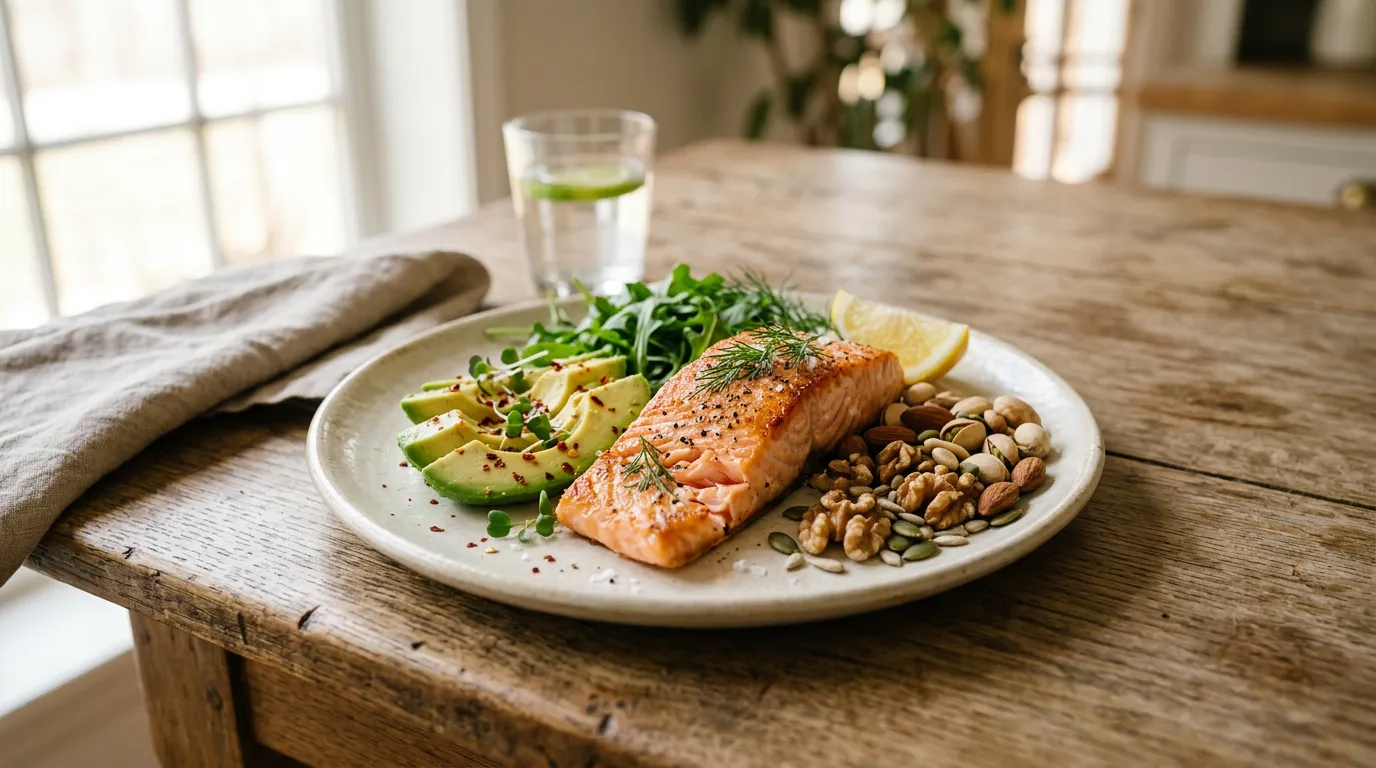
In practice, that means food quality matters more than supplement stacking for most people. Zinc is concentrated in shellfish, red meat, and pumpkin seeds; magnesium in leafy greens, nuts, and whole grains; vitamin D mainly in fatty fish, egg yolks, and sunlight exposure, which is why deficiency is more common in winter months or for anyone who's mostly indoors. If you suspect a real gap — a plant-heavy diet with no deliberate planning, minimal sun exposure, or a diet dominated by ultra-processed food — that's worth addressing through food first and bloodwork before supplements, the same logic that applies to almost every micronutrient claim in nutrition.
Where supplements actually help, and where it's mostly marketing
This is also where it's worth being skeptical of anything sold as a general hormone "booster" rather than a fix for a specific, confirmed deficiency. DHEA is a good example: it's often marketed with anti-aging and hormone-boosting claims, but a Cochrane review found no significant benefit of DHEA supplementation on cognitive function compared to placebo. That doesn't mean DHEA does nothing in the body — its natural decline with age is real — it means the commercial promise of supplementing your way back to a younger hormonal profile isn't backed by the evidence marketing implies.
DHEA supplements are often marketed with anti-aging or hormone-boosting promises, but a Cochrane review found no significant benefit of DHEA supplementation on cognitive function versus placebo — a useful caution against commercial claims sold on the back of a hormone that does genuinely decline with age.
The same skepticism applies to any product promising to "optimize" a hormone panel that's already within a normal range. The consistent pattern across zinc, magnesium, vitamin D, and DHEA is the same: real benefit shows up when correcting an actual, confirmed shortfall, and mostly disappears once you're already adequate. Bloodwork before spend is the practical rule that holds across all of them.
Insulin: the hormone that rarely gets mentioned in this conversation
Testosterone and cortisol get most of the attention, but insulin is arguably just as central to how your body actually uses what you eat — and unlike testosterone, it responds directly and immediately to two things fully within your control: what you eat and how much you move.
Insulin drives roughly 80% of post-meal glucose uptake into muscle tissue, via the GLUT4 transporter — and a single training session boosts insulin sensitivity for at least 16 hours afterward, with muscle contraction itself moving glucose into cells during the workout independent of insulin altogether.
Regular training durably improves this system over time, while poor insulin sensitivity makes it harder for muscle to actually use the nutrients you're eating for repair and growth — a mechanism that matters as much for body composition as for straightforward blood sugar control. In practice, this is one more argument for spacing activity across the week rather than reserving it for one long weekend session, since the insulin-sensitivity window from a single workout only lasts about 16 hours, not several days.
Your Appearance Score
What's Your Appearance Score?
60 seconds. Get a score based on your habits.
What quietly tips the balance: alcohol, stress, and everyday chemical exposure
Some of the biggest hits to hormonal balance don't come from what's missing in a diet, but from what's being added consistently in the background.
A meta-analysis covering more than 10,000 regular male drinkers found lower total and free testosterone, and higher estradiol, compared to non-drinkers — but this effect shows up specifically with chronic, regular consumption, not after a single isolated night of drinking.
Chronic psychological stress adds a second, related hit: it disrupts the body's stress-hormone axis (the HPA axis), leaving cortisol poorly regulated and cells more resistant to its signal, which sustains a low-grade inflammatory state throughout the body — including, indirectly, tissues involved in hormone production. A third, less controllable factor is everyday chemical exposure: some research links common endocrine disruptors like parabens, phthalates, and certain pesticides to lower testosterone, though the evidence is inconsistent from study to study, and one common exception — bisphenol A — sometimes shows the opposite association. None of this means panicking over every plastic container, but it's a reasonable argument for reducing exposure where it's genuinely easy to (food storage, mainly), rather than treating it as a primary lever. In practical terms, a drink or two on a weekend without it becoming a daily habit sits closer to the occasional pattern the research treats as low-risk; it's the every-night pattern that shows up in the data, not moderate, infrequent drinking.
Signs your hormonal balance might actually be off
Because these systems interact, hormonal issues rarely show up as one clean symptom. A cluster of the following is a far more useful signal than any single one in isolation:
- Persistent fatigue or unexplained weight change that doesn't track with your training or eating — thyroid hormones set your resting metabolic rate, so dysfunction there often shows up this way before anything more specific.
- Visible changes in skin and hair, since thyroid dysfunction often surfaces there before it's caught any other way: dry, thickened skin and brittle hair or hair loss with an underactive thyroid, warm and moist skin with an overactive one.
- Hunger and fullness cues that feel off, especially alongside a stretch of poor sleep — too little sleep lowers leptin and raises ghrelin, so you feel hungrier and less satisfied by meals even without burning more energy than usual.
- Training recovery or motivation that's dropped off for no obvious reason — a possible sign of the cortisol/testosterone imbalance that chronic stress or overtraining can drive.
- Reduced libido or subtle mood changes stacking up over weeks rather than days — worth flagging to a doctor rather than self-diagnosing from a symptom list like this one.
Thyroid dysfunction often shows up visibly on skin and hair before it's caught any other way: dry, thickened skin and brittle hair or hair loss with hypothyroidism, warm and moist skin with hyperthyroidism. Useful signs to notice — but they support a medical diagnosis, they don't replace one.
None of this is a self-diagnosis tool. If two or more of these signs persist for several weeks, that combination is worth a conversation with a doctor and bloodwork — thyroid panels, testosterone, and basic metabolic markers are all relatively simple tests that can rule most of this list in or out.
A weekly routine that actually supports the system
None of the above requires an overhaul. Most of it is a short list of habits, repeated consistently, rather than a strict protocol:
- Protect 7-9 hours of sleep on a consistent schedule — the single lever with the most direct evidence behind it, since testosterone release is tied to deep sleep specifically.
- Train with resistance 2-4 times a week, and keep at least some aerobic activity in the mix — both support the testosterone/cortisol balance and the insulin sensitivity gains covered above.
- Build meals around zinc, magnesium, and vitamin D sources most days — shellfish or red meat, leafy greens or nuts, fatty fish or regular sun exposure — rather than relying on a multivitamin to cover the gap.
- Keep alcohol occasional rather than regular — the research links chronic, not occasional, drinking to lower testosterone and higher estradiol.
- Space training and activity across the week instead of one long session, so you're regularly inside that post-workout insulin-sensitivity window rather than outside it most days.
- Where it's easy, reduce food contact with plastic during storage and reheating — a low-effort way to cut one source of everyday chemical exposure without treating it as the main lever.
This is exactly the kind of pattern that's nearly impossible to track by memory: whether your meals are actually giving you enough zinc, magnesium, and vitamin D in a normal week, whether alcohol has quietly crept from occasional to regular, or whether a bad stretch of sleep is compounding into a habit. HALOIA's meal scoring is built to catch exactly that — log what you're actually eating, and it flags the nutritional gaps most plausibly connected to how you feel and look, instead of leaving you to guess from a list like this one.
If you want a faster starting point than trial and error, HALOIA's free appearance quiz gives you a baseline read on your diet, sleep, and habits before you change anything.
This article is for information only and is not a substitute for medical advice. For any question about your health, a treatment or a supplement, consult a qualified professional.
Improve your appearance by eating better
Build real confidence by tracking your diet. Download HALOIA and start your tracking.

Go further

The Sleep Habits for Better Skin
Everyone tells you to "sleep more," but almost nobody explains which habits actually move the needle. Here are the ones with real numbers behind them.

How Your Sleep Shapes Your Face
People can tell when you slept badly, even when the mirror can't. Here's what the research actually proves about sleep and your face, and what's still myth.
The Real Link Between Cortisol and Belly Fat
Every corner of the internet blames belly fat on cortisol. The real mechanism is narrower, and more useful, than the myth — here's what the hormone research actually shows.