
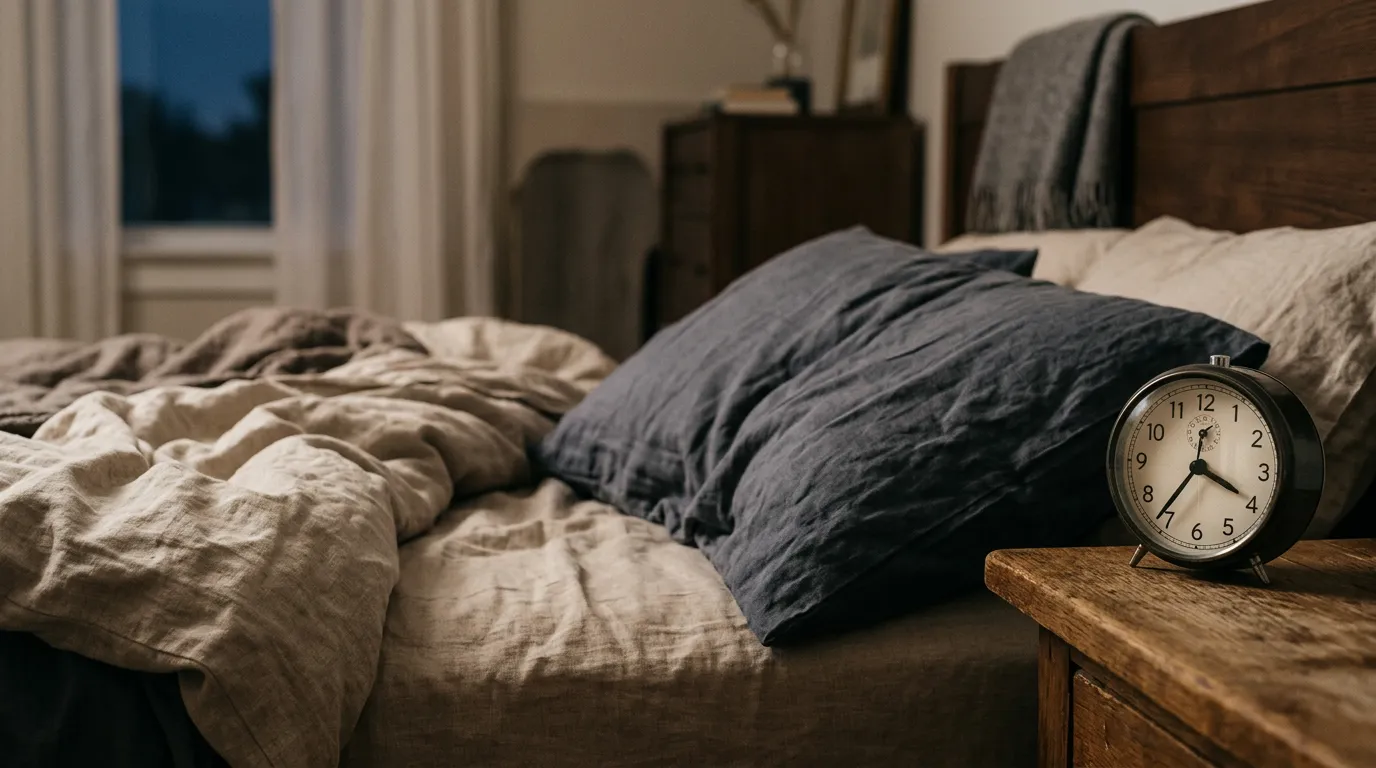
How Your Sleep Shapes Your Face
People can tell when you slept badly, even when the mirror can't. Here's what the research actually proves about sleep and your face, and what's still myth.
 Damien, founder of HALOIA11 min read
Skip one night of real sleep and people can tell, even if they can't explain how. That's not just a feeling — researchers have actually measured it: after a single night of restricted sleep, strangers rate the same faces as less attractive, less healthy, and less appealing to interact with, with no measurable change in how trustworthy those faces seem. But before you panic and buy a fourth serum, here's the part that matters more: when scientists went looking for the actual physical markers behind that impression — skin tone, eye openness, dark circles — they mostly couldn't find them. The 'tired face' people react to seems to live more in perception than in provable biology. That gap, between what people notice and what's actually measurable, is where this article lives: what sleep verifiably does to your face and body, what's still unproven, and what's genuinely worth changing tonight.
What actually happens while you sleep
Sleep isn't one flat state — your body cycles through lighter and deeper stages several times a night, roughly every 90 minutes. The deepest stages, concentrated in the first half of the night, are when the body is believed to run most of its repair and restoration work: tissue maintenance, hormone regulation, and immune activity all shift into a different gear compared to when you're awake. REM sleep, which dominates the second half of the night, is tied more to cognitive processing, memory consolidation, and emotional regulation than to physical repair.
The practical consequence is that you don't lose sleep stages evenly when you cut a night short. Go to bed two hours late and wake up at your normal time, and you're disproportionately cutting into the back half of the night — REM first. Keep doing that for a week, and you eventually eat into deep sleep too, because the two get compressed together as total sleep time shrinks. That's part of why 'I'll catch up this weekend' doesn't fully undo five short nights: the stages aren't interchangeable, and one long lie-in doesn't perfectly reimburse what several nights owed you.
This is also why regularity matters almost as much as total hours. Your circadian rhythm — the internal clock that decides when your body wants to enter deep sleep versus lighter sleep — runs on consistency, not just duration. Sleeping 7.5 hours at wildly different times each night (midnight to 7:30am on weekdays, 3am to 10:30am on weekends) doesn't give your body the same stable window to run its deepest repair cycles as 7.5 hours at roughly the same time every night. It's part of why the American Heart Association's cardiometabolic framing explicitly includes both duration and regularity as separate, trackable variables — a genuinely erratic schedule can undercut even a technically 'good' average.
How many hours you actually need
There's a real, well-established number here, not a wellness-culture guess dressed up as science. A large umbrella review of sleep duration and health outcomes in adults found that 7 to 8 hours a night is associated with the best results across cardiovascular disease, type 2 diabetes, and all-cause mortality risk — and the relationship isn't gentle once you drop below that.
A 2021 umbrella review of sleep duration and health outcomes found that below 7 hours a night, each additional hour lost raises all-cause mortality, cardiovascular disease, and type 2 diabetes risk by 3 to 11%. Seven to eight hours was associated with the best outcomes overall.
More sleep isn't automatically better, either. Regularly sleeping 9 or more hours is linked to worse outcomes on those same measures — higher risk of stroke, cardiovascular disease, and type 2 diabetes — and it often signals poor sleep quality rather than genuine extra rest. Long time in bed without much actual sleep (tossing, waking, scrolling) counts as hours logged, not hours recovered. If you're regularly sleeping 9+ hours and still feel tired, the number itself isn't the problem worth chasing — the quality underneath it is.
The cortisol, inflammation, and mood connection
This is the part that's easy to oversimplify into a scary headline about sleep 'destroying' your skin, so let's be precise about what's actually established. Sleep — both duration and regularity — is recognized by the American Heart Association as a standalone cardiometabolic risk factor, on par with diet and physical activity. That's not a soft lifestyle nice-to-have; it's a hard clinical variable that gets tracked alongside cholesterol and blood pressure in cardiovascular risk models. Chronic short sleep is associated with the kind of systemic inflammation and hormonal dysregulation that shows up across the whole body, not just under your eyes.
On the mood and stress side, a recent meta-analysis found that improving sleep quality significantly reduced depression and anxiety symptoms compared to standard care alone. Mood and chronic stress have their own well-documented downstream effects on how people carry themselves and how much effort they put into their appearance on a given day — tension patterns, posture, whether you bothered with your usual routine that morning. None of this proves a direct 'sleep loss ages your skin by X percent' pathway on its own, and you should be skeptical of anyone who claims it does with a precise number. What it does prove is that sleep is a real physiological lever tracked by cardiologists and mental health researchers, not a cosmetic afterthought — which is reason enough to treat it with the same seriousness as diet or training.
The compounding part is what usually gets missed. One rough night is a blip your body can mostly absorb. Weeks of five-and-a-half-hour nights, stacked on top of a stressful stretch at work, are a different situation entirely — that's when the cardiometabolic and mood effects actually accumulate to the point of being clinically measurable, rather than staying a one-off inconvenience. If you're trying to figure out whether sleep is 'the problem' behind how you've been looking or feeling lately, the honest test isn't last night — it's your average over the past two to three weeks.
Does poor sleep really show on your face?
Here's where it gets genuinely interesting, and where most sleep-and-skin content stops being honest with you. In a controlled study, observers looked at photographs of the same people taken after a normal night and after a night of restricted sleep.
In a study published in Royal Society Open Science (2017), observers rated faces as less attractive, less healthy, and less socially appealing after a night of restricted sleep than after a normal night — with no measurable change in how trustworthy those same faces seemed.
So the effect on how you're perceived by other people is real, measured, and replicated in a controlled setting. What's much murkier is why. A separate study went looking for the objective physical signals that might explain that perception.
A study of 181 participants (Journal of Sleep Research, 2019) found no significant link between sleep deprivation and objectively measured facial changes — skin color, eye openness, and dark circles — suggesting the 'tired face' effect is mostly a matter of perception, not a reliably measurable physical marker.
Put those two findings together and the honest read is this: people can genuinely tell when you're tired, but science hasn't nailed down exactly which visible cue gives it away, and hasn't proven it's a stable, photographable before-and-after biological marker rather than something more subtle — expression, eye movement, micro-posture, or simply how much effort went into your appearance that particular morning. That's a meaningfully more careful claim than 'sleep loss visibly damages your skin overnight,' and it's the more accurate one. It also means chasing a single overnight fix for 'tired face' is likely to disappoint you, because the visible cue isn't a fixed target.
Your Appearance Score
What's Your Appearance Score?
60 seconds. Get a score based on your habits.
Dark circles aren't only about sleep
If dark circles are your main piece of evidence that sleep is 'showing on your face,' it's worth knowing they're one of the most misattributed features in skincare. Dermatology research describes dark circles as multifactorial: dermal melanin deposits, post-inflammatory pigmentation, periorbital swelling, visible blood vessels close to the thin under-eye skin, and skin laxity that creates shadowing are all separately documented causes. Clinicians actually classify dark circles into five distinct types — structural shadowing, vascular, idiopathic hyperpigmentation, post-inflammatory hyperpigmentation, and constitutional — because each one needs a different fix. A vascular case doesn't respond to what fixes a pigmentation case.
That means two people can both look 'tired' around the eyes for completely different underlying reasons, and only one of them might have anything to do with how much they slept last night. This isn't a reason to ignore your sleep — it's a reason not to assume dark circles will fully resolve just because you started sleeping 8 hours a night. If they don't budge after a few weeks of genuinely consistent sleep, the cause is more likely structural or vascular than a sleep debt you can still pay off. That doesn't mean nothing can be done about a non-sleep cause, it just means the fix is a dermatology conversation, not another early bedtime.
A sleep hygiene routine that actually moves the needle
The controllable levers with real evidence behind them are less exciting than a skincare haul, but they're the ones that actually change how much and how well you sleep:
- Cut evening blue light exposure: research shows that blue-light-blocking glasses worn in the evening limit the melatonin suppression caused by LED screens and reduce pre-bedtime alertness, consistent with standard sleep hygiene advice to limit screens before bed — useful if you're not willing to just put the phone away.
- Manage your caffeine cutoff, not just your caffeine amount: timing matters more than most people think. A typical dose taken early enough barely registers; the same amount taken late clearly does, so track your last cup relative to bedtime, not just your total for the day.
- Cool the bedroom down: a global systematic review of sleep and temperature research found that warmer ambient temperatures, both at night and during the day, are consistently linked to worse sleep, with a stronger effect during hot periods. Most people under-invest in this lever compared to mattress or pillow upgrades.
- Don't panic over one rough stretch: a moderate, habitual reduction of 1-2 hours below your normal sleep doesn't appear to block strength or muscle mass gains from resistance training over several weeks. That's evidence of some real tolerance margin for occasional short sleep — not a reason to make it a habit, but a reason not to spiral over a bad week.
- Anchor your wake time before your bedtime: it's easier to control when you get up than when you fall asleep, and a fixed wake time is what actually stabilizes the circadian rhythm mentioned earlier. Pick one wake time you can hold seven days a week, and let bedtime follow from how tired you actually are, rather than chasing a rigid bedtime first.
In a 2025 dosing study published in Sleep, a typical caffeine dose (about one cup) taken up to 4 hours before bedtime didn't meaningfully disrupt sleep. A high dose (around four cups) taken within 12 hours of bedtime clearly did, cutting perceived sleep quality by roughly 34% when taken 4 hours before sleep.
None of this requires obsessive tracking or chasing a mythical, perfectly optimized 8.5-hour night. But sleep is genuinely hard to self-assess — you can't accurately rate your own deep sleep from memory the next morning, and 'I feel fine' is a weak proxy for what actually happened overnight. That's exactly why it helps to see the pattern instead of guessing at it. HALOIA pulls your sleep data straight from Apple Health and lines it up against how your skin, energy, and appearance score are trending over the same weeks, so instead of wondering whether last month's rough stretch was diet, stress, or those three nights you scrolled until 1am, you can actually see which one it was — and fix the lever that's actually holding you back, instead of the one that happens to be easiest to blame.
This article is for information only and is not a substitute for medical advice. For any question about your health, a treatment or a supplement, consult a qualified professional.
Improve your appearance by eating better
Build real confidence by tracking your diet. Download HALOIA and start your tracking.

Go further
The Sleep Habits for Better Skin
Everyone tells you to "sleep more," but almost nobody explains which habits actually move the needle. Here are the ones with real numbers behind them.
Male Hormonal Balance: The Foods That Matter
Every 'boost your testosterone' list treats one hormone like the whole story. Here's what actually shapes male hormonal balance as a system, and the food habits backed by real research.
The Real Link Between Cortisol and Belly Fat
Every corner of the internet blames belly fat on cortisol. The real mechanism is narrower, and more useful, than the myth — here's what the hormone research actually shows.