
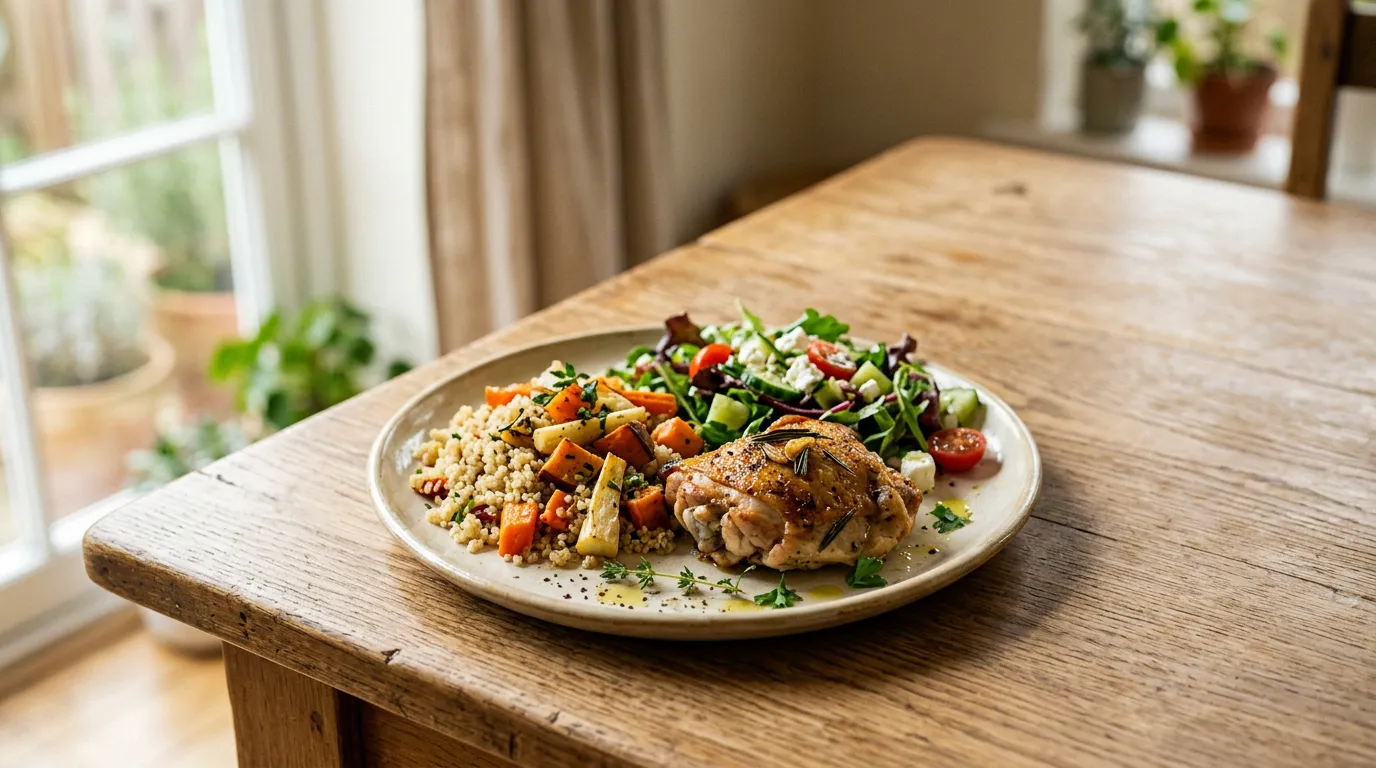
One Meal a Day: The Real Health Cost
OMAD and a normal three-meal day at the exact same calories aren't the same experience for your body. Here's what the one controlled trial on this actually found.
 Damien, founder of HALOIA11 min read
If you've switched to eating once a day and told yourself the math checks out because the calories are the same, you're only half right. A 2007 controlled trial in the American Journal of Clinical Nutrition tested that exact scenario: healthy adults eating all their calories in a single meal versus the same total split across three. The one-meal group didn't end up leaner or more disciplined for it. They reported feeling hungrier, and their LDL cholesterol and blood pressure both went up, even though nothing else in their diet had changed. That's the study most one-meal-a-day (OMAD) advice online skips entirely. This piece walks through what the research actually found, why OMAD still has such a devoted following anyway, how it differs from a moderate format like 16:8, what warning signs are worth taking seriously, and what a more sustainable version of the same goal looks like.
What the 2007 trial actually measured
Most claims about one-meal-a-day eating lean on a mix of anecdote and loosely related research on time-restricted eating in general. The Am J Clin Nutr trial is more useful precisely because it isolated one variable. Researchers put healthy adults through two eating patterns, three meals a day and one meal a day, while keeping total daily calories identical between conditions. That detail matters more than it sounds: it means whatever changed couldn't be explained away by "well, they just ate less overall," which is the usual explanation for why restrictive eating windows produce weight loss. With calories held constant, any difference in hunger, cholesterol, or blood pressure had to come from the pattern of eating itself, not from how much food was consumed. The result: perceived hunger increased on the one-meal schedule, and so did LDL cholesterol and blood pressure. Nothing about total intake changed. Only the number of times a day food showed up did.
A controlled trial published in the American Journal of Clinical Nutrition (2007) found that eating one meal a day, even at calories matched to a standard three-meals-a-day pattern, increased perceived hunger and raised LDL cholesterol and blood pressure in healthy adults. In other words: the cost showed up independent of whether someone was gaining, losing, or maintaining weight.
Why "same calories" is the detail everyone skips
Here's the confusion that keeps OMAD's reputation intact: plenty of people really do lose weight eating one meal a day, and they conclude the meal timing itself did the work. In practice, it's almost always the opposite mechanism. Compressing all your food into one sitting makes it physically harder to eat as much as you would across three normal meals, so total calorie intake drops without anyone deliberately tracking it. That's a real effect, and it's genuinely useful for some people. But it's not evidence that eating once a day changes your metabolism for the better. A 2024 isocaloric trial in Annals of Internal Medicine tested this directly by matching calories between a restricted eating window and unrestricted meal timing, and found no difference in body weight. A separate year-long trial in the New England Journal of Medicine added an 8-hour eating window on top of calorie restriction and got no extra weight loss compared with calorie restriction alone. Put together, these two studies say the same thing from different angles: the scale moves because of how much you eat, not when you stop eating it. Once you match calories, the way the 2007 trial did, the number-of-meals variable stops helping and starts costing you something instead: more hunger, higher LDL, higher blood pressure.
An isocaloric randomized trial in Annals of Internal Medicine (2024) confirms this directly: at matched calorie intake, restricting the eating window to a 16:8 or 18:6-style format does not change body weight compared with unrestricted meal timing. Weight loss from time-restricted eating in the real world is almost always a calorie story wearing a timing costume.
Why OMAD still has such a devoted following
If the data is this unflattering, why does OMAD keep resurfacing in fitness and biohacking circles? A few reasons, and none of them are irrational. One meal a day removes decision fatigue: no meal planning three times a day, no snack-timing calculations, just one sitting to get right. For people who struggle with grazing or mindless snacking, having a hard stop is genuinely easier to follow than "eat in moderation." There's also a social layer to it: skipping meals in front of other people reads as discipline, and discipline gets rewarded online with the kind of attention that a normal, unremarkable three-meal day never earns. That reward loop keeps people posting about OMAD long after the novelty of the format itself has worn off, which quietly reinforces it as a personality trait rather than a diet experiment with a start and an end date. There's also a cultural halo around fasting adjacent to claims about autophagy, the cellular cleanup process credited with everything from longevity to mental clarity. The problem is how thin that evidence actually is in humans. Most of what's known about fasting and autophagy comes from animal and cell studies; direct human data on short fasts in the 16 to 24 hour range remains limited, and a 2023 review in Advances in Nutrition explicitly flags that fasting-triggered autophagy isn't a one-way miracle mechanism, it can have both beneficial and potentially adverse effects depending on context and intensity. None of that makes OMAD irrational to try. It makes the reasons people usually give for sticking with it, simplicity and self-control, honest ones, while the reasons it's marketed on, metabolic magic and cellular renewal, considerably shakier than the framing suggests.
OMAD vs. 16:8: what's actually different
The gap between OMAD and a moderate format like 16:8 (eating within an 8-hour window instead of one sitting) isn't just about which one sounds more extreme. It shows up in the safety data itself. An 8-hour time-restricted window was tested in adults with obesity over several months and found to be safe and well tolerated, with no serious adverse effects reported. That kind of longer-duration safety data simply doesn't exist for OMAD, or even for shorter 20:4 windows, which haven't been studied nearly as thoroughly, especially outside short trials. There's also a practical, physiological difference: an 8-hour window still gives you room for two real meals, which matters for how your body uses protein. In men doing resistance training, an 8-week 16:8 protocol preserved lean mass and reduced fat mass, with stable testosterone, while a single daily meal makes it structurally harder to hit a meaningful protein dose more than once a day. OMAD isn't automatically dangerous for everyone who tries it. But it's the format with the thinnest safety record, the narrowest margin for hitting your protein needs, and, per the 2007 trial, a measurable cardiovascular cost that 16:8 hasn't shown in comparable research.
An 8-hour time-restricted window (16:8) was found safe and well tolerated over several months in adults with obesity, with no serious adverse effects reported, according to a study in Applied Physiology, Nutrition, and Metabolism (2019). Safety data are considerably more solid for this moderate format than for OMAD or 20:4.
Your Appearance Score
What's Your Appearance Score?
60 seconds. Get a score based on your habits.
The muscle-loss risk nobody mentions
There's a second cost to OMAD that rarely comes up next to the cholesterol and blood pressure numbers: muscle. A recent review in Nutrition Reviews flags a heightened muscle-loss risk specifically tied to the most restrictive fasting formats, very short eating windows like 20:4 or one meal a day, particularly when protein intake is insufficient or the person is older. The mechanism is about frequency, not total protein. Muscle protein synthesis responds to getting a meaningful dose of protein regularly enough across the day, not just to hitting a total gram target once. Squeeze all your eating into one sitting, and you get exactly one shot a day to trigger that response, no matter how much protein is technically in that single meal. Even if you technically eat enough grams of protein across your one meal, most people physically can't finish a plate large enough to hit their daily target in a single sitting without discomfort, so the target quietly slips too. For younger, well-trained people already eating enough protein, this risk is manageable with planning. For older adults, anyone recovering from illness, injury, or surgery, or athletes already training on a calorie deficit, it's a meaningfully worse trade-off than a wider eating window would be. This isn't a reason to panic if you've tried OMAD once. It's a reason to treat it as a short-term experiment rather than a default, especially past your thirties, when protein needs for maintaining muscle already start climbing.
A 2026 review in Nutrition Reviews specifically flags a heightened muscle-loss risk with more restrictive fasting protocols, very short eating windows like 20:4 or one meal a day, particularly when combined with insufficient protein intake or in older adults.
Warning signs worth taking seriously
If you're currently doing OMAD, none of this means stop immediately. It means the format deserves the same scrutiny you'd give any other intervention with measurable side effects, because that's what the data says it is. A few signs suggest the cost is outweighing the convenience:
- Hunger that gets worse over weeks instead of settling, rather than the initial adjustment period fading like most people expect.
- Noticeably lower strength or stalled progress in the gym despite training consistently, a possible early sign of the muscle-loss pattern research links to very restrictive windows.
- Dizziness or lightheadedness when standing up, worth mentioning to a doctor given the blood pressure changes the research associates with this pattern.
- Finding it harder, not easier, to read your own hunger and fullness signals over time, the opposite of what most OMAD advice promises will happen after an adjustment period.
- Irritability or poor sleep that tracks closely with how hungry you were that day.
- A pattern where "one meal" quietly becomes a binge, followed by guilt and stricter restriction the next day.
A more sustainable version of the same goal
If what actually drew you to OMAD was the simplicity, one clear rule instead of constant small decisions, a wider window keeps that upside without the cardiovascular and muscle-loss cost the research flags. Head-to-head comparisons across fasting formats are reassuring here: an umbrella review in JAMA Network Open found that intermittent fasting overall produces weight loss broadly similar to standard calorie restriction, and a more recent comparison in Advances in Nutrition found alternate-day fasting, 5:2, and time-restricted formats like 16:8 perform comparably to each other on body composition and cardiometabolic markers. In plain terms: switching from one meal a day to a 16:8 or 14:10 window isn't settling for a weaker version of the same result. It's very likely the same result, with a much better-documented safety profile and enough room in the day to actually spread protein across two meals instead of one. The practical version: pick an 8 to 10 hour window that fits your schedule, put real protein at both meals inside that window rather than treating it as leftover space, and stop treating hunger as something to override through sheer willpower. It's data, not a character flaw, and OMAD generates more of it than a wider window does for the same calorie total.
None of this requires picking a side between "fasting is great" and "fasting is dangerous." The honest version is narrower: a controlled trial says the most extreme version of it carries a measurable cost, and a moderate version gets you most of the same benefits without it. The part that's actually hard isn't picking a protocol, it's knowing whether the one you're on is working for your body specifically, not just in the studies. Who should avoid fasting altogether is a related question worth reading before you experiment. And what fasting does to your energy covers the day-to-day side.
That's the part HALOIA is built for. Instead of asking you to trust a fixed eating-window rule, it logs your real meals and shows you, plainly, where your protein, calories, and meal timing actually land each day, so you can see whether a 16:8 window is genuinely working for you, or just feels like it should be, without waiting for a cholesterol panel to find out the hard way.
Sources
This article is for information only and is not a substitute for medical advice. For any question about your health, a treatment or a supplement, consult a qualified professional.
Improve your appearance by eating better
Build real confidence by tracking your diet. Download HALOIA and start your tracking.

Go further
The Best Breakfast for Clear Skin in Your 20s
Forget "eat clean" advice with no specifics. Here's the exact breakfast structure that keeps blood sugar stable and gives your skin what it needs to repair overnight's damage.

Ashwagandha: Its Real Effect on Stress and Training
Ashwagandha gets credited for almost everything. Two claims actually hold up in controlled trials — stress/cortisol and strength/muscle — and they don't have the same evidence behind them. Here's the honest breakdown.

Who Should Never Fast?
Intermittent fasting is safe for most healthy adults — but not for everyone. Here's exactly who should skip it, and why, according to the research.