
Should You Hire a Photographer for LinkedIn?
A close-up selfie and a professional headshot don't just look different, they make people think different things about you. Here's what the research actually shows, and how to get most of the effect without booking a studio.
 Damien, founder of HALOIA10 min read
Short answer: it depends on what job the photo needs to do. A 2020 study in Facial Plastic Surgery & Aesthetic Medicine compared close-up, filtered selfies against professional photos shot with a DSLR camera at a distance, and found that observers rated the selfies as more attractive and healthier-looking, while the DSLR photos won clearly on perceived confidence, intelligence, and competence. For a dating profile, the selfie has the edge. For a LinkedIn headshot, a job application, or a client-facing bio, the traits that actually get rewarded are the ones the professional camera captures better. That doesn't automatically mean you need to book a $300 studio session. It means you need to understand exactly which variables move the needle, camera height, light angle, distance, so you can either hire the right kind of shoot or replicate the parts that matter yourself.
What the research actually found
The Kandathil study showed observers two versions of the same people: a close-up selfie edited with a typical smartphone filter, and a photo taken with a professional DSLR camera from several feet away, unfiltered. The selfie version won on attractiveness and how healthy the person looked. The DSLR version won, by a clear margin, on confidence, intelligence, and competence. Same face, same person, two very different verdicts from the people looking at them. The only thing that actually changed was the camera, the distance, and the amount of digital processing applied afterward.
That split matters because it means a good photo isn't one thing. A photo that makes you look attractive and a photo that makes you look competent are not automatically the same photo, and optimizing for one can quietly work against the other. LinkedIn, unlike a dating app, is scored almost entirely on the second axis: whether a stranger scrolling past your profile picture assumes you're capable, credible, and worth a reply. This is closer to what psychologists call a halo effect running in reverse: instead of one strong trait (attractiveness) bleeding into every other judgment, the format of the photo itself sets which halo gets triggered. A close-up, filtered face reads through the "is this person appealing" filter. A formally framed, unfiltered face reads through the "is this person capable" filter, and the two filters produce different verdicts on the exact same underlying face.
Facial Plastic Surgery & Aesthetic Medicine (Kandathil et al., 2020): in a direct comparison, the same people were rated as more attractive and healthier-looking in close-up filtered selfies, but as more confident, more intelligent, and more competent in unfiltered DSLR shots taken from a distance. Clear evidence that photo type, not just photo quality, changes what a viewer assumes about you.
Why a selfie and a studio photo send different signals
Two things happen at once with a close-up selfie: the face fills more of the frame, and it's usually taken by the subject holding the camera close, often with a casual, relaxed smile. Both read as personal and informal, the visual grammar of a friend rather than a colleague. A DSLR photo taken from a few feet back, by someone else, uses the visual grammar of a formal portrait, the kind used on staff pages, in yearbooks, and for press photos. Viewers have seen thousands of both formats over the years and unconsciously borrow the context that usually surrounds each one, even when they can't explain why a photo feels a certain way.
This isn't a cosmetic detail. Research on first impressions has found that appearance-based judgments shape perceived competence and occupational success within the first seconds of contact, and that this effect is separate from clothing style, meaning the photo format itself is doing work that a good outfit alone can't fully compensate for. On a platform where a recruiter or a potential client scrolls past your profile picture in a couple of seconds, the format of that photo is already shaping their read on you before they've reached a single word of your headline.
Recruiters in particular make a lot of these snap judgments, at volume, all day. A search result page shows dozens of thumbnails at once, and the profile picture is the first, and sometimes only, piece of information a recruiter processes before deciding whether to open a profile at all. A photo that reads as informal in that context doesn't just look slightly less polished, it can get skipped entirely before your headline, your experience, or your recommendations ever get read.
When the professional investment actually pays off
The stakes here are economic, not just cosmetic. A 2020 analysis of labor-market data found that perceived physical attractiveness is tied to higher earnings and better fringe benefits, a documented "beauty premium" that shows up independent of a person's actual skills. A professional headshot isn't going to rewrite your resume or fake competence you don't have, but on a platform where a recruiter's first exposure to you is a thumbnail, closing the gap between how competent you actually are and how competent you look in that thumbnail has a real, measurable payoff.
Think of it less as a beauty purchase and more as removing a friction point. If your actual experience and track record are solid, a photo that quietly undersells your competence is a tax on all of that other work, one that costs nothing to remove once you know which three variables actually matter. The reverse is also true: no amount of photographer skill fixes a profile with a thin work history or a vague headline. The photo changes whether people open the profile, not what they find once they do.
- Worth it: active job searching, executive or client-facing roles, freelance or consulting profiles, speaker bios, board applications, anywhere a stranger decides in seconds whether to take you seriously.
- Usually not worth it: a personal Instagram, a dating profile, or a casual social account, where this same research shows a close, relaxed, even filtered photo actually performs better.
- The middle ground: if a paid session isn't in the budget right now, most of the effect comes from correcting camera height, light angle, and distance, not from the photographer's equipment or years of experience.
Economics and Human Biology (Dilmaghani, 2020): labor-market data show that perceived physical attractiveness is associated with higher earnings and fringe benefits, independent of actual skill, a documented "beauty premium" that makes the format of a professional photo more than a vanity choice on a career platform.
The angle, light, and distance a pro photographer gets right
Professionals aren't guessing when they set up a headshot. Three variables show up repeatedly in the research, and they're the same three variables most people get wrong when they hand a phone to a friend, or worse, hold it themselves.
- Camera height: shooting from eye level, not below or above, is rated as more trustworthy than the same face shot from a lower or higher angle. Camera elevation alone doesn't change perceived attractiveness, but it does change how trustworthy you look, and trustworthy is exactly the signal a professional photo needs to send.
- Light angle: from directly in front up to about 30 degrees off-center, lighting makes no measurable difference to how you're perceived. Push past that, especially toward a hard 60-degree side light, and perceived attractiveness drops while the face is judged as heavier, because strong side lighting exaggerates shadow and contour along the jaw and cheeks.
- Distance and framing: a photo taken a few feet back, showing head and shoulders rather than filling the frame with your face, reads as a portrait rather than a selfie. That framing choice alone is doing a large part of the work a photographer gets paid for.
Empirical Studies of the Arts (Baranowski & Hecht, 2018): people photographed at eye level are consistently rated as more trustworthy than the same people shot from a lower or higher camera angle, even though camera height alone doesn't move attractiveness ratings up or down.
One caveat worth knowing: a study on slight high-angle shots combined with a small rotation of the face found that this specific combination does increase perceived attractiveness, especially for men, and makes the face appear thinner, but it also makes the person look less helpful. That's a reasonable trade for a dating profile photo. It's the wrong trade for a photo meant to signal you're approachable and competent, which is exactly why photographers default to eye level for a professional headshot instead of the more flattering high angle you'd see on a dating app.
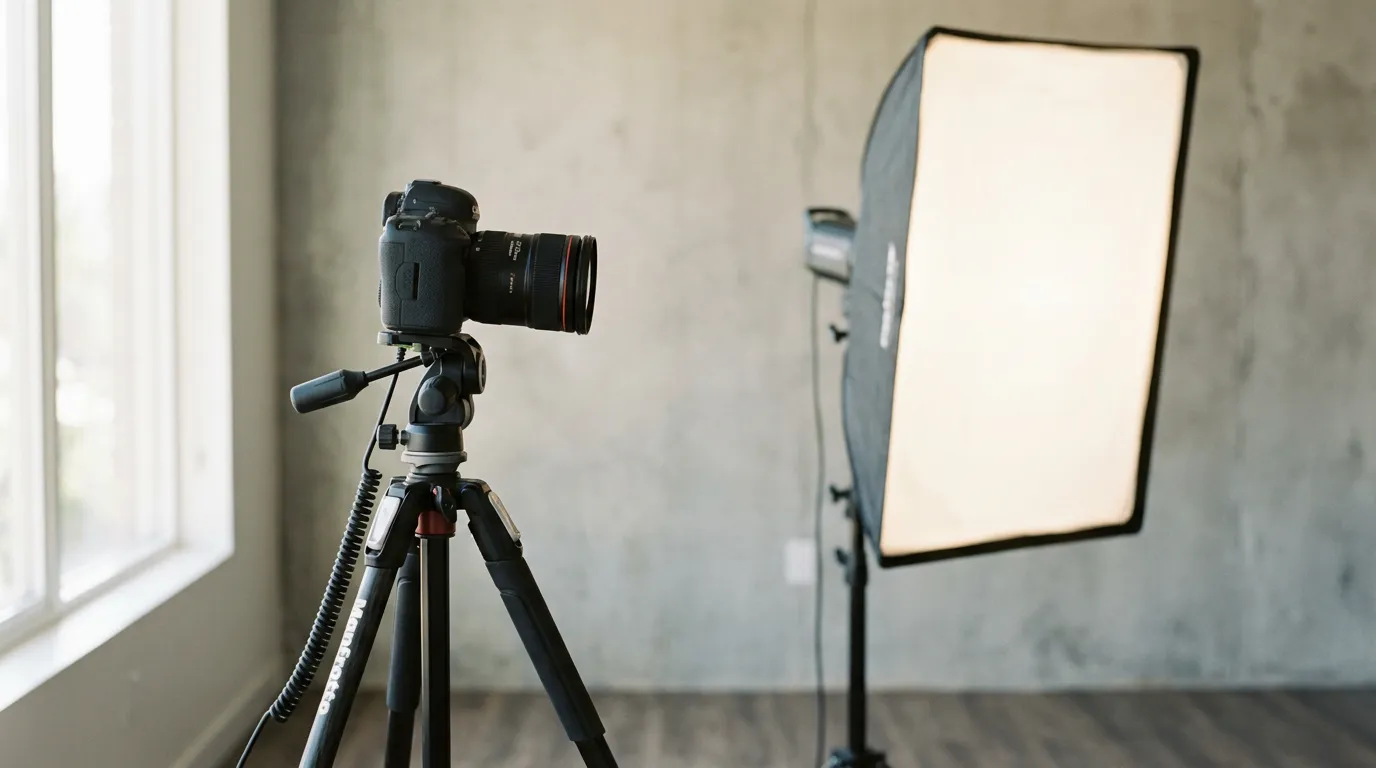
This is also why a photographer bothers with a reflector, a window, or a cheap softbox instead of just using whatever light happens to be in the room. The 30-degree threshold isn't a stylistic preference, it's roughly the point where shadow starts doing more work on your face than your actual features do. A single overhead light or a lamp to one side routinely blows past that threshold without anyone noticing in the moment, which is why so many home-shot photos look subtly "off" in a way that's hard to name. Diffused, roughly frontal light isn't a creative choice, it's the boring, repeatable fix for a problem most people can't quite diagnose in their own photo.
Your Appearance Score
What's Your Appearance Score?
60 seconds. Get a score based on your habits.
The DIY setup that gets you most of the way there
None of the three variables above actually require a photographer. They require knowing what to control, and about fifteen minutes, which is worth doing even if you eventually book a professional session, since the same setup makes it obvious what you're paying a photographer to improve on.
- Prop your phone at eye level (stack of books, tripod, a doorframe) instead of holding it and shooting down or up at yourself.
- Face a window instead of a wall. Natural light from roughly in front, or a soft angle up to about 30 degrees, avoids the harsh shadowing that hard side light creates.
- Step back and crop to head-and-shoulders instead of filling the frame with a close-up. It's the single biggest cue that separates a portrait from a selfie.
- Skip the beauty filter entirely. It's the one variable the research consistently ties to the "more attractive, less competent" trade-off you don't want on a professional profile.
- Smile like you mean it. A genuine smile that involves the muscles around the eyes, not just the mouth, is reliably rated as more sincere and more attractive than a posed one, and it's genuinely hard to fake in a photo.
Cognition & Emotion (Gunnery & Ruben, 2016): a meta-analysis across multiple studies confirmed that genuine "Duchenne" smiles, the ones that reach the eyes, are consistently rated as more positive, sincere, and attractive than posed smiles, one of the few cues in a photo that's genuinely difficult to fake on command.
Clothing plays a smaller but measurable role too. A series of controlled experiments found that dressing more formally increases how competent you're perceived to be, but decreases perceived warmth, a real trade-off, not a myth. For most LinkedIn profiles, business casual splits that difference better than a full suit, unless the specific role you're applying for rewards formality over approachability.
Classic LinkedIn photo mistakes
Most profile photos that quietly undersell someone aren't badly lit disasters, they're one of a handful of repeat offenders:
- The vacation or group photo, cropped down to just your face, with the background and a stray shoulder still visible.
- The gym mirror or car selfie, held at arm's length and shot from slightly below.
- Heavy filters or beauty smoothing, which the research links to being seen as less competent, not more.
- Harsh window or overhead light hitting from the side, which reads as unflattering and, per the light-angle research, correlates with looking heavier and less put-together.
- A closed-mouth, posed smile that never reaches the eyes, and reads as stiff rather than confident.
A good professional photo is a snapshot of one carefully controlled moment: the right camera height, the right light, the right distance. But it's still a snapshot of whatever you're actually working with that day, puffiness, dull skin, tired under-eyes, none of which a better angle can fully correct, and a photographer will politely not mention any of it while quietly angling the light to hide as much of it as possible. Those show up because of sleep, hydration, and what you ate the day before, factors a single studio session resets to zero on the day it happens, but that drift right back within a week if nothing else changes. That's exactly what HALOIA tracks day to day, not to replace a good photo, but to make sure the face showing up in it looks like that on more than just shoot day. If you want a clearer read on where your appearance actually stands before your next headshot, HALOIA's free appearance quiz gives you that baseline in a few minutes.
This article is for information only and is not a substitute for medical advice. For any question about your health, a treatment or a supplement, consult a qualified professional.
Improve your appearance by eating better
Build real confidence by tracking your diet. Download HALOIA and start your tracking.

Go further

Does Building a Non-Smoker Identity Help You Quit?
Willpower treats every cigarette as its own fight to win. Identity skips the fight entirely. Here's what a year-long study of 623 smokers found, and how the same lever works on food and exercise too.
Cold Showers: The Real Effect on Stress
Everyone's doing cold showers for the mental health benefits, but the science is pickier than the trend suggests: the calming effect is real, it just isn't the one you get from a single icy blast.

Reframing Thoughts: The Measured Effect on Mood
Reframing a thought isn't a mood trick, it's a measurable shift in brain activity. Here's what the neuroscience actually shows, the real technique, and where it stops working.