
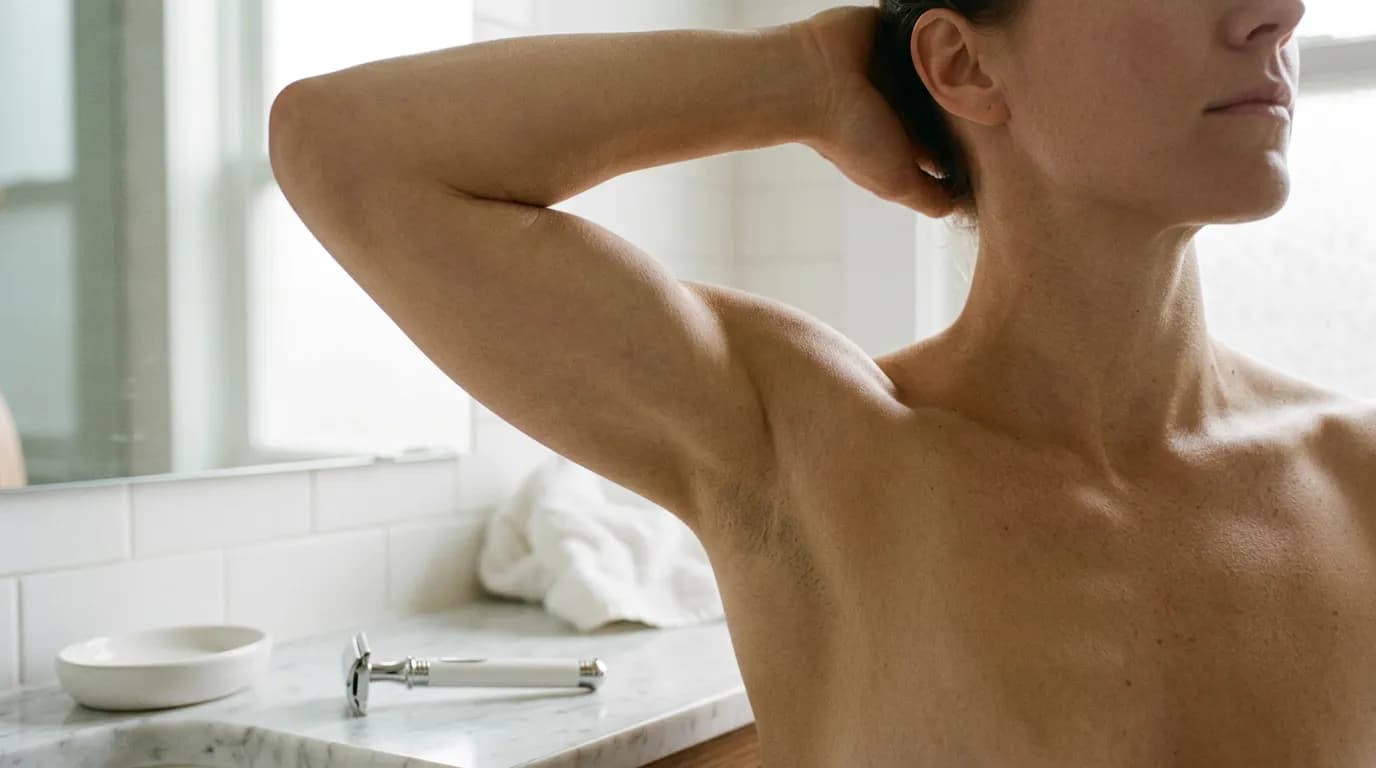
Shaving Your Armpits: Effect on Body Odor
This isn't a razor ad claim. A clinical study measured it: shaving armpit hair before washing cuts body odor by more than half. Here's why, and how to actually use it.
 Damien, founder of HALOIA10 min read
If you shave or wax your armpits and assumed it was purely cosmetic, there's a real physiological payoff hiding in the habit: a clinical study found that shaving armpit hair before washing cut body odor by 57% compared to washing alone, and waxing pushed that reduction to 75%, with the effect lasting several days rather than fading by the next morning. That's not a claim from a razor ad. It's a measured result tied to how hair physically interacts with the bacteria that actually cause body odor. The size of that effect is worth sitting with: a 57% reduction is closer to what you'd expect from switching to a stronger antiperspirant entirely than from a grooming step most people do on autopilot. Here's the mechanism behind it, what the study measured, how shaving stacks up against waxing, and how to build a routine around it so you get the full effect instead of half of it.
Body Odor Doesn't Come From Sweat Itself
Sweat, fresh off your skin, is close to odorless. Most of it comes from eccrine glands spread across your body and is mostly water and salt. The armpits also carry a second type, apocrine glands, which secrete a thicker fluid rich in proteins and lipids — and even that fluid is nearly odorless when it first reaches the surface. What actually produces the smell is bacteria living on your skin, which feed on that fluid and break it down into smaller, volatile compounds. Those compounds are what your nose registers as body odor. It's not really "sweat that stinks" — it's what happens to sweat after it's been sitting on skin for a while. That's also why the armpits get so much attention specifically: apocrine glands cluster there far more densely than anywhere else on your body, so it's the one zone where this whole bacteria-and-hair dynamic plays out the fastest and the most noticeably.
Fresh sweat is nearly odorless. A 2015 study in FEMS Microbiology Letters (Bawdon et al.) confirmed that body odor comes almost entirely from skin bacteria breaking down otherwise odorless compounds in sweat, not from the sweat itself. That single fact is the reason hair removal has any effect on odor at all — it changes the environment bacteria operate in, not how much you sweat.
Why Hair Makes the Bacteria's Job Easier
Armpit hair isn't neutral in this process — it actively helps the bacteria along. Hair retains moisture, keeping the skin underneath damp for longer after you sweat or shower, which extends the exact window bacteria need to break sweat compounds down. It also multiplies the surface area available for bacterial colonies to grow on, the same way a sponge holds more water and more bacteria than a flat, smooth surface. More surface area and more retained moisture together mean a bigger, longer-lived bacterial population working on the same amount of sweat. Remove the hair, and you remove both advantages at once: less surface for bacteria to colonize, and skin that dries faster after sweating. Think of hair as scaffolding rather than a cause: it doesn't produce odor on its own, but it multiplies every condition bacteria actually need to thrive — a damp surface, a large area to spread across, and extra hours before the next wash resets the clock.
What the Study Actually Measured
The finding comes from a study published in the Journal of Cosmetic Dermatology in 2016 (Lanzalaco et al.), which compared body odor after shaving before washing, waxing before washing, and washing with no hair removal at all. The result: shaving before washing reduced measured body odor by 57% relative to washing alone. Waxing beforehand did better still, at a 75% reduction. Just as notable as the size of the effect is how long it held — the researchers found the odor reduction persisted for several days, not just for the few hours right after the shower. That rules out a simple explanation like "shaving just makes you smell more clean-shaven for the rest of the day" — the mechanism is doing something more durable than that. The core comparison is what makes the result credible: hair removed versus hair left in place, tested under otherwise identical washing conditions, isolates hair itself as the variable rather than any difference in soap, water temperature, or general hygiene between groups.
Shaving armpit hair before washing reduced body odor by 57% compared to washing alone, and waxing reduced it by 75%, with the effect lasting several days (Lanzalaco et al., Journal of Cosmetic Dermatology, 2016). Hair retains moisture and provides extra surface area for bacteria — removing it removes both.
Shaving vs. Waxing: Why the Gap Exists
The 57% versus 75% gap isn't random — it tracks with how each method removes the hair. Shaving cuts hair at the skin's surface, so stubble starts regrowing within a day or two, gradually rebuilding the surface area and moisture-trapping structure that gave bacteria their advantage in the first place. Waxing pulls hair out from further below the surface, which means regrowth takes noticeably longer to reach a length and density that recreates the same conditions. In practical terms: shaving is cheap, fast, and needs to be repeated every couple of days to keep the odor-reduction effect going, while waxing is more expensive and more uncomfortable but holds its advantage over a longer stretch between sessions. Neither is "wrong" — they're the same lever, pulled with different frequency and different cost. Waxing also carries a higher chance of ingrown hairs and short-term redness for some skin types, so if you're switching from shaving, it's worth testing a small area first rather than committing your whole routine to it right away.
- Shaving: lowest cost and effort per session, but the effect fades faster as stubble regrows — repeat every 1-3 days to maintain it.
- Waxing: higher cost and more discomfort per session, but the hair-free window (and the odor-reduction effect that comes with it) lasts noticeably longer between appointments.
- Either one beats doing nothing: the study's baseline, washing with hair left in place, was the worst-performing option of the three.
Building the Routine: Timing Matters as Much as the Razor
Hair removal is one lever. Antiperspirant is the other, and most people use it in a way that undersells it. Dermatologists recommend applying antiperspirant at night before bed rather than in the morning shower, because you sweat less overnight — that gives the product's aluminum salts time to actually form a plug in your sweat ducts before the next day's sweat has a chance to dilute it. Skin also needs to be dry at the moment of application, or the same dilution problem shows up immediately. Some studies cited by dermatologists find that applying both at night and again in the morning outperforms a single daily application, if you want to push the effect further.
There's one timing detail specific to shaving that's easy to miss: don't apply antiperspirant immediately onto skin you just shaved. French health agency ANSES specifically recommends avoiding application on irritated skin or right after shaving, since freshly shaved skin is more sensitive and more likely to react to the aluminum salts. The practical fix is simple — shave in the evening, let your skin settle for a bit, then apply antiperspirant before bed as part of the same routine rather than back-to-back in the same five minutes.
- Shave or wax in the evening, not right before you plan to apply antiperspirant.
- Let freshly shaved skin settle for at least a few minutes before applying anything to it.
- Apply antiperspirant to dry skin, at night, so the aluminum salts have hours of low-sweat time to form their plug.
- Reapply in the morning too if odor control has been inconsistent — two applications outperform one.
If you're shaving or waxing every few days mostly to keep this effect going, and the upkeep is the part that bothers you, laser hair removal and IPL are worth knowing about as a longer-horizon option. Both work by targeting the hair follicle itself over a series of sessions, which thins out regrowth over months rather than days, so the same hair-and-moisture dynamic described above stays suppressed for much longer stretches without needing a razor or wax strip every few days. It's a bigger upfront time and cost commitment than either shaving or waxing, and it's not necessary for most people chasing the odor benefit specifically — but if upkeep frequency is the actual obstacle to staying consistent, it's the option built to solve exactly that problem.
Your Appearance Score
What's Your Appearance Score?
60 seconds. Get a score based on your habits.
Deodorant, Antiperspirant, or Both
It's worth being precise about what each product actually does, because they're not interchangeable. Deodorant masks odor and reduces some of the bacteria producing it, but it doesn't touch how much you sweat. Antiperspirant uses aluminum salts to form a temporary plug in your sweat ducts, which actually reduces sweat output itself. In the US, that difference isn't just marketing — the FDA classifies antiperspirant as an over-the-counter drug because it alters a body function, while deodorant is only regulated as a cosmetic. That regulatory gap is a fair proxy for how differently they perform. If odor is your main concern, an antiperspirant (used correctly, per the timing above) is doing more of the actual work than a deodorant alone.
On the aluminum question specifically, since it comes up whenever antiperspirant is mentioned: concerns linking aluminum salts to breast cancer have circulated since the early 2000s, but the US National Cancer Institute has found no scientific evidence connecting these products to breast cancer, a conclusion reinforced by a 2024 meta-analysis covering more than 7,000 participants. The same holds for a proposed link to Alzheimer's disease — large studies have never replicated the original findings that raised the concern. That's not a reason to be careless with any product, just a reason not to skip antiperspirant over a link the research hasn't actually found.
Does This Work the Same Way for Everyone
The mechanism here isn't hormonal or gender-specific — it's physical and microbial. Hair traps moisture and adds surface area for bacteria regardless of whose armpit it's growing in, and the bacteria that break sweat down into odor-causing compounds live on everyone's skin. That means the underlying logic (less hair surface, less trapped moisture, fewer places for bacteria to build a colony) applies to any underarm hair, on any body. Whether you shave, wax, or leave it as is, you're working with the same biology either way — the study measured a physical and microbial effect, not a male or female one. What changes from person to person is baseline sweat volume and skin sensitivity, not whether the mechanism itself applies. It's also worth noting that full removal isn't the only lever — even trimming hair shorter, without removing it completely, reduces the surface area and moisture-trapping effect somewhat, just not to the same degree the study measured for shaving and waxing. If full removal isn't something you want as a routine, shorter is still better than longer for this specific purpose.
If Regular Antiperspirant Still Isn't Enough
For most people, hair removal plus a correctly timed antiperspirant covers it. If odor or sweat is still bothersome after that, the next step up before seeing a dermatologist is an over-the-counter "clinical strength" antiperspirant, usually zirconium-salt based, with up to 20% active ingredient compared to roughly 10% in a standard one. If sweating itself is the real issue rather than odor — sweating heavy enough to intolerably interfere with daily activities, not just mild self-consciousness — that's a different problem (hyperhidrosis) with its own escalation path: prescription-strength antiperspirants first, and botulinum toxin injections as a second-line option if that doesn't resolve it. Most people troubleshooting occasional body odor never need to go that far; hair removal and antiperspirant timing solve the large majority of cases on their own.
None of this is a one-off fix so much as a routine — the same way a skincare habit or a training plan only pays off if you keep doing it. Grooming, hydration, and the small daily habits that affect how you look and feel are exactly the kind of thing that's easy to intend and hard to actually track over weeks. HALOIA's appearance tracking is built around that gap: log the habits that matter and see which ones are actually moving the needle, instead of guessing whether last week's routine changes did anything. If you want a starting point, HALOIA's free appearance quiz gives you a baseline read on where your grooming, skin, and habits currently stand.
This article is for information only and is not a substitute for medical advice. For any question about your health, a treatment or a supplement, consult a qualified professional.
Improve your appearance by eating better
Build real confidence by tracking your diet. Download HALOIA and start your tracking.

Go further
The 4 Real Causes of Facial Water Retention
Puffy face again? There are only four real culprits, and they leave different clues. Here's how to tell them apart instead of guessing.

Text Neck: The Real Risk of Your Phone
Your head weighs about 5kg. Tilt it forward to check your phone and your neck can end up carrying nearly 27kg instead — the weight of an 8-year-old, hanging off your cervical spine for hours a day.
Leg Lengthening Surgery: Cost and Risks
It's a real orthopedic procedure, not a shortcut: a bone is surgically cut and pulled apart by about a millimeter a day. Here's what it actually costs, what can go wrong, and what's worth trying before you get anywhere near an operating table.