
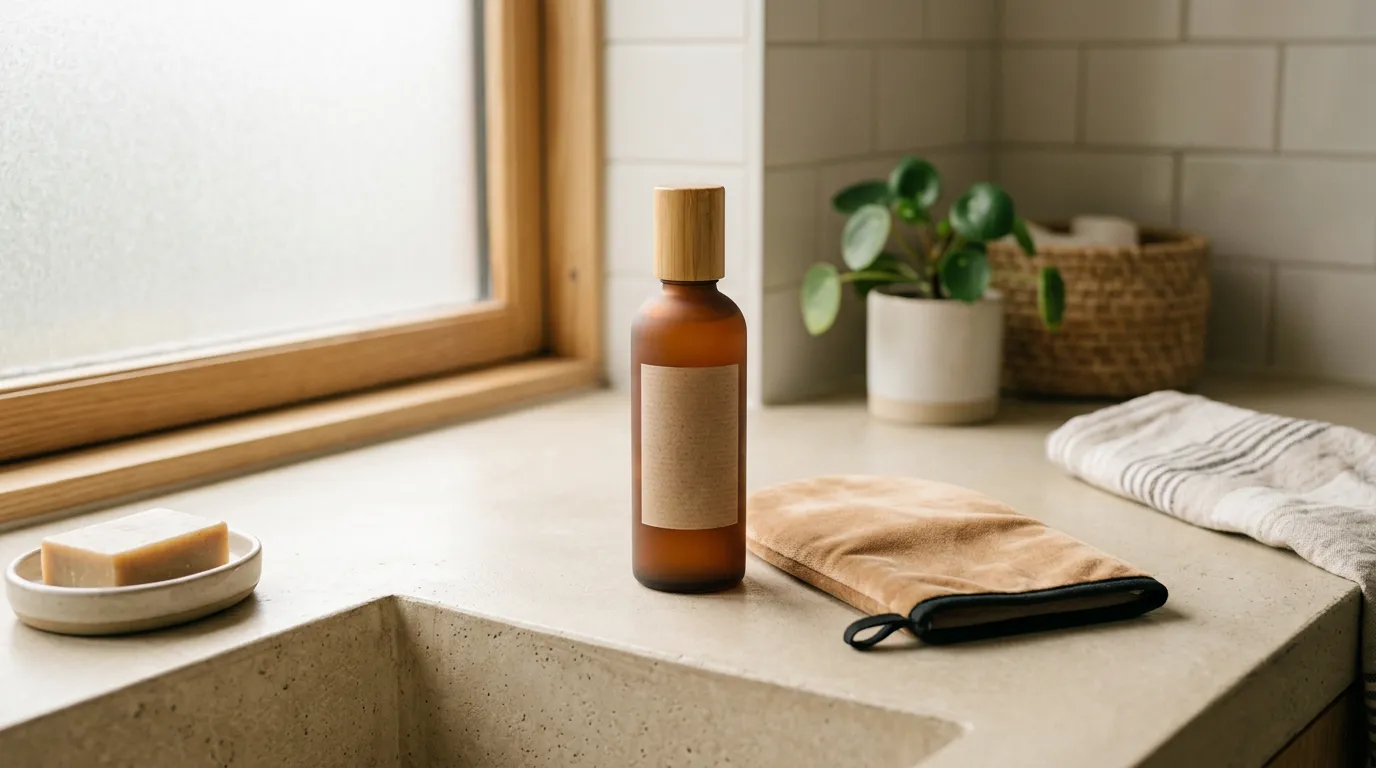
Spray Tan or Tanning Bed: Which Is Safer
One of these raises melanoma risk by 75% before 30. The other's only real caution is keeping it out of your eyes. Here's the full comparison, mechanism to maintenance.
 Damien, founder of HALOIA11 min read
If you're deciding between a spray tan and a tanning bed, the comparison isn't close, and it's worth being upfront about that before getting into the details. A tanning bed works by damaging your skin's DNA with UV radiation, the exact same mechanism the World Health Organization's cancer research agency places in its highest risk category, alongside tobacco. A spray tan works by staining the dead surface layer of your skin with a color-changing compound called DHA, a mechanism the FDA has never linked to cancer at all. Same visual goal, a tan, reached through two completely different processes, one of which carries a documented, well-quantified health cost and one of which doesn't. That's the headline, and it's not a close-enough call to hedge on. What follows is the actual mechanism behind each one, the precautions that matter for the option that's actually safe, how long each lasts, what each one costs, and why 'spray tan or tanning bed' isn't really a debate once you understand what's happening at the cellular level rather than just what shows up in the mirror an hour later.
The short answer: what's actually different
A tan, no matter how you get it, is a color change in your skin. But the two methods that get you there don't share a mechanism, a risk profile, or a regulatory history, and conflating them as 'two ways to tan' obscures the one fact that actually matters: a tanning bed changes your skin color by damaging living cells, and a spray tan changes it by reacting with cells that are already dead. Everything else, the cost, the maintenance, the precautions, the look, is a secondary detail. The primary one is that only one of these two options has ever been classified as a human carcinogen.
How a tanning bed works, and why that's the entire problem
A tanning bed exposes your skin to concentrated UVA and UVB radiation, often at intensities higher than midday summer sun, specifically to produce a fast, deep tan. UV light penetrates into the living layers of skin and can be absorbed directly by DNA, causing structural malformations called pyrimidine dimers, essentially the DNA strand fusing incorrectly at points where it shouldn't. Your skin's melanocytes respond by pumping out melanin, the pigment that darkens skin, partly as a defensive reaction to that damage. The color you're chasing is, quite literally, your skin's alarm system going off. Most of that DNA damage gets repaired, or the damaged cell dies before it can cause harm. But some of it doesn't, and cells carrying unrepaired mutations survive to divide again. Over enough repeated exposure, mutations can land in genes that control cell growth, and that's the mechanical bridge between 'got a tan' and a cancerous mole years later. It's not a metaphor, it's a documented cellular pathway, and it's why UV tanning devices sit where they do on the WHO's risk scale.
The WHO's cancer research agency (IARC) classifies UV tanning devices in its highest cancer-risk category, Group 1, the same tier as tobacco and asbestos. Starting artificial UV tanning before age 30 increases melanoma risk by 75%. (El Ghissassi et al., The Lancet Oncology, 2009.)
How spray tan works, and why the risk profile isn't even close
A spray tan, or any DHA-based self-tanner, works through a completely different chemical reaction, and understanding it is the whole reason the risk comparison isn't close. DHA, short for dihydroxyacetone, is a simple sugar that reacts with amino acids in the stratum corneum, the outermost layer of skin, which is made entirely of dead, flattened cells your body is in the process of shedding. That reaction, called a Maillard reaction, is the same basic chemistry that browns bread crust or turns a cut apple brown when it's left exposed to air. It produces melanoidins, brown-toned compounds that sit on the surface and create the tanned color. Critically, DHA does not penetrate down to the living layers of skin where your actual DNA is, and it doesn't involve UV radiation at any point in the process. There's no cell being damaged, no repair mechanism being taxed, no mutation risk being introduced, because the entire reaction happens on cells that are already dead and on their way off your body anyway. That's not a marketing claim, it's just what the chemistry is doing, and it's why the two 'ways to tan' aren't remotely equivalent once you look past the shared result of darker skin.
Sunless tanner (DHA-based) is a safe alternative to UV tanning for a tanned look, since it doesn't cause the DNA damage UV does. The FDA's only official caution is to avoid contact with lips, nose and eyes, and not inhale it during spray-tan sessions. (U.S. Food and Drug Administration.)
The precautions that actually matter with spray tan
Because DHA doesn't cause DNA damage, the FDA's guidance on it isn't a cancer warning, it's a narrow, practical caution about a handful of body parts where DHA hasn't been specifically evaluated as safe: your lips, the inside of your nose, and your eyes, all mucous membranes rather than the dead outer skin the product is designed for. The other real caution is inhalation during spray sessions, since booth and airbrush application puts a fine mist in the air around your face. None of that is a reason to skip spray tanning, it's a reason to be deliberate about how you apply it, which is a completely different category of risk management than 'this device is classified alongside tobacco.' In practice, most people who get patchy results or mild irritation aren't running into some hidden DHA risk, they're skipping the basic prep steps below, which matter far more for how a spray tan actually turns out than any product-specific caution.
- Wear the nose plugs and eye protection provided at a spray tan booth, or keep your eyes closed and breathe through a cloth if you're doing it at home, since inhaling the fine mist is the FDA's actual caution point.
- Apply a thin layer of lip balm and a barrier around your nostrils before a DIY application, since DHA can dry out or irritate these mucous-membrane areas that aren't the target skin.
- Exfoliate 24 hours before applying, dead, flaky skin absorbs DHA unevenly and is the single biggest cause of patchy, streaky results.
- Moisturize elbows, knees, and ankles first, these dry areas grab pigment fastest and can go noticeably darker than the rest of your skin if left untreated.
- Wash your palms immediately after applying by hand, this is the single biggest fix for the orange-hands giveaway that gives DIY tans away.
Your Appearance Score
What's Your Appearance Score?
60 seconds. Get a score based on your habits.
How long each one lasts, and what upkeep looks like
This is genuinely the one category where a tanning bed has an edge, and it's worth naming honestly rather than pretending the comparison is one-sided in every respect. UV tanning produces melanin your body actually manufactures, so a base tan built up over repeated sessions can last for several weeks with some upkeep, following the natural fade of melanin as skin cells turn over. A spray tan, since it's a surface stain on cells that are already scheduled to slough off, typically fades within about five to seven days as your skin's normal turnover cycle sheds the stained layer. That means spray tan requires more frequent reapplication if you want continuous color, roughly weekly versus every few weeks for UV-maintained color. The tradeoff is straightforward: UV tanning buys you longer-lasting color by borrowing against your skin's long-term health, while spray tan asks for more frequent five-minute touch-ups in exchange for asking nothing of your DNA. Framed as a maintenance schedule rather than a health decision, that's a genuinely fair trade for most people, especially since a spray tan session takes minutes and a tanning bed session, repeated weekly for the same upkeep, is where cumulative UV exposure actually adds up.
What each option actually costs
Pricing varies by region and provider, but the rough shape of the comparison holds across most US markets. A single professional spray tan session, airbrushed at a salon, typically runs somewhere in the $25 to $60 range depending on the studio and whether it's a full-body or targeted application. A bottle of at-home self-tanner costs meaningfully less, often $10 to $25, and covers several applications, which makes DIY the cheapest way to maintain color if you don't mind doing the exfoliation and application steps yourself. Tanning salons typically charge per session, often in the $7 to $15 range, or sell monthly unlimited packages that run anywhere from roughly $30 to $100 depending on the bed tier and market. Run the math over a few months of regular use and the two options land in a similar monthly range for most people, which quietly removes the one argument, 'it's cheaper', that might otherwise make UV tanning look like the practical choice. What's harder to price is the cost that doesn't show up on a receipt: dermatology visits, skin checks, and treatment for sun damage down the line aren't line items on a tanning membership, but they're a realistic downstream cost of regular UV exposure in a way spray tan simply doesn't create. When the sticker price is roughly a wash, the decision comes down to what each option actually asks of your skin over time, and that's not close.
The one thing spray tan can't do, and why that's a fair trade
To be fair to the comparison, spray tan does have a real limitation beyond just fading faster: it colors only the skin it touches, so missed spots, hands, feet, and hairlines require careful technique, and it does nothing for the deeper skin changes some people associate with 'a good tan', a slightly firmer or more even-looking texture. But that association is itself worth examining, because what UV tanning is actually doing to skin texture over time isn't a benefit, it's damage in progress. UV breaks down collagen and elastin in the skin through direct radiation exposure, and the visible result years down the line is the opposite of a healthy glow: looser skin, more fine lines, and uneven pigmentation. The tan pursued for a look that reads as healthier right now is, mechanically, accelerating the changes that read as aged later. That's not a scare tactic, it's the same UV mechanism already covered, just showing up on a longer timeline than cancer risk. It's also worth saying that a lot of what people credit to 'a good tan', a more sculpted or defined look, has more to do with contrast and lighting than the tan itself, and that effect works exactly as well with DHA color as it does with UV color, since a camera and a mirror can't tell the two apart.
About 80% of visible facial skin aging, wrinkles, spots, loss of firmness, is attributed to cumulative UV exposure over the years rather than the simple passage of time. (Flament et al., Clinical, Cosmetic and Investigational Dermatology, 2013, a single clinical study of 298 Caucasian women aged 30 to 78, with several authors affiliated with L'Oréal.)
Why spray tan is the only 'tan' with no established health risk
Put the two side by side and the comparison stops being about which one looks better or lasts longer, because on the one axis that actually matters, spray tan is the only version of a tan that carries no established health risk when used as directed, while a tanning bed sits in the same risk category as tobacco for reasons that are mechanistically well understood, not just statistically observed. That doesn't make wanting a tan irrational or vain, wanting to look a certain way is a completely normal thing to want, it just means the smart move is routing that goal through the mechanism that doesn't quietly compound risk for the next twenty years. That's the same principle behind how HALOIA approaches appearance more broadly: the changes that actually move how you look and feel come from choices that hold up under scrutiny, not shortcuts that trade a short-term result for a cost you won't see the bill for until much later. If you're working on your skin and want a clearer, current read on where your habits and routine actually stand, HALOIA's free appearance quiz is a faster starting point than guessing.
This article is for information only and is not a substitute for medical advice. For any question about your health, a treatment or a supplement, consult a qualified professional.
Improve your appearance by eating better
Build real confidence by tracking your diet. Download HALOIA and start your tracking.

Go further
The 4 Real Causes of Facial Water Retention
Puffy face again? There are only four real culprits, and they leave different clues. Here's how to tell them apart instead of guessing.

Text Neck: The Real Risk of Your Phone
Your head weighs about 5kg. Tilt it forward to check your phone and your neck can end up carrying nearly 27kg instead — the weight of an 8-year-old, hanging off your cervical spine for hours a day.
Leg Lengthening Surgery: Cost and Risks
It's a real orthopedic procedure, not a shortcut: a bone is surgically cut and pulled apart by about a millimeter a day. Here's what it actually costs, what can go wrong, and what's worth trying before you get anywhere near an operating table.