

How to Keep a Summer Body All Year Round
Every spring, the same 8-week sprint. Every winter, the same reset. Here's the alternative: a baseline you build once, barely notice, and never fully abandon.
 Damien, founder of HALOIA11 min read
To keep a summer body all year round, stop treating it as an 8-to-12-week sprint you restart every spring. The people who actually look and feel the same in December as they do in July aren't running a stricter diet than you — they're running a smaller, more repeatable one, most of the year, with room to flex. Research comparing named diet programs head-to-head keeps landing on the same finding: the specific diet matters far less than how long someone actually sticks with it. A body you rebuild from scratch every year through a crash phase is a body you'll spend three months maintaining and nine months losing and re-earning. The alternative isn't more willpower during the sprint — it's a lower, sustainable baseline you never fully leave, flexed up or down depending on the season. Add up the actual habit-forming stretch of a diet-cycling approach and it comes out roughly backwards: a few intense weeks of visible effort followed by months of quiet effort you're not even tracking, which is exactly the part that goes missing first when things get busy.
Why crash diets and diet-cycling don't work
The "get shredded for summer, relax in winter" cycle feels efficient — restrict hard for two months, hit the goal, then loosen up until next spring's countdown starts again. It rarely delivers what it promises twice in a row. One of the most-cited diet comparison trials put Atkins, Ornish, the Zone Diet, and Weight Watchers head-to-head for a full year and found nearly identical, modest results across all four — roughly 2 to 3 kg lost on average — with the outcome tracking each person's adherence level far more than which diet they'd been assigned. A separate network meta-analysis of 14 popular diet programs found that low-carb approaches like Atkins do pull ahead at 6 months, but that advantage largely evaporates by 12 months as the harder-to-sustain version of the diet gets abandoned. And in a real-world pragmatic trial comparing a paleo-style diet against intermittent fasting and the Mediterranean diet for long-term weight loss, no approach came out ahead — because dropout was high across every group, not just one. The pattern repeats across studies: a diet restrictive enough to work fast is usually restrictive enough that almost nobody keeps doing it. That's not a willpower failure specific to you; it's the expected outcome of the format itself.
A year-long head-to-head trial of Atkins, Ornish, the Zone Diet, and Weight Watchers found essentially the same result across all four: 2-3 kg lost on average, tracking adherence far more than diet type — with a high dropout rate by month 12. If a rotating cast of well-designed programs can't beat "the one you'll actually keep doing," the diet you choose next isn't the lever that matters most. — Dansinger et al., JAMA (2005)
Build a durable base, not a seasonal sprint
A durable base looks unglamorous next to a 6-week transformation plan, and that's the point. It's a small number of repeatable defaults — a protein target you hit most days, a produce habit, a consistent sleep window, a training frequency you can realistically hold in a busy month — set at a level maintainable in December, not just July. When people frame a leaner, more defined look as "the diet" rather than "the baseline," the leaner look is the first thing that disappears once life gets busy, because it was never built to survive a busy month. Diet quality itself backs this up better than any single restrictive category does: a cohort meta-analysis found that higher overall diet quality — diversity and adherence to general nutrition guidelines — was associated with reduced cardiovascular risk more consistently than any one named restrictive diet. And on the mortality side, a large cohort study found a U-shaped relationship between carbohydrate intake and long-term mortality risk — extremes in either direction, very low or very high, tracked worse outcomes than a moderate, varied middle. None of this is an argument for eating whatever you want; it's an argument for building the 80% of your plate around a small set of boring, repeatable choices, so the 20% you spend on flexibility doesn't have to carry the whole year.
- A protein anchor at most meals (25-40g), not just on "diet days" — it's the one macro consistently linked to better appetite control and less muscle loss whether you're maintaining or in a deficit.
- A produce and fiber floor you don't drop below, even during a busy week — it's the lever behind most of the diet-quality research above, independent of which named diet you follow.
- A training frequency you can realistically hold for 50 weeks a year, not the ambitious one you can only hold for 6.
- A consistent sleep window — the habit most people cut first when busy, and the one most likely to undo the other three if it goes.
There's also a compounding cost to the sprint-and-relapse pattern that rarely gets counted: every time you drop the baseline entirely and rebuild it from a restrictive start, you're re-earning ground you'd already covered, and re-learning discipline you already had. A protein habit you've held for two years takes no willpower to maintain; one you dropped in October and are relearning in April takes real effort again, for weeks, before it becomes automatic. That's the actual price of "relaxing completely" every winter — not the extra pounds, which mostly come back off, but the two or three months every spring spent rebuilding automaticity you already owned the year before. A base that never fully collapses skips that tax entirely.
The 80/20 rule: how much flexibility actually works
If the baseline should be boring, the flexible 20% is where "year-round" actually becomes livable. The strongest direct test of this idea is the DIETFITS trial: over 12 months, a well-designed low-carb diet and a well-designed low-fat diet produced almost identical weight loss, around 5 to 6 kg on average. The macro ratio itself wasn't what separated the winners from the rest — food quality and how consistently people stuck with their version of the diet was. That's the practical case for 80/20: roughly 80% of your meals following your baseline defaults (protein-forward, produce-heavy, minimally processed), and 20% genuinely flexible — the slice of pizza, the second glass of wine, the dessert that isn't a "cheat," just a normal meal that doesn't happen to hit your usual template. The mistake that undoes this framework isn't the 20%, it's letting the 20% creep past 20% without noticing, because there's no restriction phase forcing a correction. The fix isn't more discipline in the moment — it's deciding your 80% in advance (what you default to for breakfast, what's always in the fridge, what you order without thinking at your three most common restaurants), so flexibility is something you spend on purpose, not something that happens to you by default when the boring choice wasn't in front of you.
In the DIETFITS trial — 609 overweight adults tracked for 12 months — a well-designed low-carb diet and a well-designed low-fat diet produced nearly identical weight loss, about 5-6 kg on average. The deciding factor wasn't the carb-to-fat ratio; it was food quality and how consistently each person actually followed their version of the plan. — Gardner et al., JAMA (2018)
Your Appearance Score
What's Your Appearance Score?
60 seconds. Get a score based on your habits.
Handling social eating without losing the week
Vacations, holidays, birthdays, and the random Tuesday dinner invite are where most "all year round" plans actually break — not because of one meal, but because of what people do to the three days around it. Arriving at a dinner starving after skipping meals to "save calories" reliably leads to eating past comfortable fullness, the opposite of the intended effect. Alcohol compounds this in a specific way: it lowers inhibition around food choices at the exact moment you're already more likely to be hungry, which is why a night that starts with one drink "to loosen up" before eating often ends with a meal that has little to do with what you'd normally choose. A single indulgent meal, eaten normally within a normal day, has a limited and mostly temporary effect on the scale and essentially none on your actual body composition trend. What does have a lasting effect is the week after: swinging into a punitive restriction to "make up for it," skipping training out of guilt, or treating one off-plan dinner as permission for three more. Concretely: eat close to your normal pattern on the day of a social event rather than starving beforehand, pick a couple of things at the event you actually want instead of a bit of everything out of anxiety, and then — this is the part people skip — go back to your normal baseline at the very next meal, not the next Monday.
- Don't "bank" calories by skipping meals before a dinner out — it sets up overeating later and teaches your body nothing useful.
- Decide your 2-3 non-negotiables at the event in advance (the dessert, the drink, the appetizer) instead of grazing on everything out of a scarcity mindset.
- Move the next meal back to baseline immediately — the damage from one indulgent dinner is real but small; the damage from a guilt-driven three-day spiral is what actually shows up later.
- If it's a recurring event (weekly team dinner, standing brunch), build it into your 20% permanently rather than re-negotiating it every single week.
Measuring progress that actually reflects your habits
The scale and the mirror both move for reasons that have nothing to do with your habits — water retention, sodium, a late period, a bad night's sleep — which makes them a noisy way to judge whether a year-round approach is working. A more honest signal is dietary diversity and consistency tracked over months, not days. A cohort study following older adults found that declining dietary diversity over time was associated with higher mortality, while stable or increasing diversity was protective — a reminder that the width of your normal diet, not just its restrictiveness, is itself a health marker worth tracking. Separately, research into people who reach exceptional longevity repeatedly flags a varied, balanced diet sustained across decades — not a specific restrictive protocol — as one of the associated lifestyle factors. Practically, that means tracking things a crash diet never bothers to measure: how many different vegetables you actually ate this month, how many weeks in a row you hit your baseline habits without a full reset, whether your energy and training performance are trending flat or improving. Photos and weight still have a place — same lighting, same angle, weekly not daily — but pair them with an adherence measure, and consider a tape measure at the waist, checked monthly: it tends to track real body-composition change more reliably than the scale alone, since it's less affected by the day-to-day water shifts that make bathroom-scale numbers so noisy. A body that looks good for one photoshoot and a body that looks the same in every month's photo are being built by two different processes.
In older adults, a cohort study found that declining dietary diversity over time was linked to higher mortality risk, while stable or increasing diversity was protective — evidence that how varied your normal diet stays over months and years is itself a measurable health marker, not just a proxy for "eating clean." — Liu et al., Clinical Nutrition (2021)
What a year-round week actually looks like
In practice, a sustainable version of "summer body" habits looks close to identical in February and August: a protein-forward breakfast most days, a produce habit that doesn't depend on motivation, 3-4 training sessions you can actually fit around work, and a sleep window you protect more often than not. Two or three meals a week are genuinely flexible — a dinner out, a weekend brunch, whatever fits your life that week — and the rest default to the boring template you've already decided on. Nothing about this list requires a 6-week countdown, a "before" photo, or a specific date on the calendar to start working, which is exactly why it survives past whatever date you were originally optimizing for. The version of you that shows up in July under this approach isn't the result of a spring sprint; it's just what 48 other unremarkable weeks look like when you never fully stopped. If you would still like a time-boxed version, here is a realistic 90-day calendar.
This is also where most people lose the thread without realizing it — not from one bad week, but from slowly drifting away from the baseline without any signal telling them it's happening. That's exactly the gap HALOIA's meal tracking and appearance score are built to close: instead of waiting for a mirror check before a trip, it shows you, week by week, whether your actual eating pattern is drifting from your baseline or holding steady — so a rough patch gets caught and corrected in two weeks instead of becoming the reason you start another restrictive sprint in April.
If you're not sure where your current habits actually stand, HALOIA's free appearance quiz gives you a baseline read on your diet consistency, sleep, and habits before you change anything — a faster starting point than guessing your way into another seasonal reset.
Sources
This article is for information only and is not a substitute for medical advice. For any question about your health, a treatment or a supplement, consult a qualified professional.
Improve your appearance by eating better
Build real confidence by tracking your diet. Download HALOIA and start your tracking.

Go further
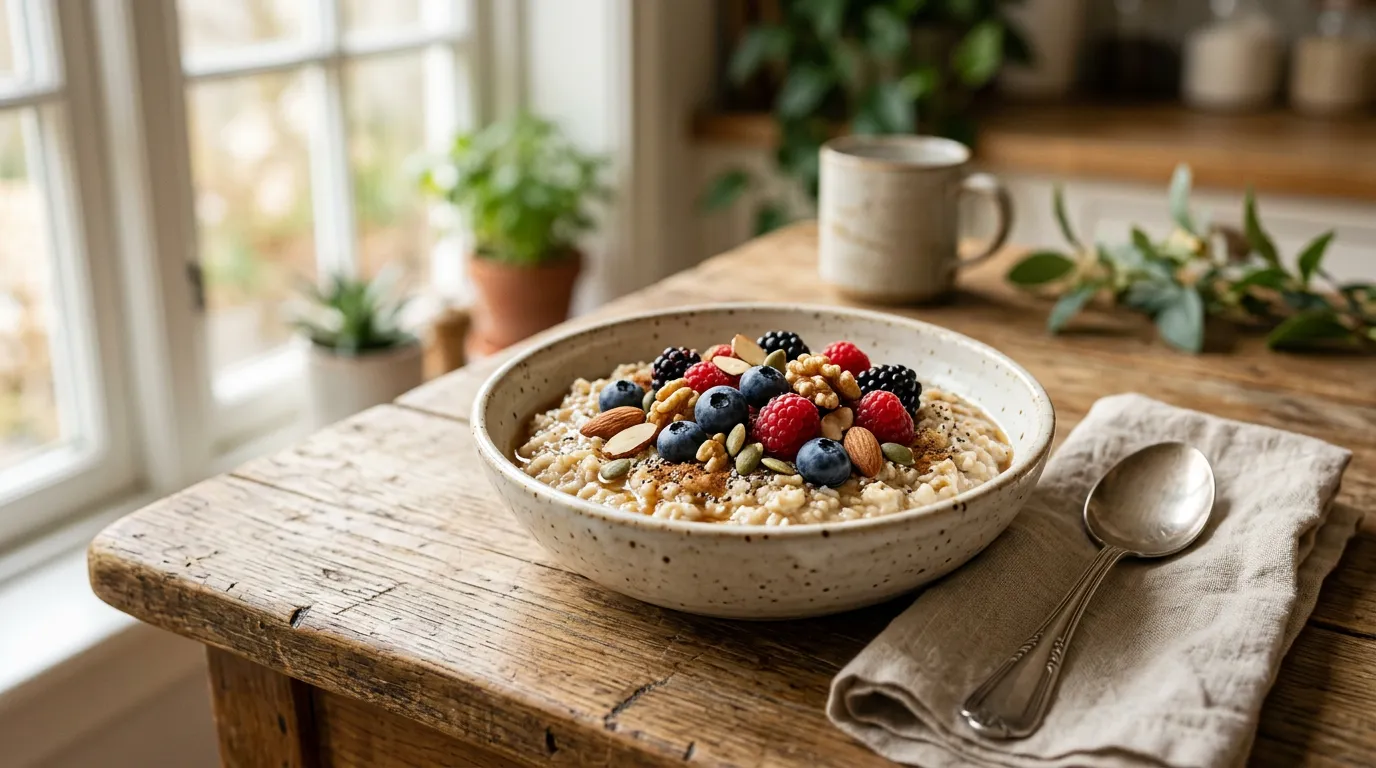
The Best Breakfast for Clear Skin in Your 20s
Forget "eat clean" advice with no specifics. Here's the exact breakfast structure that keeps blood sugar stable and gives your skin what it needs to repair overnight's damage.

Ashwagandha: Its Real Effect on Stress and Training
Ashwagandha gets credited for almost everything. Two claims actually hold up in controlled trials — stress/cortisol and strength/muscle — and they don't have the same evidence behind them. Here's the honest breakdown.

Who Should Never Fast?
Intermittent fasting is safe for most healthy adults — but not for everyone. Here's exactly who should skip it, and why, according to the research.