
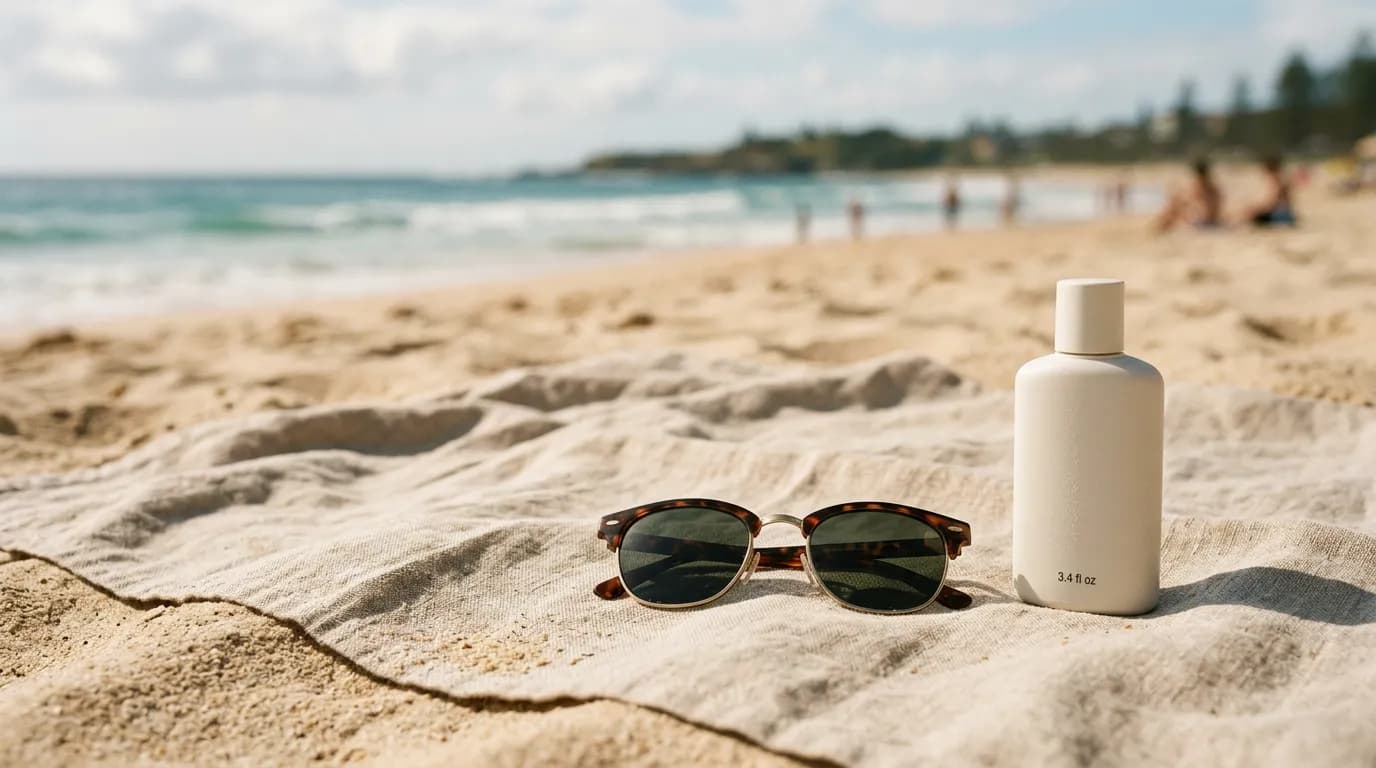
Tanning Beds Before 30: A 75% Higher Cancer Risk
The WHO ranks UV tanning devices alongside tobacco and asbestos, and starting before 30 raises melanoma risk by 75%. Here's the actual classification, the mechanism, and why people keep tanning anyway.
 Damien, founder of HALOIA11 min read
If you've ever stepped into a tanning bed before turning 30, here's the number worth sitting with: it raises your risk of melanoma, the deadliest form of skin cancer, by 75%. That figure isn't from a wellness blog or an ad campaign designed to scare you off it. It comes from the World Health Organization's own cancer research agency, the International Agency for Research on Cancer (IARC), which places UV tanning devices in its highest cancer-risk category, the same tier as tobacco and asbestos. There is no category above it. This isn't about piling on scare tactics. It's about actually understanding what that classification means, why the under-30 window specifically matters more than tanning later in life, what UV light is doing to your skin's DNA in the moment you're getting that glow, why people keep doing it anyway even though the warnings have been public for over a decade, and what the real, science-backed alternative looks like if what you actually wanted was the look, not the risk.
What 'highest cancer-risk category' actually means
IARC sorts everything it evaluates, foods, chemicals, devices, into groups based on the strength of the evidence that it causes cancer in humans. Group 1 is reserved for agents where the evidence is considered conclusive, not suggestive, not correlational, conclusive. Tobacco smoke is Group 1. Asbestos is Group 1. UV-emitting tanning devices have been Group 1 since 2009, when an IARC-convened working group reviewed the accumulated epidemiological data and moved tanning beds up from a lower risk tier after the evidence became strong enough to leave no reasonable doubt. That reclassification came out of a formal review published in The Lancet Oncology, not a press release. It's worth being precise about what Group 1 does and doesn't claim: it doesn't mean tanning beds are exactly as dangerous as tobacco, dose and exposure patterns differ. It means the causal link between exposure and cancer is established with the same level of confidence. That's a materially different statement than "probably raises risk" or "linked to," the language you'll see attached to lower IARC tiers. This is the top of the list.
The WHO's cancer research agency (IARC) classifies UV tanning devices in its highest cancer-risk category, Group 1, the same tier as tobacco and asbestos. Starting artificial UV tanning before age 30 increases melanoma risk by 75%. (El Ghissassi et al., The Lancet Oncology, 2009.)
Why age 30 specifically, not just 'UV exposure in general'
The 75% figure isn't about UV exposure at any point in life, it's specifically about starting before 30. That distinction matters and it's not arbitrary. Skin cell DNA repair capacity is highest earlier in life and gradually declines with age and cumulative sun exposure, but that's only half the story. The bigger factor is time: melanoma often takes decades to develop after the DNA damage that triggers it, so exposure that happens in your teens and twenties has more total years to compound into a diagnosis than exposure that starts at 45. Every tanning session creates mutations in skin cell DNA. Most get repaired or the damaged cell dies off. Some don't, and those survive to divide again, carrying the mutation forward. Start that process at 22 instead of 45, and those surviving mutated cells have an extra two decades to accumulate additional damage, be joined by more, and eventually cross the threshold into a cancerous growth. It's the same logic as smoking: the person who starts at 16 doesn't just have a higher lifetime dose than someone who starts at 35, they also have more of their life left for the damage to develop into disease. Early UV exposure functions less like an isolated event and more like starting a clock that runs for the rest of your life. It's also why the risk isn't distributed evenly across everyone who tans: fair skin, light eyes, a lot of moles, or a family history of melanoma all mean less natural pigment protection, so "I tan easily, I don't burn" doesn't mean you're in the clear, it just means the damage is happening quietly instead of announcing itself.
The mechanism: what UV light actually does to your skin's DNA
The tan itself is the tell. A tan is not a sign of health, a glow, or your skin "adapting." It's a visible damage response. UV radiation, both UVA and UVB, penetrates skin and can be absorbed directly by DNA, causing malformations in its structure called pyrimidine dimers, essentially the DNA strand fusing incorrectly at points where it shouldn't. Your skin's melanocytes respond to this damage by pumping out melanin, the pigment that darkens skin, partly as a defensive reaction to limit further harm. The color change you're chasing is your skin's alarm system going off. When the DNA repair machinery doesn't fully fix these malformations before a cell divides, the errors get copied into new cells. Over enough repetitions, mutations can land in genes that control cell growth, most notably a tumor-suppressor gene called p53 that's frequently found mutated in skin cancers, including melanoma. Once a growth-control gene is damaged, the normal checks that stop a cell from dividing uncontrollably start to fail. That's the mechanical bridge between "got a tan" and "developed a cancerous mole" years later, it's not a metaphor, it's a documented cellular pathway. And this is true of tanning beds specifically, not just excess sun: tanning devices are engineered to deliver UV at higher intensities than natural sunlight to produce a fast, deep tan, which is part of why the epidemiological signal for melanoma is so clear. And none of this requires a burn to happen: the DNA malformations occur at exposure levels well below what causes visible redness, which is exactly why a tan that never turned into a burn can still be doing the same underlying damage.
It's not just melanoma: what the comparison actually says
Melanoma gets the most attention because it's the deadliest form, but it's not the only cancer risk tanning beds raise. Having used a tanning bed at least once in your life is associated with a 67% higher risk of squamous cell carcinoma and a 29% higher risk of basal cell carcinoma than never having used one, in a systematic review and meta-analysis of 12 studies covering 9,328 cases. Those are the two most common skin cancers, generally less lethal than melanoma but far more frequent. Be precise about what that number is: it compares people who ever used indoor tanning with people who never did, across a lifetime, and it is not the measured effect of one single session, which no study has isolated. The same review found the association was stronger among people who started before 25, though the squamous cell estimate in that subgroup was too imprecise to lean on. What it does undercut is the framing of "just a little, just before the wedding, just for the vacation photos": ever having used one at all is exactly what the comparison is built on, and nobody has identified a dose low enough to be a free pass.
Having used a UV tanning bed at least once in your life is associated with a 67% higher risk of squamous cell carcinoma (relative risk 1.67) and a 29% higher risk of basal cell carcinoma (1.29) than never having used one. That's an ever-use versus never-use comparison across a lifetime, not the effect of a single session. (Wehner et al., BMJ, 2012, systematic review and meta-analysis of 12 studies, 9,328 cases.)
The cost you'll see before the one you might not: photoaging
Cancer risk is the headline, but it's not the first bill that comes due, and for a lot of people chasing a tan for appearance reasons, the first bill is the more relevant one. About 80% of visible facial skin aging, wrinkles, dark spots, loss of firmness, is attributed to cumulative UV exposure over the years, not the simple passage of time. That figure comes from one clinical study of 298 Caucasian women aged 30 to 78, with several authors affiliated with L'Oréal, so treat the exact percentage as an order of magnitude, but the direction is not in dispute: sun and UV-bed exposure, not birthdays, are the dominant driver of how old your skin looks. UV breaks down collagen and elastin through a separate mechanism from diet-driven skin aging (like sugar-linked glycation), but the visible result rhymes: looser, less resilient skin, more lines, more uneven pigmentation. The uncomfortable irony here is direct: the tan pursued for a look that reads as healthier or more attractive right now is actively accelerating the changes that read as aged later. It's not a tradeoff between looking good today and being healthy in thirty years, in a meaningful number of cases it's a tradeoff between looking good this month and looking good at 40.
About 80% of visible facial skin aging, wrinkles, spots, loss of firmness, is attributed to cumulative UV exposure over the years rather than the simple passage of time. (Flament et al., Clinical, Cosmetic and Investigational Dermatology, 2013, a single clinical study of 298 Caucasian women aged 30 to 78, with several authors affiliated with L'Oréal.)
Your Appearance Score
What's Your Appearance Score?
60 seconds. Get a score based on your habits.
Why people keep doing it anyway, despite knowing all this
None of this information is new or hidden. Tanning beds have carried cancer warnings for years, the Group 1 classification is over a decade old, and most people who use tanning beds can tell you, roughly, that it's "not great for you." So why does usage persist, especially among people under 30, the exact group the data says is most at risk? Research on actual motivation gives a clear answer, and it's not that people don't believe the risk exists, it's that the risk isn't what's driving the decision. Among a group of 321 American college students surveyed on tanning bed use, improved looks and a boost in perceived self-confidence ranked as the top motivations, well ahead of relaxation or any health-related reasoning. That tracks with how most risky beauty behaviors actually work: the payoff (looking a certain way, feeling more confident walking into a room, a specific event coming up) is immediate and vivid, while the cost is probabilistic and years away. Your brain is not well wired to weigh "a real but delayed and uncertain health risk" against "a photo-ready tan by Friday" in the way a spreadsheet would. That's not a character flaw, it's a predictable pattern, and understanding it matters more than moralizing about it, because the actual fix isn't "try harder to care about long-term risk," it's removing the tradeoff entirely. Social platforms amplify the same bias: a tanned photo gets posted and liked in real time, while the cancer-risk data lives in a study most people will never open, and the tanning industry has spent decades marketing indoor UV as "controlled" or "safer than the sun," language with no real basis given that indoor intensity often exceeds midday summer sun.
The main driver for tanning bed use isn't health, it's appearance and perceived self-confidence: among 321 American students surveyed, improved looks and a confidence boost ranked as the top motivations for going. (Newton et al., International Journal of Women's Dermatology, 2024.)
There's also no such thing as a protective 'base tan'
One persistent justification deserves to be named directly because it's still repeated as if it were established fact: the idea that getting a "base tan" before a sunny vacation protects your skin from a worse burn later. It's a myth, and it's a myth built on the same mechanism this article has already walked through. A base tan is DNA damage that's already happened, wearing the visible evidence of it as color. The sun protection factor of an actual tan tops out at roughly 3 to 4, far below the SPF 30 or higher that dermatologists recommend, meaning a base tan offers a thin, inadequate buffer while having already extracted its cost in mutated skin cells. You're not banking protection, you're pre-paying in damage for a small and unreliable discount on future damage. If the actual goal is avoiding a painful burn on vacation, broad-spectrum sunscreen, reapplied properly, does that job without the tradeoff a tanning bed session bakes in first.
The alternative that actually works: sunless tanner
Here's the part that makes the whole tradeoff unnecessary: if the actual goal was always the look, a tan, without the health cost, that already exists and it's well understood. Sunless tanner, the kind based on DHA (dihydroxyacetone), is a safe alternative to UV tanning for getting a tanned look, because it works through a completely different mechanism. DHA reacts with amino acids in the outermost, already-dead layer of skin cells to produce a color change, similar to the browning reaction that happens when you cut an apple and it's left exposed to air. It doesn't penetrate to living cells, and it doesn't cause the DNA damage that UV does, because there's no UV involved at all. The FDA's only official caution on it is narrow and practical: avoid contact with lips, nose, and eyes, and don't inhale it during spray-tan sessions, which is a mucous-membrane and inhalation precaution, not a cancer-risk warning. That's a meaningfully different risk profile than a device IARC has classified alongside tobacco. In practice, that means: exfoliate before application so the color goes on evenly instead of blotchy, moisturize dry areas like elbows and knees first since they absorb DHA faster and can go darker than the rest of your skin, and wash your hands right after applying so your palms don't develop the telltale orange tint. It won't tan skin that isn't exposed to it and it fades over about a week rather than lasting all summer, which are real limitations, but they're cosmetic inconveniences, not health tradeoffs.
Sunless tanner (DHA-based) is a safe alternative to UV tanning for a tanned look, since it doesn't cause the DNA damage UV does. The FDA's only official caution is to avoid contact with lips, nose and eyes, and not inhale it during spray-tan sessions. (U.S. Food and Drug Administration.)
- Exfoliate 24 hours before applying, dead, flaky skin absorbs DHA unevenly and causes patchiness.
- Moisturize elbows, knees, and ankles first, these dry areas grab pigment fastest and can go noticeably darker than the rest of your skin.
- Apply in circular motions and wash your palms immediately after, this is the single biggest fix for the orange-hands giveaway.
- Wait at least a full workout or shower cycle after application before sweating heavily, DHA needs several hours to fully develop.
- Reapply every 5-7 days rather than layering daily, color builds unevenly if you add fresh product before the last layer has faded.
None of this requires treating a tan as some kind of moral failure, or pretending the appeal isn't real. Wanting to look a certain way, more confident, more put-together, more like the version of yourself you feel best in, is a completely normal thing to want, and it's exactly the kind of goal worth taking seriously rather than dismissing. What the data actually argues for isn't giving up on the look, it's routing the same goal through a path that doesn't quietly compound risk in the background for twenty years. That's the same principle behind how HALOIA approaches appearance more broadly: the changes that actually move how you look and feel, in skin, physique, energy, come from consistent, trackable habits, not high-risk shortcuts that trade a short-term result for a long-term cost you won't see the bill for until much later. If you're working on how you look and want a clear, current read on where your skin, habits, and routine actually stand right now, HALOIA's free appearance quiz is a faster starting point than guessing.
This article is for information only and is not a substitute for medical advice. For any question about your health, a treatment or a supplement, consult a qualified professional.
Improve your appearance by eating better
Build real confidence by tracking your diet. Download HALOIA and start your tracking.

Go further
The 4 Real Causes of Facial Water Retention
Puffy face again? There are only four real culprits, and they leave different clues. Here's how to tell them apart instead of guessing.

Text Neck: The Real Risk of Your Phone
Your head weighs about 5kg. Tilt it forward to check your phone and your neck can end up carrying nearly 27kg instead — the weight of an 8-year-old, hanging off your cervical spine for hours a day.
Leg Lengthening Surgery: Cost and Risks
It's a real orthopedic procedure, not a shortcut: a bone is surgically cut and pulled apart by about a millimeter a day. Here's what it actually costs, what can go wrong, and what's worth trying before you get anywhere near an operating table.