
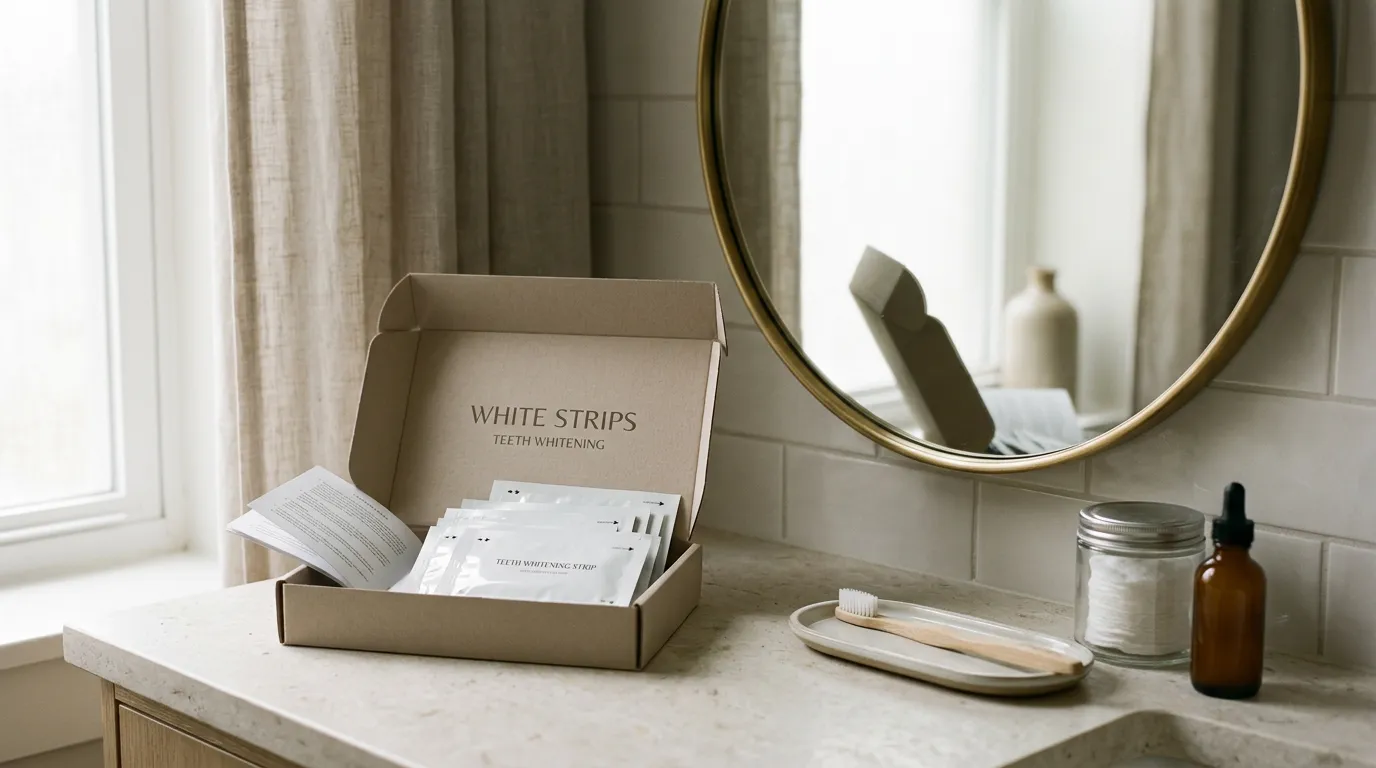
Whitening Strips: What They Do to Your Teeth
Whitening strips aren't magic and they aren't a myth either. Here's the actual mechanism, what to expect week by week, and what the research says about safety.
 Damien, founder of HALOIA11 min read
Whitening strips work through a genuinely simple mechanism: a thin layer of hydrogen peroxide gel sits against your enamel for a set number of minutes, oxidizes the pigmented molecules causing discoloration, and lightens the actual color of your teeth from within the enamel, not just the surface. The most rigorously tested version of this, Crest Whitestrips at 6% hydrogen peroxide, produces visible whitening starting in the first week of twice-daily 30-minute use, with roughly 1 in 5 users getting mild, temporary sensitivity or irritation and under 1% quitting because of it. That's the actual clinical data, not marketing. Whitening strips also sit in a strange spot in most people's routines: cheap enough to buy on impulse, but chemical enough that skipping the fine print is a bad idea. Here's the mechanism behind it, what to expect week by week, who should be cautious, and how it stacks up against paying a dentist to do it for you.
How hydrogen peroxide actually whitens your teeth
Your tooth color comes from two layers working together: a translucent outer layer of enamel and a naturally yellower layer of dentin underneath it. Enamel isn't solid — it's a porous, crystalline structure with microscopic channels running through it, and over years those channels pick up stain molecules from coffee, tea, wine, and everyday food pigments, plus some staining that builds up from the inside as the tooth ages. Whitening strips work by getting hydrogen peroxide gel into direct, sustained contact with that porous surface. The peroxide breaks down into free radicals that chemically split apart the large, colored stain molecules into smaller, colorless ones. That's an oxidation reaction, not a cleaning or polishing action — it's a fundamentally different mechanism from brushing, scrubbing, or eating crunchy foods, none of which can reach stain sitting inside the enamel structure itself. This is also why whitening takes repeated daily sessions rather than a single treatment: each application only oxidizes the stain the peroxide can physically reach in that window, and getting to the stain deeper in the enamel takes cumulative exposure over days. It's also why results vary from person to person even on the exact same product: enamel thickness, how porous it is, and how much stain has actually built up over the years all change how much the peroxide has to work through and how fast the color shift becomes visible.
Week by week: what the clinical data actually shows
The standard tested protocol for 6% hydrogen peroxide strips is 30 minutes, twice a day, for two weeks — not a one-time treatment, and not something you keep going indefinitely by default. In the trial that established this protocol, participants saw a measurable, statistically significant color change starting after just the first week of use, with further improvement through the second week. That timeline matters because it sets realistic expectations: whitening strips are not an overnight fix, and anyone expecting a dramatic change after two or three applications is comparing themselves to a marketing photo, not the actual data. The visible change is gradual and cumulative, shade by shade, which is also part of why it tends to look natural rather than obviously "done."
Crest Whitestrips at 6% hydrogen peroxide, used 30 minutes twice daily for 2 weeks, progressively whiten teeth starting from week 1. About 1 in 5 users get mild irritation or sensitivity, almost always temporary — under 1% of users discontinue because of it. (Source: Gerlach et al., Journal of Dentistry, 2009)
Side effects: sensitivity and irritation, by the actual numbers
The two side effects that show up in essentially every whitening-strip trial are tooth sensitivity (a sharp, brief reaction to cold or air) and gum irritation (mild redness or tenderness where the strip's gel touches soft tissue). Both are well documented, both are common enough that you should expect at least a mild version of one of them, and both are, for the overwhelming majority of users, temporary — resolving within days of stopping or reducing use. That's a real trade-off, not a reason to panic: roughly 1 in 5 users on a standard 6% strip notice something, and fewer than 1 in 100 find it bad enough to stop entirely. Where it gets more relevant is at higher concentrations, where the gap widens noticeably.
Comparing whitening strip concentrations directly, 9.5% hydrogen peroxide produced more whitening than 6.5%, but also more side effects: 62% of users reported irritation or sensitivity at the higher concentration, versus 53% at the lower one. More peroxide means more whitening and more discomfort, in roughly the same proportion. (Source: Donly et al., American Journal of Dentistry, 2010)
Stronger isn't automatically better: the concentration trade-off
It's tempting to assume a stronger gel gets you to the same result faster with less hassle, but the research doesn't support that shortcut. A 2025 pooled analysis of 32 studies found that a low-concentration carbamide peroxide gel, around 10%, carries roughly a 67% lower risk of sensitivity than a strong one at 20-22%, for comparable whitening results overall. In practice, that means the smarter default for most people isn't the highest-percentage product on the shelf — it's a lower concentration used consistently over the full recommended course, which gets you most of the color change with a fraction of the discomfort. Save the stronger formulas for situations where you specifically need a faster result and are willing to trade comfort for speed, like a deadline before an event, rather than as a everyday default.
A low-concentration carbamide peroxide gel (around 10%) carries about 67% lower sensitivity risk than a strong one (20-22%), for comparable whitening results. Stronger isn't automatically better — it's a different point on the same efficacy-versus-comfort curve. (Source: Cordeiro et al., Japanese Dental Science Review, 2025)
Who should think twice before whitening
None of this means whitening strips are risky for most people — the data above says the opposite. But "low risk for most people" isn't the same as "no reason to check first," and a few groups get a meaningfully different risk-benefit trade-off than the general population the trials were mostly run on.
- Anyone with active gum inflammation or untreated periodontal disease: gum tissue that's already irritated or receding is more likely to react to direct peroxide contact, and about 46% of U.S. adults over 30 have some form of periodontal disease, often without realizing it since it's frequently silent early on. If your gums bleed regularly when you brush or floss, get that checked before starting a whitening course, not after.
- Anyone with existing tooth sensitivity: strips add a second source of sensitivity on top of whatever's already there. Starting with a lower concentration, shorter sessions, or every-other-day use is a reasonable way to test your tolerance before committing to the full two-week course.
- Anyone with visible dental work in their smile: crowns, veneers, bonding, and fillings don't change color with peroxide the way natural enamel does. Whitening around them can leave your natural teeth several shades lighter than the restoration, creating a visible mismatch that then needs a separate fix.
- Pregnant or nursing users: whitening-strip trials generally don't include this group, so there isn't dedicated safety data to point to either way. The standard, conservative dental guidance is to wait until after pregnancy and breastfeeding rather than assume it's fine by default.
Your Appearance Score
What's Your Appearance Score?
60 seconds. Get a score based on your habits.
Strips vs. professional whitening: how they actually compare
The instinct that an in-office treatment must be the stronger, more effective option turns out to be only half right. In-office whitening does apply a supervised, often higher-concentration gel, sometimes paired with a UV or LED light marketed as accelerating the process — most of the actual whitening credit still goes to the peroxide, not the light itself. But when researchers pooled the results across studies comparing the two approaches directly, the at-home tray-and-gel method came out ahead on comfort without giving up effectiveness.
At-home tooth whitening (tray plus gel) causes significantly less tooth sensitivity than in-office whitening, for an equal or better result, according to a pooled analysis of 32 studies. (Source: de Geus et al., Operative Dentistry, 2025)
That's a real, if slightly counterintuitive, finding: paying more and sitting in a dentist's chair doesn't automatically buy you a better outcome, and it may buy you more discomfort along the way. Where in-office treatment does still make sense is for people who want the fastest possible result under professional supervision, or who have a dental history complicated enough that a dentist should be managing the process directly rather than a strip out of a box.
Do peroxide-free "natural" alternatives actually work?
Charcoal toothpaste, baking-soda pastes, and peroxide-free "whitening" strips get marketed as gentler alternatives, but the direct comparison isn't close. In a controlled double-blind trial, classic peroxide strips produced a measurable color improvement, while a full peroxide-free routine — strips, toothpaste, and mouthwash from the same product line, marketed the same way — showed no significant change at all over the same period.
In a double-blind trial, classic peroxide strips produced measurable color improvement, while a peroxide-free "natural" routine (strips, toothpaste, mouthwash) showed no significant change. Peroxide remains the ingredient that actually whitens. (Source: Gurich et al., American Journal of Dentistry, 2023)
That result lines up with the mechanism explained earlier: whitening requires an oxidation reaction that breaks apart stain molecules inside the enamel, and nothing about brushing harder, adding abrasive charcoal particles, or rinsing with a peroxide-free mouthwash can replicate that chemistry. Abrasive "natural" pastes can even work against you, since enamel doesn't regenerate — repeated mechanical scrubbing wears the surface down rather than changing its color, which can eventually expose more of the yellower dentin underneath.
Is long-term daily use actually safe?
Given that peroxide is genuinely doing chemistry to your enamel, it's reasonable to wonder whether using it continuously, well past the standard two-week course, causes cumulative damage. A controlled trial specifically tested this by having participants use 6% hydrogen peroxide strips daily for a full 12 months, and found no major safety signal over that period. That's reassuring, but it doesn't mean daily use for a year is actually a good idea — it just means the ceiling on safety is higher than most people assume. The practical limit isn't a hidden danger; it's that whitening has a natural stopping point. Once your enamel's shade stabilizes, there's no more stain left for the peroxide to oxidize, and continuing to whiten past that point buys you sensitivity risk with no additional visible benefit.
Continuous daily use of 6% hydrogen peroxide strips for a full 12 months showed no major safety signal in a controlled trial. The real limit to prolonging whitening isn't a proven danger — it's the lack of extra benefit once the shade has stabilized. (Source: Journal of Dentistry, 12-month controlled trial, 2008)
In practice, that translates into a simple rule: run the full two-week course, stop, and only repeat it every few months for touch-ups as new staining accumulates from coffee, tea, or wine, rather than treating strips as a daily habit indefinitely. If you notice zero further shade change after a course, that's your enamel telling you the reaction has nothing left to work on, not a sign you need a stronger product.
Put together, the honest picture is this: whitening strips are one of the few appearance products where the marketing and the clinical data actually agree with each other. A 6% hydrogen peroxide strip, used exactly as directed for two weeks, produces real, measurable whitening starting in week one, with side effects that are common but almost always mild and temporary. The mistakes people make are reaching for the strongest formula by default, skipping a dental check when their gums are already inflamed, or treating strips as a forever-habit instead of a periodic touch-up. None of that requires guesswork — the studies behind these numbers already ran the experiment so you don't have to: follow the tested protocol, pick your concentration based on your own sensitivity rather than the biggest number on the box, and give it the full two weeks before deciding whether it worked. Whitening is one visible piece of a bigger picture your daily habits quietly shape — sleep, hydration, what you eat and drink, and yes, what stains or protects your enamel along the way. That's the same pattern HALOIA's appearance tracking is built around: instead of guessing which habit is actually moving the needle on how you look, you log what you're really doing and see what changes and what doesn't. If you want a quick starting point before trying anything, HALOIA's free appearance quiz gives you a baseline read on your skin, habits, and overall look before you change a thing.
This article is for information only and is not a substitute for medical advice. For any question about your health, a treatment or a supplement, consult a qualified professional.
Improve your appearance by eating better
Build real confidence by tracking your diet. Download HALOIA and start your tracking.

Go further
The 4 Real Causes of Facial Water Retention
Puffy face again? There are only four real culprits, and they leave different clues. Here's how to tell them apart instead of guessing.

Text Neck: The Real Risk of Your Phone
Your head weighs about 5kg. Tilt it forward to check your phone and your neck can end up carrying nearly 27kg instead — the weight of an 8-year-old, hanging off your cervical spine for hours a day.

Leg Lengthening Surgery: Cost and Risks
It's a real orthopedic procedure, not a shortcut: a bone is surgically cut and pulled apart by about a millimeter a day. Here's what it actually costs, what can go wrong, and what's worth trying before you get anywhere near an operating table.