
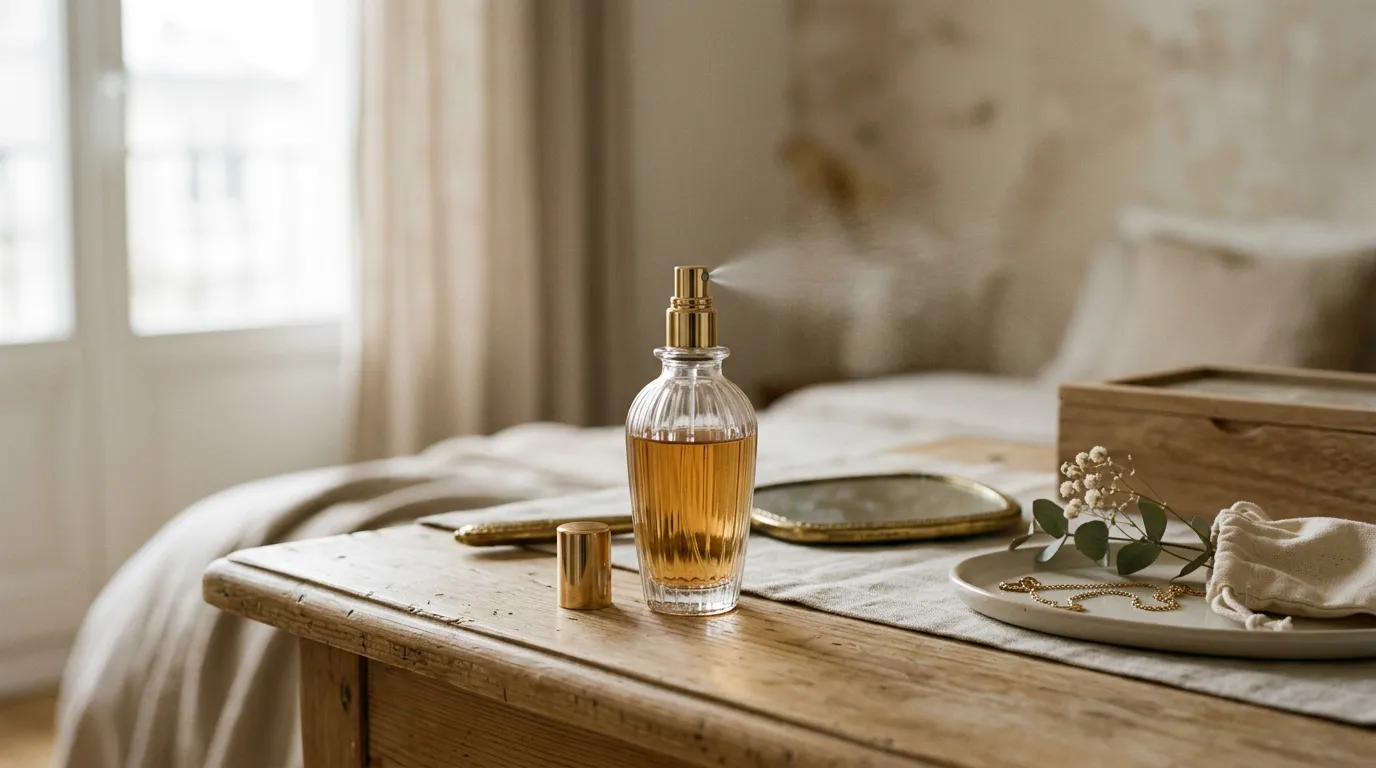
Where to Apply Perfume So It Lasts
You've probably been spraying perfume in the wrong place, then quietly ruining what's left by rubbing your wrists together. Here's where it actually belongs, and the small habits that make a bottle last.
 Damien, founder of HALOIA10 min read
Where you spray perfume matters almost as much as which bottle you bought. The short answer: pulse points — the neck, inner wrists, behind the ears, inner elbows, and behind the knees — where blood runs closer to the skin's surface and body heat naturally lifts the scent throughout the day. But the how matters just as much as the where: apply to moisturized skin rather than dry skin, never rub your wrists together after spraying, and don't judge a fragrance off a paper test strip in a store. Your own skin chemistry — its pH, its oil level — quietly rewrites how a fragrance develops on you, which is part of why the same bottle smells different on you than on a friend. None of this is folklore; it's a handful of mechanisms perfumers and dermatologists point to again and again, and once you know them, most "why doesn't my perfume last" complaints solve themselves.
Why pulse points aren't just a beauty myth
The advice to apply perfume to your pulse points isn't a marketing invention — it's about basic physiology. At the neck, inner wrists, behind the ears, inner elbows, and behind the knees, blood vessels run closer to the surface of the skin, which means slightly more warmth radiates off those spots compared to the rest of your body. Fragrance is a chemistry problem before it's an aesthetic one: scent molecules need heat to evaporate and release into the air, which is literally how you and everyone around you perceive them. A cooler patch of skin holds onto those molecules longer without releasing them, so you end up wearing a perfume that's technically still there but not actually doing anything. Warmer skin does the opposite — it acts like a low, steady engine that keeps releasing the fragrance gradually across the day instead of dumping it all in the first twenty minutes.
- Neck — one of the warmest, most exposed points, and close to where most people (and most noses) end up during a conversation or a hug.
- Inner wrists — easy to reach for reapplication, though never rub them together (more on why below).
- Behind the ears — subtle, close-range diffusion, good for a scent you want to notice more than others do.
- Inner elbows — often skipped, but a genuinely warm spot with good, slow release.
- Behind the knees — underrated for a scent that rises gently as your body warms up over the day.
Body temperature doesn't just control how much scent comes off your skin, it also changes which part of the fragrance you smell first. Warmer skin speeds up evaporation and intensifies base notes in particular — the deep, long-lasting compounds like musk, amber, and vanilla that are usually the last third of the fragrance to show up. That's a big part of why the same bottle can smell brighter and more citrusy on someone with cooler skin, and warmer and heavier on someone running hot. Spraying on pulse points isn't about looking like you know what you're doing — it's the one placement decision that actually changes the physics of how the scent leaves your skin.
Your skin's pH decides how the scent unfolds
Skin isn't neutral ground — it's naturally slightly acidic, typically sitting somewhere between pH 4.5 and 5.5, and that acidity acts almost like a filter on top of whatever you spray on it. On more acidic skin, the top notes of a fragrance (the bright, citrusy, herbal opening you smell in the first few minutes) get sharpened and sped through faster, so the fragrance moves toward its heart and base sooner than the bottle's official notes might suggest. On skin closer to neutral, those same top notes get softened, and the whole progression stretches out more gently. Neither version is wrong or broken — it's simply your own skin chemistry doing what it always does, which is one of the real reasons the exact same bottle can smell noticeably different from one person to the next, even standing in the same room.
Skin sits at a naturally acidic pH of roughly 4.5 to 5.5. More acidic skin sharpens and speeds up a fragrance's top notes; more neutral skin softens them and pushes the scent toward its base faster — a primary reason the same perfume never smells identical on two people (The Essence Vault, skin chemistry and fragrance).
Skin oil level plays a similar role, working alongside pH rather than instead of it. Oily skin holds fragrance noticeably longer than dry skin: sebum forms a thin lipid film that traps scent molecules and lets them go gradually instead of all at once, which is functionally what a good longevity spray tries to fake with polymers. Dry skin has none of that cushioning, so the same spritz evaporates faster and the fragrance's whole timeline compresses — a scent rated for eight hours might genuinely wear closer to four or five on very dry skin with nothing underneath it. This isn't a flaw you need to fix with more perfume. It's the actual reason the next trick works as well as it does.
The unscented moisturizer trick that buys you hours
If dry skin burns through fragrance faster because there's nothing to hold the scent molecules in place, the fix is straightforward: give it something to hold onto. Applying an unscented, fragrance-free moisturizer before you spray creates a slightly oily base on the skin that slows the evaporation of those molecules, essentially borrowing the same mechanism that makes oily skin naturally better at holding a scent. This isn't a folk hack passed around online — it's a recognized technique among perfumers and fragrance professionals specifically for stretching wear time, especially in dry climates, in winter, or on skin that's naturally on the drier side. The moisturizer has to be unscented, though; a scented lotion layered under a fragrance muddies both and can throw off the whole composition, turning a clean citrus opening into something that smells vaguely soapy instead.
Applying an unscented moisturizer before spraying perfume creates a slightly oily base that slows evaporation of scent molecules and can add 2 to 3 hours of wear, especially on dry skin — a recognized professional technique (Scento, fragrance longevity techniques).
In practice, this means the ten seconds you spend moisturizing right after a shower are doing double duty: skin barrier maintenance, and a longer-lasting fragrance later that day. You don't need a thick layer, just enough that the skin isn't tight or visibly dry when you spray. If you're someone who reapplies perfume by early afternoon no matter what you're wearing, this single change — plain, unscented moisturizer first — is worth testing before you assume the bottle itself is the problem.
Why rubbing your wrists together ruins the scent
This is the single most common mistake, and it happens almost automatically: spray both wrists, then rub them together like you're warming your hands. It feels like it should help distribute the fragrance evenly. It does the opposite. The friction from rubbing mechanically breaks down the most fragile scent molecules — the top notes, which are the lightest, most volatile part of the fragrance and the first thing you and everyone else smell. Crushing them through friction speeds up their degradation, so instead of a clean, bright opening that gradually settles into the heart notes over twenty to thirty minutes, you get a flattened, sometimes slightly "off" version of the fragrance that skips straight past the part it was designed to lead with.
The correct move is almost annoyingly simple: spray and let it air-dry. No rubbing, no fanning it with your hand, no patting it in. If you've sprayed one wrist and the amount feels uneven, apply directly to the second wrist rather than trying to transfer scent from one to the other by rubbing them together. It costs nothing and it's the easiest fix on this entire list — you're just removing a habit, not adding a step.
Your Appearance Score
What's Your Appearance Score?
60 seconds. Get a score based on your habits.
Skip the paper strip, test it on skin
Smelling a fragrance off a paper blotter in a store and deciding whether to buy it is one of the most common ways people end up with a bottle they regret. Paper doesn't have a pH, doesn't produce heat, and doesn't have any of the oils that skin does — all three of which genuinely transform how a fragrance smells once it's actually on you. A scent that reads sharp and simple on a strip can turn warmer, sweeter, or completely different once your own skin chemistry gets involved, in either direction. The blotter is useful for a first, rough impression across a dozen fragrances in a few minutes, nothing more.
A fragrance tested on a paper blotter never smells exactly like it does on skin, which genuinely transforms the composition through body temperature, pH, and skin oils. The professional standard is to test on skin and wait 30 minutes to an hour before judging it — not to decide from a quick sniff of the blotter in-store (Fragrance Familia).
Once you've narrowed things down with the blotter, spray your actual candidates on a pulse point and give it real time. The first few minutes are almost never representative — that's the volatile top notes doing their brief opening act. What you're smelling at the thirty- to sixty-minute mark, once the heart notes have taken over, is much closer to what you'll actually be wearing for the rest of the day, and it's the only fair way to judge whether a fragrance is genuinely for you.
Why you stop smelling your own perfume by noon
If you've ever sprayed perfume in the morning and, by lunchtime, become convinced it's completely worn off — only for a coworker to mention how nice you smell — you've experienced olfactory fatigue, and it's not a sign the fragrance is gone. It's a normal, well-documented phenomenon: your brain gets used to processing a constant, familiar smell and essentially stops flagging it to your conscious attention, the same way you stop noticing your own home's smell but a visitor picks up on it instantly. The scent molecules are almost always still there, doing exactly what they were designed to do; your nose has simply filed the input as "not new information" and moved on.
The practical trap here is reapplying because you can't smell it anymore. Doing that changes nothing for your own perception — your brain will adapt to the reapplied scent within minutes, the same way it did the first time — but it does noticeably change how much fragrance the people around you are getting, often past the point of pleasant. Fragrance overload from repeated same-day reapplication is a far more common complaint from people nearby than any actual allergic reaction: genuine contact allergies to fragrance are rare, affecting fewer than 3% of people, thanks to strict industry safety standards on ingredient concentration. So the real risk of "topping up" isn't usually a health one, it's a social one. If you genuinely want to check how strong you're wearing something, ask someone else rather than trusting your own nose by the afternoon — theirs hasn't adapted the way yours has.
True contact allergies to fragrance are rare: fewer than 3% of people develop one, a figure kept low by strict industry safety standards on ingredient concentration (IFRA, the International Fragrance Association).
Storage mistakes that quietly kill a bottle
Everything above assumes the perfume in the bottle is still behaving the way it did the day you bought it — which isn't guaranteed if it's been sitting somewhere it shouldn't. The single most common mistake is storing perfume in the bathroom, which feels convenient but is close to the worst place for it: the humidity and heat swings from hot showers can degrade the formula in as little as three to six months, throwing off both the scent and, eventually, its color. Light is the other quiet killer, UV in particular, which chemically breaks down scent molecules over time and can shift both smell and color — the reason most perfume bottles come in tinted glass in the first place, and why the original box isn't just packaging to throw away.
- Keep it between roughly 13-21°C (55-70°F) — a bedroom drawer or closet shelf, not a bathroom cabinet or a car.
- Keep it out of direct light, ideally back in its original box, especially if it's a clear or lightly tinted bottle.
- Keep the cap on tightly between uses to limit air exposure, which speeds up the same degradation process as heat and light.
None of this requires buying anything new — it's a five-minute relocation from a bathroom shelf to a bedroom drawer. But it explains a fairly common complaint: a bottle that smelled great for the first year and then started smelling "off" or thinner usually wasn't a bad batch, it was six months of steam and light quietly doing their work.
What all of this really comes down to is that a fragrance never performs in isolation from your actual skin — its temperature, its pH, how much oil and hydration it's holding are the same variables that decide how long a scent lasts on you specifically, not just what's printed on the bottle. Those are largely the same skin fundamentals — hydration, oil balance, what you're feeding your skin from the inside — that HALOIA already tracks day to day through your real meals, not just your skincare shelf.
If you're curious where your own skin and habits currently stand before you start troubleshooting anything — fragrance included — HALOIA's free appearance quiz gives you a baseline read in a couple of minutes.
This article is for information only and is not a substitute for medical advice. For any question about your health, a treatment or a supplement, consult a qualified professional.
Improve your appearance by eating better
Build real confidence by tracking your diet. Download HALOIA and start your tracking.

Go further
The 4 Real Causes of Facial Water Retention
Puffy face again? There are only four real culprits, and they leave different clues. Here's how to tell them apart instead of guessing.

Text Neck: The Real Risk of Your Phone
Your head weighs about 5kg. Tilt it forward to check your phone and your neck can end up carrying nearly 27kg instead — the weight of an 8-year-old, hanging off your cervical spine for hours a day.
Leg Lengthening Surgery: Cost and Risks
It's a real orthopedic procedure, not a shortcut: a bone is surgically cut and pulled apart by about a millimeter a day. Here's what it actually costs, what can go wrong, and what's worth trying before you get anywhere near an operating table.