
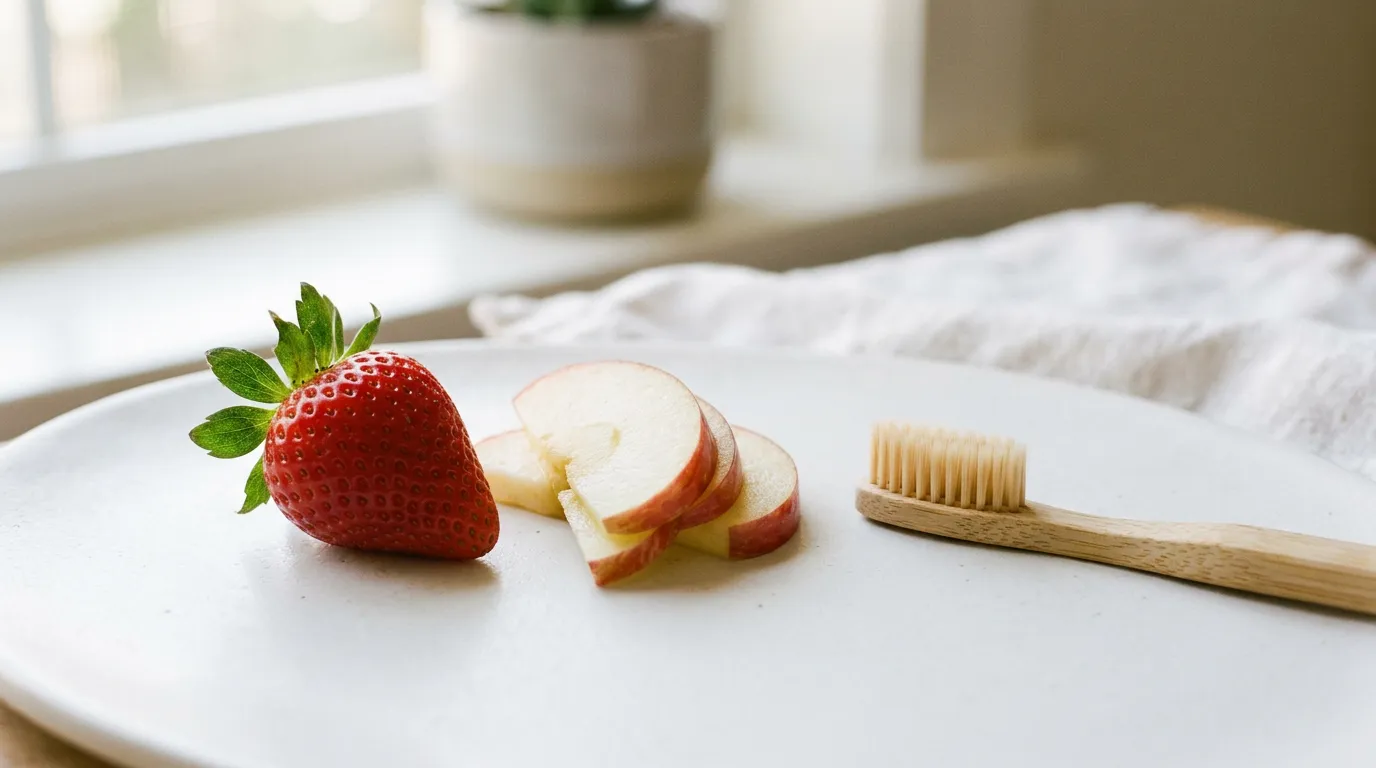
Teeth-Whitening Foods: A Real Myth?
Rubbing strawberries on your teeth or crunching an apple after dinner feels like a whitening hack. Here's what the actual research says these foods do — and what genuinely works instead.
 Damien, founder of HALOIA11 min read
Short answer: no, not the way people mean it. Rubbing a strawberry on your teeth or eating an apple after dinner doesn't bleach your enamel — dental research is pretty clear on that. What these foods actually do is mechanically wipe away some of the loose surface debris sitting on your teeth while you chew, which can make them look a shade brighter for a few hours. That's a real, physical effect. It's just a different mechanism entirely from what a peroxide-based whitening product does, which is why the two get compared as if they're competing methods when they're not really doing the same job. Here's what the studies actually say these foods are doing, which foods are quietly working against you instead, and what closes the real gap.
Why the "whitening foods" myth won't die
Every few months the same claim resurfaces on social media: rub a strawberry on your teeth, eat a crunchy apple a day, chew celery after every meal, and you'll bleach your smile without ever seeing a dentist. It's usually pitched as a "natural" alternative to peroxide strips or professional whitening, which is part of why it spreads so easily — "natural" reads as safer and cheaper, and nobody wants to be talked into a product they don't need.
The claim survives because it isn't entirely invented — it's a real effect stretched past what it can actually do. The kernel of truth is texture, not chemistry. Crunchy, fibrous foods create friction against your teeth as you chew, and that friction, combined with the extra saliva your mouth produces to break the food down, does physically remove some of the loose film sitting on your enamel: plaque, food particles, a bit of surface pigment. What it doesn't do is change the color of the enamel itself, which is where your baseline tooth shade actually comes from — and that's the part the myth quietly skips over.
It also tends to get lumped together with other loosely related claims — oil pulling, "alkaline" diets, baking-soda pastes — all sold on the same logic that something cheap and food-based must be doing chemically what a dental product does. None of them have shown a chemical whitening effect in controlled testing; at best, a few work the same mechanical angle as crunchy fruit, just less efficiently.
What crunchy foods actually do to your teeth
Enamel is the hard, translucent outer layer of your tooth, and underneath it sits dentin, which is naturally more yellow. What you see when you look at your teeth is a combination of both — a translucent white layer over a yellower one. Real whitening changes the pigment within or on top of that enamel layer. Crunchy foods don't do that. What they do is closer to light polishing: friction plus saliva flow, working only on the very outer surface, with no bleaching compound involved at all.
- Apples and pears: their fibrous texture and high water content boost saliva flow, which helps rinse away loose debris as you chew — though the fruit's own acidity works slightly against you at the same time (more on that below).
- Celery and carrots: firmer and less acidic than apples, so you get a similar mechanical cleaning effect with less of the acid trade-off.
- Cheese and other dairy: not abrasive at all, but it raises the pH in your mouth after a meal, helping neutralize acids that soften enamel — a genuinely useful habit, just not a whitening one.
- Plain water: rinsing after coffee, tea, or acidic foods reduces how long staining compounds and acids sit on your enamel. Arguably the single most underrated "whitening food" isn't a food at all.
A 2023 systematic review of 11 lab studies on activated-charcoal toothpaste — built on this exact idea of mechanical whitening — found it whitened no better than a conventional toothpaste, and was consistently more abrasive to enamel. That's the same mechanism people credit to crunchy foods, just concentrated into a paste and repeated twice a day. (Source: Annals of Anatomy, 2023)
That charcoal finding matters here because it's the closest lab-tested proxy we have for the "abrasive natural whitener" category foods get filed under. If a purpose-built abrasive paste can't out-whiten a normal toothpaste, an apple — which is far less abrasive and on your teeth for a few minutes at most — was never going to bleach anything either.
The acid trade-off nobody mentions
Here's the part that rarely makes it into the "eat this for whiter teeth" posts: most of the fruits credited with whitening are also acidic. Apples, strawberries, citrus — all of them lower the pH in your mouth for a stretch after you eat them, and that acidity temporarily softens the outer layer of enamel.
Softened enamel is more porous, which means it's briefly easier to stain and to wear down through brushing or further friction. So the same bite of strawberry that mechanically buffs away a little surface pigment is also, for the next 20 to 30 minutes or so, leaving your enamel in a slightly more vulnerable state. Neither effect is dramatic from one piece of fruit. The problem is habits built specifically around this myth — rubbing fruit directly against your teeth, or brushing right after eating something acidic — which scrubs a softened surface instead of a hardened one, over and over.
Dose matters more than any single exposure. An apple a few times a week, eaten normally, isn't a risk to your enamel — dentists see erosion from daily, prolonged exposure (constant snacking on citrus, sipping acidic drinks over hours), not from the occasional piece of fruit. It's the deliberate "rub it on your teeth and let it sit" version of the myth that turns a neutral food into a mild, repeated acid exposure with no whitening payoff to show for it.
The fix isn't avoiding these foods. It's simple sequencing: eat the fruit, then wait 20-30 minutes (or rinse with water) before brushing, and skip the direct-rubbing habit entirely.
The foods quietly staining your teeth
While apples get credit they haven't fully earned, other foods and drinks are doing the opposite — actively depositing color onto enamel, meal after meal, with no myth-busting needed because the effect is well documented.
- Coffee and black tea: tannins bind to the tooth surface and are, for most adults, the single biggest dietary contributor to yellowing over time.
- Red wine: tannins plus real acidity, a combination that stains and softens enamel at the same time.
- Dark berries and pomegranate: deeply pigmented juices leave chromogens — color compounds — that adhere easily to enamel.
- Tomato-based sauces, soy sauce, balsamic vinegar, and turmeric: all carry strong pigments, and in the case of vinegar and tomato, meaningful acidity too.
None of this means cutting coffee or red wine out of your life. It means the sequencing rule from above applies here too, in reverse: a glass of water after the cup of coffee does more for your color over a year than any amount of apple-crunching ever will. Tobacco and cigarettes remain the single biggest non-food stainer by a wide margin, but that's a separate conversation from what's on your plate.
Your Appearance Score
What's Your Appearance Score?
60 seconds. Get a score based on your habits.
What actually whitens teeth, compared side by side
The ingredient that reliably changes tooth color is peroxide — hydrogen peroxide, or carbamide peroxide, which breaks down into hydrogen peroxide once it's in your mouth. It penetrates into the enamel and breaks apart the pigmented molecules causing discoloration. That's a fundamentally different action than surface friction: one polishes what's already there, the other chemically alters it.
In a 2023 double-blind trial, classic peroxide strips produced a measurable color improvement, while a peroxide-free "natural" routine — strips, toothpaste, and mouthwash marketed the same way — showed no significant change at all. Peroxide isn't one whitening option among several equally good ones; in controlled testing, it's the one ingredient that reliably does the job. (Source: American Journal of Dentistry, 2023)
Concentration and format change the trade-off, not whether it works. At-home strips using 6% hydrogen peroxide show visible whitening from the first week of twice-daily use, and roughly 1 in 5 users get mild, temporary sensitivity. Push the concentration to 9.5%, and whitening improves — but the side-effect rate climbs too, from a little over half of users to noticeably more.
A 2025 pooled analysis of 32 studies found that a low-concentration carbamide peroxide gel (around 10%) carries about 67% lower sensitivity risk than a strong one (20-22%), for comparable whitening results. Stronger isn't automatically better — it's a different point on the same curve. (Source: Cordeiro et al., Japanese Dental Science Review, 2025)
Where you do it matters less than you'd think, too. That same pooled analysis found at-home whitening (tray plus gel) causes significantly less sensitivity than in-office whitening, for an equal or better result — a big part of why at-home systems are now the default recommendation for most people without a specific dental problem. In-office kits sometimes add a UV or LED light and market it as accelerating the process; most of the actual whitening credit still goes to the peroxide concentration used under supervision, not the light itself.
Why "natural" whitening keeps disappointing people
The pattern across the research is consistent: methods without peroxide test as roughly equivalent to doing nothing, and abrasive "natural" methods trade a whitening effect you can't actually measure for enamel wear you eventually can. Charcoal toothpaste is the clearest example — marketed as gentle and natural, it tested as more abrasive than the toothpaste probably already in your bathroom. Diet does have a documented effect elsewhere on appearance: what you eat can change how you smell.
Enamel doesn't regenerate. Once it's worn thin from repeated abrasive scrubbing — whether from charcoal, baking soda, or an aggressive fruit-rubbing habit — the slightly yellower dentin layer underneath becomes more visible, not less. It's genuinely possible to spend months on a "natural" routine and end up with teeth that look duller than when you started, simply because you polished away a layer instead of changing a color.
A realistic routine that actually moves the needle
- Eat the crunchy stuff for its real benefit, not a fake one. Apples, celery, and carrots are still a genuinely good habit — just file them under "oral hygiene bonus," not "whitening treatment."
- Rinse with plain water after coffee, tea, wine, or anything acidic. It costs ten seconds and measurably limits how long staining compounds and acid sit on your enamel.
- Wait before you brush after acidic food. Brushing straight after fruit, citrus, or wine scrubs enamel while it's temporarily softened. Give it 20-30 minutes, or rinse first.
- If you want a visible shade change, use a peroxide product. A low-concentration gel-and-tray system (around 10% carbamide peroxide) gives you most of the whitening with a fraction of the sensitivity risk of a stronger formula.
- Skip charcoal and baking-soda pastes for daily use. The lab data says they don't out-whiten a normal toothpaste, and the abrasion adds up permanently.
- Keep the basics tight underneath it all — an interdental brush or floss to clear the spots between teeth where stains and plaque build up fastest, since no whitening product works well over a layer of plaque.
- Give any routine its full two weeks before judging it. Every whitening study that shows real results measures it over days-to-weeks of consistent use, not one session.
Your smile is one visible line item in a much longer list of things your daily food and drink choices quietly shape — skin, energy, weight, and yes, tooth color. Most of it isn't obvious in the moment; it shows up weeks later as a pattern you can only really see in hindsight, the same way one strawberry never changes anything but a year of habits does. That's the gap HALOIA's meal tracking and appearance score are built to close: log what you're actually eating and drinking, and see the cumulative picture instead of guessing at it one bite at a time.
Sources
This article is for information only and is not a substitute for medical advice. For any question about your health, a treatment or a supplement, consult a qualified professional.
Improve your appearance by eating better
Build real confidence by tracking your diet. Download HALOIA and start your tracking.

Go further
The Best Breakfast for Clear Skin in Your 20s
Forget "eat clean" advice with no specifics. Here's the exact breakfast structure that keeps blood sugar stable and gives your skin what it needs to repair overnight's damage.
Ashwagandha: Its Real Effect on Stress and Training
Ashwagandha gets credited for almost everything. Two claims actually hold up in controlled trials — stress/cortisol and strength/muscle — and they don't have the same evidence behind them. Here's the honest breakdown.

Who Should Never Fast?
Intermittent fasting is safe for most healthy adults — but not for everyone. Here's exactly who should skip it, and why, according to the research.