
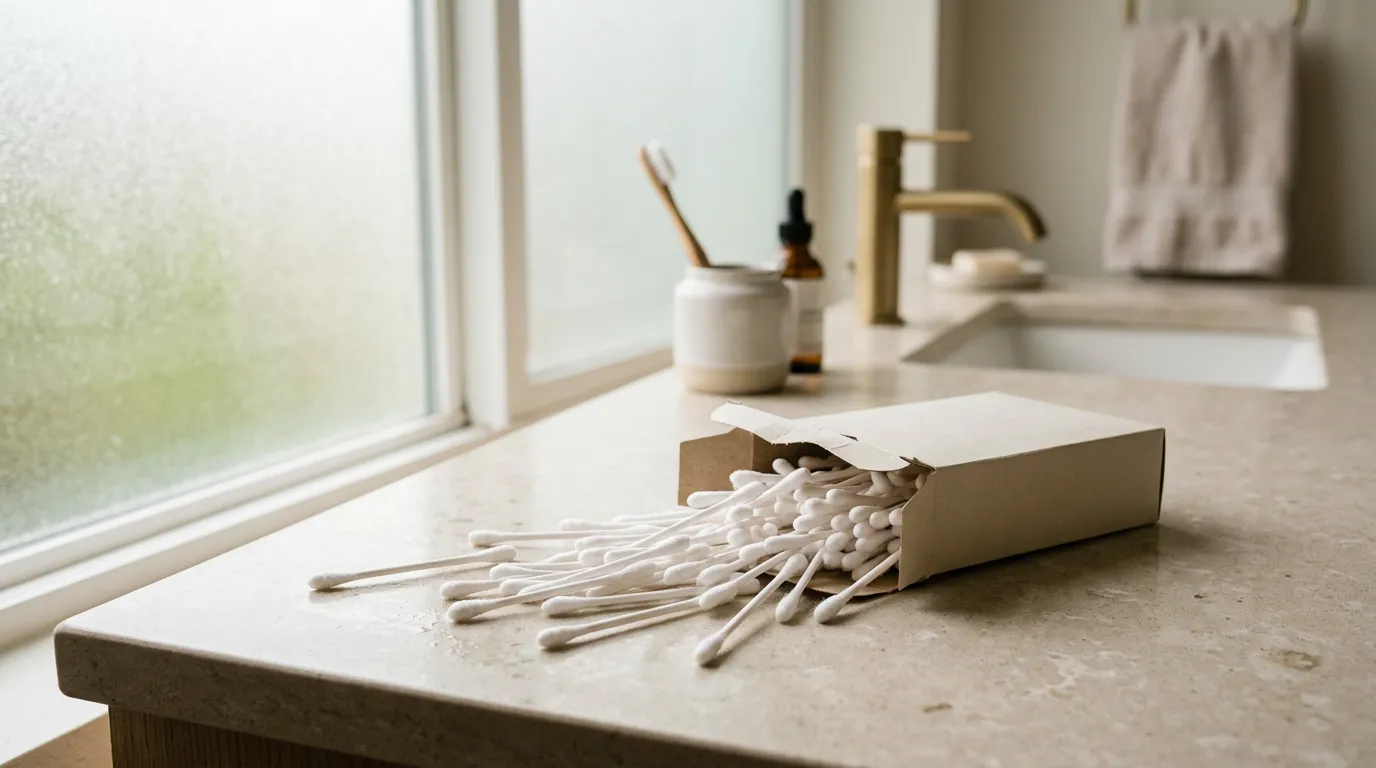
Cotton Swabs: The Habit That Damages Your Ears
That satisfying swipe of a cotton swab isn't cleaning your ear, it's pushing wax deeper in. Here's what your ear canal is actually doing on its own, and what to do if you're genuinely blocked.
 Damien, founder of HALOIA10 min read
If you clean your ears with a cotton swab, you're most likely making things worse, not better. Earwax, medically called cerumen, isn't a hygiene failure your body needs help fixing. It's a substance your ear canal produces on purpose, water-repellent, mildly antibacterial, built to trap dust and debris before it reaches your eardrum. Your ear canal already has a built-in system for clearing it out on its own, no cotton tip required. The habit of reaching for a swab after a shower doesn't remove wax so much as relocate it, pushing most of it deeper into the canal instead of out. It's such a common mistake that it sends hundreds of thousands of people, many of them kids, to the emergency room. Here's what's actually happening inside your ear canal when you swab it, why it backfires, and what to do instead if you genuinely feel blocked up.
Your ear is already cleaning itself
The skin lining the outer third of your ear canal, closest to the opening, produces cerumen from a mix of oil and sweat glands. It's not dirt and it's not a sign your ears are unclean, it's a functional barrier. Earwax traps dust, pollen, dead skin and even small insects before they can travel further in, coats the canal to keep the skin from drying out and cracking, and carries mild antibacterial properties that help keep infections from taking hold. On top of producing it, your ear canal also has a way of getting rid of it without any input from you. Every time you talk, chew or yawn, the movement of your jaw joint, which sits right next to the ear canal, gently nudges older wax outward toward the opening. By the time it reaches the entrance, it's usually dry enough to flake away on its own, often while you sleep or shower, long before you'd ever notice it happening.
- Trapping dust, pollen, dead skin cells and small insects before they reach the eardrum
- Coating the canal skin so it doesn't dry out, crack or itch
- Carrying mild antibacterial properties that make infections less likely to take hold
- Clearing itself outward over time through ordinary jaw movement: talking, chewing, yawning
The cotton swab doesn't clean, it compacts
The problem with a swab is purely mechanical. Its cotton tip is close to the same width as your ear canal, so instead of acting like a broom sweeping wax out, it acts more like a plunger pushing it in. Whatever sits right at the entrance does end up on the cotton, which is exactly why it feels productive, you can see the result. But the wax further down the canal, past the point a swab can safely reach, gets shoved deeper instead, packed against itself into a harder, denser plug than the loose wax you started with. Do this regularly enough and you're not preventing a blockage, you're building one, one shower at a time. Ear specialists list trying to clean the canal yourself, with a swab, a finger, or anything else, as the single most common cause of the impacted earwax people eventually need a professional to remove, whether through the irritation it causes to the canal or the wax it packs down. The instinct to clean makes sense. The tool just does the opposite of what it looks like it's doing.
There's a geometry problem layered on top of the mechanical one. The ear canal isn't a straight tube, it curves slightly on its way to the eardrum, and a swab pushed in blind has no way to follow that curve or judge how close it's getting. That's part of why perforations happen, not because people are being reckless on purpose, but because a sudden jerk, a bump to the elbow, someone startling you mid-swab, is enough to send a rigid stick further than intended into a passage that was never designed to be entered in the first place. The margin for error is smaller than the habit suggests.
A 2017 review of two decades of US hospital data, published in The Journal of Pediatrics, found that around 263,000 children were treated in emergency rooms between 1990 and 2010 for injuries linked to cotton-tip applicators, most of them from kids trying to clean their own ears. Spread that out and it's close to one child every 40 minutes, for twenty straight years, and that count doesn't even include the adults treated over the same period.
Why it still feels so satisfying anyway
If swabbing is counterproductive, why does it feel so good? Part of it is a simple itch-scratch loop: the ear canal is dense with nerve endings, so any pressure or movement inside it registers as relief, even when nothing useful is happening. Part of it is visual feedback: seeing wax on the cotton tip feels like proof the swab worked, even though it only shows what was already near the entrance and about to flake away on its own anyway. And part of it is just habit, cotton swabs have been marketed as an ear-cleaning tool for close to a century, so the association feels obvious even though the actual medical guidance has said the opposite for decades. None of that makes it safe. It just explains why a habit doctors keep warning against is still one of the hardest to drop.
There's also a bit of a loop that keeps the habit going: repeated contact irritates the thin skin of the canal, and an irritated canal is more likely to feel itchy, which is the same irritation mechanism behind most impaction in the first place. So the swab that's supposed to relieve the itch can end up feeding it, which is part of why it's so easy to go from doing this occasionally to doing it every single shower.
The other "cleaning" habits that don't work either
Cotton swabs aren't the only tool people reach for, and most of the alternatives are worse, not better. Bobby pins, rolled tissue corners and fingernails all create the same plunger effect as a swab, minus the cotton, which means a higher risk of scratching the thin skin of the canal or nicking the eardrum itself. Ear candles are the other common one: a hollow, lit candle held in the ear canal, sold on the idea that it creates suction that pulls wax up and out. It's been tested directly, and it doesn't work that way at all.
- Bobby pins, hairpins or rolled tissue corners pushed into the canal
- Fingernails used to scratch or dig at an itch
- Aggressive twisting or repeated insertion of a cotton swab
- Ear candles, marketed as pulling wax out through suction
Ear candling has actually been studied, and the verdict is blunt: the NHS's clinical guidance states there is no evidence it removes earwax at all, and flags a real, documented risk of burns to the ear or face from the candle's melted wax dripping down mid-treatment. It's a ritual that feels like it's working, with a genuine injury risk attached to it.
Your Appearance Score
What's Your Appearance Score?
60 seconds. Get a score based on your habits.
Your ears don't need a daily routine
It's worth saying plainly: healthy ears don't need a maintenance routine at all. Skin benefits from cleansing, hair benefits from washing, but the ear canal is one of the few parts of the body that works best when left completely alone. There's no product, no gadget and no weekly ritual that improves on what it already does automatically. The only part that's fair game is the outer ear, the visible fold you can see in a mirror, which is fine to wipe with a damp washcloth during a normal shower. Everything past that point should stay untouched unless you're actually dealing with a blockage, not because it's due for a clean.
What actually works when you feel blocked
If wax builds up enough to cause a real blockage, dullness in one ear, a feeling of fullness, mild ringing, the fix isn't more scrubbing, it's softening. The recommended at-home approach is simple: a few drops of olive oil or almond oil in the affected ear, lying on your side for a few minutes so the oil has time to travel down the canal, repeated a few times a day for several days in a row. You're not trying to flush the wax out in one go, you're softening a hardened plug so your ear's own natural clearing mechanism, the same jaw-movement process that normally handles this without help, can finish the job on its own. The part that trips people up is patience: it's tempting to check after one application and assume it didn't work, when the realistic timeline is closer to a week of consistent use before the wax is soft enough to clear.
The exact protocol is specific for a reason: 2 to 3 drops of olive or almond oil in the affected ear, lying on your side for 5 to 10 minutes so it can travel down the canal, repeated 3 to 4 times a day for 3 to 5 days straight. Most people see the softened wax fall out or dissolve on its own within one to two weeks, no swab, candle or clinic visit required.
When to skip the home remedy entirely
Oil drops aren't the right move for everyone, and it's worth checking before you start. If you have a perforated eardrum, current or in your history, ongoing ear pain, or any discharge coming from the ear, putting oil or anything else into the canal can make things worse, not better, and it's worth getting checked before trying a home fix. The same goes if what you're dealing with isn't a slow wax build-up but something that came on suddenly: sharp pain, fluid draining from the ear, a sudden drop in hearing, or dizziness aren't things to wait out or self-treat with oil. Those are reasons to get seen the same day, not signs of a routine wax problem.
This matters more for kids than adults. Since children make up the majority of cotton swab injuries treated in emergency rooms, it's worth extending the same caution to home fixes, not just the swab itself: check with a pediatrician before trying oil drops on a young child, a squirming toddler and a bottle of oil is its own small risk, and what looks like ordinary wax build-up from the outside can occasionally be an ear infection that needs a different treatment entirely.
How to know if you actually have a blockage worth treating
Most ears never need active wax removal, and the honest answer for most people reading this is: leave it alone. Earwax only needs to be dealt with when it's actually causing a problem, not on a schedule, and not because clearing it out feels satisfying. If your ears feel completely normal, the wax sitting in there right now is doing its job and doesn't need help.
- A feeling of fullness or pressure in one ear that doesn't go away
- Muffled or noticeably reduced hearing on one side
- Mild ringing (tinnitus) that started around the same time
- An itch deep in the canal that keeps coming back
- Occasional dizziness with no other obvious cause
If a couple of these apply and stick around for more than a few days, that's the point to try the oil protocol above, or book a same-day visit with a pharmacist or doctor for a proper look and, if needed, professional removal. Notice none of those situations call for a cotton swab. Not one.
This is a small habit, but it's a good example of a bigger pattern: a lot of what people do "for hygiene" or "just to feel clean" is inherited from what looks satisfying, not from what actually works, and it usually takes someone actually explaining the mechanism before the habit changes. HALOIA applies the same instinct to diet and appearance, cutting through the habits that feel productive but don't move the needle, and pointing you toward the ones backed by something real. If you're curious where your own daily habits stand, HALOIA's free appearance quiz gives you an honest baseline to start from, no cotton swab required.
This article is for information only and is not a substitute for medical advice. For any question about your health, a treatment or a supplement, consult a qualified professional.
Improve your appearance by eating better
Build real confidence by tracking your diet. Download HALOIA and start your tracking.

Go further
The 4 Real Causes of Facial Water Retention
Puffy face again? There are only four real culprits, and they leave different clues. Here's how to tell them apart instead of guessing.

Text Neck: The Real Risk of Your Phone
Your head weighs about 5kg. Tilt it forward to check your phone and your neck can end up carrying nearly 27kg instead — the weight of an 8-year-old, hanging off your cervical spine for hours a day.
Leg Lengthening Surgery: Cost and Risks
It's a real orthopedic procedure, not a shortcut: a bone is surgically cut and pulled apart by about a millimeter a day. Here's what it actually costs, what can go wrong, and what's worth trying before you get anywhere near an operating table.