

Bloated Before Your Period: Causes and What Helps
That heavier, puffier feeling in the week before your period is real, it's hormonal, and it's not something you did wrong. Here's what's actually happening, and what genuinely helps.
 Damien, founder of HALOIA10 min read
If your face, hands, or waistband feel noticeably fuller in the days before your period, that's not you imagining it, and it's not a sign you ate badly or need to "detox." It's a real, well-documented shift in how your body holds fluid, driven by the natural rise and fall of estrogen and progesterone across your cycle. The most useful thing to know upfront: the one explanation almost everyone reaches for, eating too much salt, is actually the one researchers have ruled out. What's really going on is hormonal, it's temporary, and there's a short list of things that genuinely help — separate from a long list of things that don't. Here's the real mechanism, when in your cycle to expect it, what to do about it, and when it's worth mentioning to a doctor.
This deserves to be said before anything else, too: nothing about this article is here to give you one more thing to optimize about your body. The goal isn't a flatter stomach or a less puffy face in the days before your period — it's understanding a pattern your body already runs on its own, so a completely normal week doesn't get mistaken for a problem you need to fix. Plenty of the advice aimed at this exact window (cleanses, extreme salt-cutting, skipping meals) is built on a misunderstanding of what's actually happening. Knowing the real mechanism means you get to stop chasing the wrong fix.
It's Hormonal, Not a Character Flaw
Worth saying plainly before anything else: feeling puffier before your period is not a sign your body is doing something wrong, and it's not a discipline problem you can fix by "being good" with food. It's a normal, expected pattern that a very large share of women experience, tied to a hormonal shift that's happening whether you eat perfectly that week or not. There's a difference between a body that's temporarily redistributing fluid on a monthly rhythm, and a body that has a problem — this is the first kind, and it deserves to be treated that way instead of as evidence you did something wrong.
It's also worth naming how much of the messaging around this specific week is built to make you feel like you're failing at something. "Bloat-fighting" teas, pills marketed for "that time of the month," whole content genres built around hiding or shrinking a completely normal bodily rhythm — most of it treats a hormonal pattern as a flaw to correct rather than something to understand and work with. You don't need to fight your own cycle to feel good in your body that week. You need accurate information about what's actually happening, so you can stop guessing and stop blaming yourself for something hormonal, not behavioral.
What's Actually Happening, Hormonally
Across your cycle, estrogen and progesterone rise and fall in a coordinated pattern, and both peak and then drop during the luteal phase — the one to two weeks between ovulation and your period. In the first half of your cycle, the follicular phase, estrogen is the dominant hormone, gradually rising toward ovulation. After ovulation, progesterone takes over as the dominant hormone, rising steeply through the luteal phase before both hormones fall sharply in the final days before your period starts — that hormonal drop is actually what triggers your period itself. Progesterone's reach goes well beyond reproduction: research shows that, through its neurosteroid metabolites, it also acts on your central nervous system, including sleep quality, which is one reason this same window often comes with feeling more tired or foggier, not just puffier.
Fluid regulation in the body runs on its own hormonal system, one that's sensitive to shifts elsewhere, including the sex hormones cycling through the luteal phase — your body doesn't wall off reproductive hormones from the systems that manage blood volume and where fluid sits between your cells. Researchers haven't pinned down one single, fully agreed-on mechanism for exactly how that hormonal shift translates into the puffy, tight feeling so many women notice in that window — the honest answer is that this is still an area of ongoing research, and any article that hands you a single tidy mechanism with total certainty is oversimplifying it. But what has been tested directly, and ruled out, is the explanation almost everyone defaults to.
Progesterone's influence goes beyond reproduction: through its neurosteroid metabolites, it also acts on the central nervous system, including sleep quality — one reason the pre-period window often brings tiredness alongside puffiness, not just one or the other (Oettel & Mukhopadhyay, Aging Male, 2004).
When It Actually Peaks
For most women, this fuller, heavier feeling isn't constant across the month — it clusters tightly in the luteal phase, roughly the one to two weeks before your period starts, and tends to be most noticeable in the final few days of that window, right as estrogen and progesterone both drop. During the first half of your cycle, the follicular phase running from your period to ovulation, most women don't notice this pattern at all, and many describe that stretch as when they feel lightest and most like themselves. That timing is itself useful information: if the puffy, heavy feeling reliably shows up and fades on a roughly monthly rhythm tied to your cycle, that's consistent with the ordinary hormonal pattern described here. If it doesn't follow that rhythm, or doesn't fade once your period starts, it's worth looking at separately from the cycle-linked kind covered in this article.
Cycle length and luteal phase length vary somewhat from person to person, so "one to two weeks before your period" is a range, not a fixed countdown that applies identically to everyone. The more useful marker isn't the calendar date, it's your own pattern: most women who track this notice it's fairly consistent for them specifically, showing up around the same number of days before their period, month after month. That consistency is exactly what makes it recognizable as cycle-linked rather than random — once you've seen the pattern land in the same spot on your calendar two or three months running, it stops feeling unpredictable.
The Sodium Myth You Can Finally Let Go Of
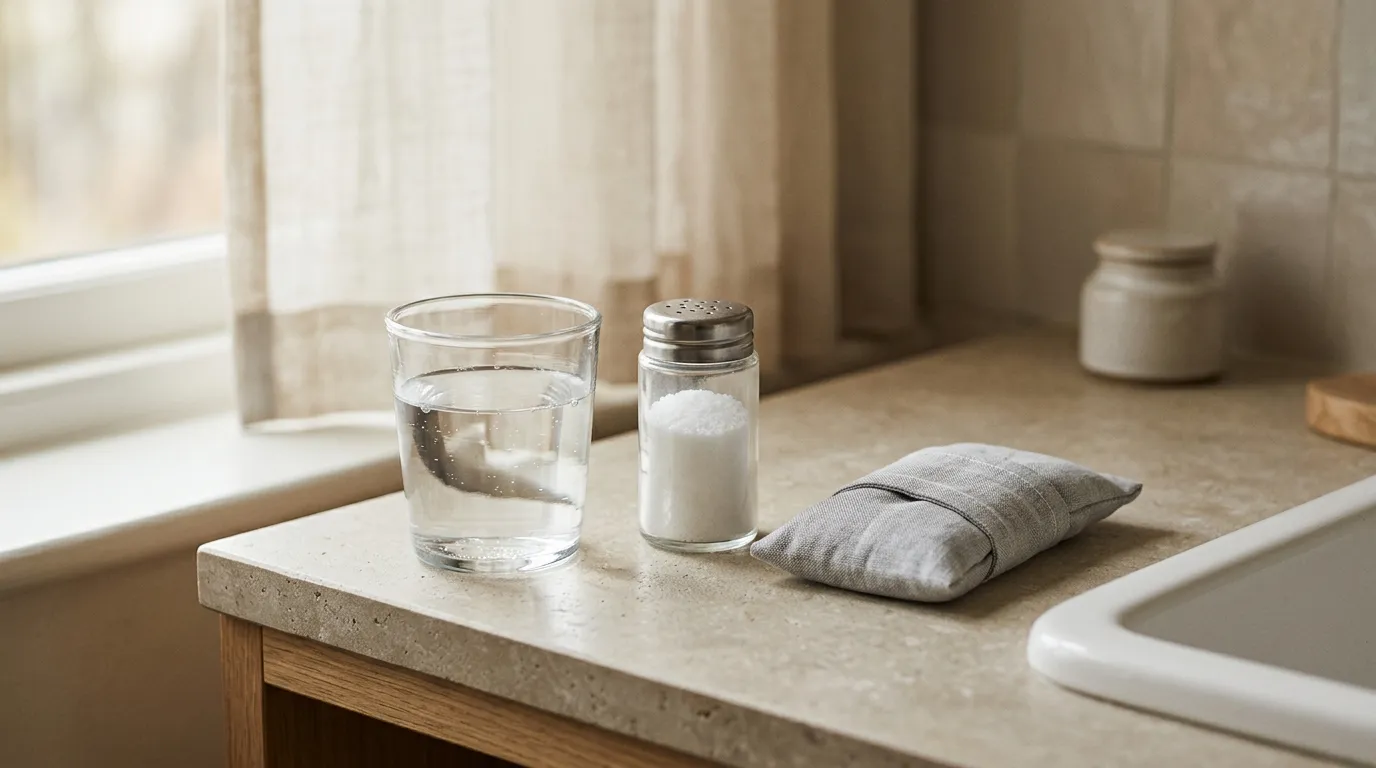
Cutting salt before your period is one of the most repeated pieces of advice out there, and it's worth retiring. A controlled study measuring sodium excretion across the menstrual cycle found that women actually excrete more sodium during the luteal phase, not less — the opposite of what you'd expect if bloating were caused by the body hoarding salt. The same study restricted salt intake during that window and found it made no measurable difference to bloating symptoms. That doesn't mean your diet plays no role at all in the luteal phase — it means this specific, most-repeated explanation isn't the right one, so restricting salt harder in the days before your period isn't the lever that's actually going to help. It's one less thing to feel like you're failing at.
A controlled study found that women excrete more sodium, not less, during the luteal phase — and that restricting salt intake during that window did not reduce bloating symptoms at all, directly contradicting the common belief that premenstrual bloating comes from the body retaining salt (Olson et al., Annals of Internal Medicine, 1996).
What Actually Helps: Food and Hydration
Since sodium restriction isn't the lever, the more useful place to put your attention is potassium and steady hydration, both of which support your body's normal fluid balance rather than fighting against a mechanism that isn't the real cause. Leafy greens, potatoes with the skin on, bananas, and beans are easy, unglamorous sources of potassium you can fold into meals you're already making — nothing here requires a special "anti-bloat" shopping list.
- Leafy greens (spinach, kale, chard) — easy to fold into a meal you're already making rather than treating as a separate health food.
- Bananas, oranges, and potatoes with the skin on — some of the most accessible potassium sources in a normal grocery cart.
- Beans and lentils — a potassium source most "de-bloating" advice skips, despite being one of the denser options per serving.
- Water, consistently through the day — not a large spike right before bed, just a steady baseline rather than restricting it out of a fear of "holding onto more."
On hydration specifically, the instinct to drink less when you feel puffy is understandable but backwards — staying consistently hydrated supports your body's own fluid regulation, while under-drinking tends to make that system work harder, not less. One more thing worth knowing about carbs specifically: eating more refined, starchy carbs than usual can add a bit of extra water weight, since your body stores carbohydrate as glycogen bound to water, at roughly 3 to 4 grams of water for every gram of glycogen stored. That effect is real but genuinely modest, and it's not unique to the luteal phase — it happens any time you eat a larger carb-heavy meal, any week of the month, so there's no need to treat a pasta dinner the week before your period as a special mistake.
Carbohydrate your body doesn't burn right away gets stored as glycogen, bound to roughly 3 to 4 grams of water per gram stored — a real but modest contributor to feeling puffier after a carb-heavy meal, and one that applies any week of the month, not specifically the luteal phase (Shiose et al., Nutrients, 2022).
Your Appearance Score
What's Your Appearance Score?
60 seconds. Get a score based on your habits.
What Actually Helps: Gentle Movement
You don't need an intense workout for this — in fact, this is exactly the week many women feel least like doing one, and that's a completely reasonable thing to listen to. A walk, some light stretching, or just not sitting still for hours at a time is enough to keep fluid moving through your body rather than settling in one place, the same basic principle behind why your legs feel heavier after a long flight or a full day at a desk. It's a small, low-effort lever, not a fix on its own, and it works best stacked with the food and hydration habits above rather than replacing them.
This is also a good week to let intensity be optional rather than a rule. If a heavier training session feels genuinely good and energizing that week, there's no reason to avoid it — but if your body is asking for less, honoring that isn't laziness, it's reading a real signal. The goal here isn't to push through discomfort for the sake of a routine; it's giving your body enough gentle, regular movement that fluid keeps circulating, on whatever version of "movement" actually feels good that week.
The Myth of "Draining" It Away
Facial massage tools and "lymphatic drainage" routines are everywhere in beauty content, often specifically marketed at this exact pre-period window. It's worth knowing that a search of the medical literature turns up almost no studies on cosmetic facial lymphatic drainage for everyday, benign puffiness of any kind — nearly everything published on facial lymphatic drainage concerns actual post-surgical or post-cancer lymphedema, a genuinely different medical condition, not the kind of temporary fullness covered here. If a gua sha routine or a jade roller feels good and is part of a ritual you enjoy, there's no reason to stop — it's just honest to say the effect is more about how the ritual feels than about fluid being "drained" from anywhere.
A search of the medical literature finds almost no studies dedicated to cosmetic facial lymphatic drainage for everyday, benign puffiness — nearly all published research on the topic concerns pathological post-surgical or post-cancer lymphedema, a distinct medical condition (Journal of Plastic, Reconstructive & Aesthetic Surgery, 2011).
When to Actually Talk to a Doctor
The ordinary version of this covered above is mild, cycle-linked, and fades on its own once your period starts. It's worth a real conversation with a doctor instead of a diet or lifestyle tweak if swelling is severe, painful, concentrated on one side of your body, doesn't ease once your period arrives, or shows up alongside symptoms like shortness of breath or unusual fatigue — those patterns can point to kidney, thyroid, or heart-related causes that a food or hydration change won't touch, no matter how well you execute it. The same goes if the emotional and physical symptoms around your cycle are intense enough to disrupt your daily life month after month — that pattern has a name (PMDD, premenstrual dysphoric disorder) and real treatment options, and it's not something you're supposed to just push through quietly or explain away as "just PMS." None of that is what most women experience, but it's worth knowing where the line is, so you're not left wondering whether what you're feeling is normal.
The hardest part of all this usually isn't knowing that hormones are behind it — it's actually seeing the pattern in your own body, since one puffy week can feel random in the moment and only makes sense once you can look back and place it against your cycle. Without something to compare it to, it's easy to blame the wrong meal, the wrong week, or yourself, instead of recognizing a rhythm that was never actually about anything you did.
That's exactly what HALOIA's tracking is built for: log how you're feeling and what you're eating day to day, and it helps you see your own rhythm clearly over time, instead of second-guessing yourself every month. Once the pattern is visible, the whole week stops feeling like a mystery and starts looking like something you can plan around, kindly, instead of fight.
If you want a faster starting point than tracking on your own, HALOIA's free appearance quiz gives you a baseline read on your current habits and patterns before you change anything.
This article is for information only and is not a substitute for medical advice. For any question about your health, a treatment or a supplement, consult a qualified professional.
Improve your appearance by eating better
Build real confidence by tracking your diet. Download HALOIA and start your tracking.

Go further
The 4 Real Causes of Facial Water Retention
Puffy face again? There are only four real culprits, and they leave different clues. Here's how to tell them apart instead of guessing.
Text Neck: The Real Risk of Your Phone
Your head weighs about 5kg. Tilt it forward to check your phone and your neck can end up carrying nearly 27kg instead — the weight of an 8-year-old, hanging off your cervical spine for hours a day.
Leg Lengthening Surgery: Cost and Risks
It's a real orthopedic procedure, not a shortcut: a bone is surgically cut and pulled apart by about a millimeter a day. Here's what it actually costs, what can go wrong, and what's worth trying before you get anywhere near an operating table.