
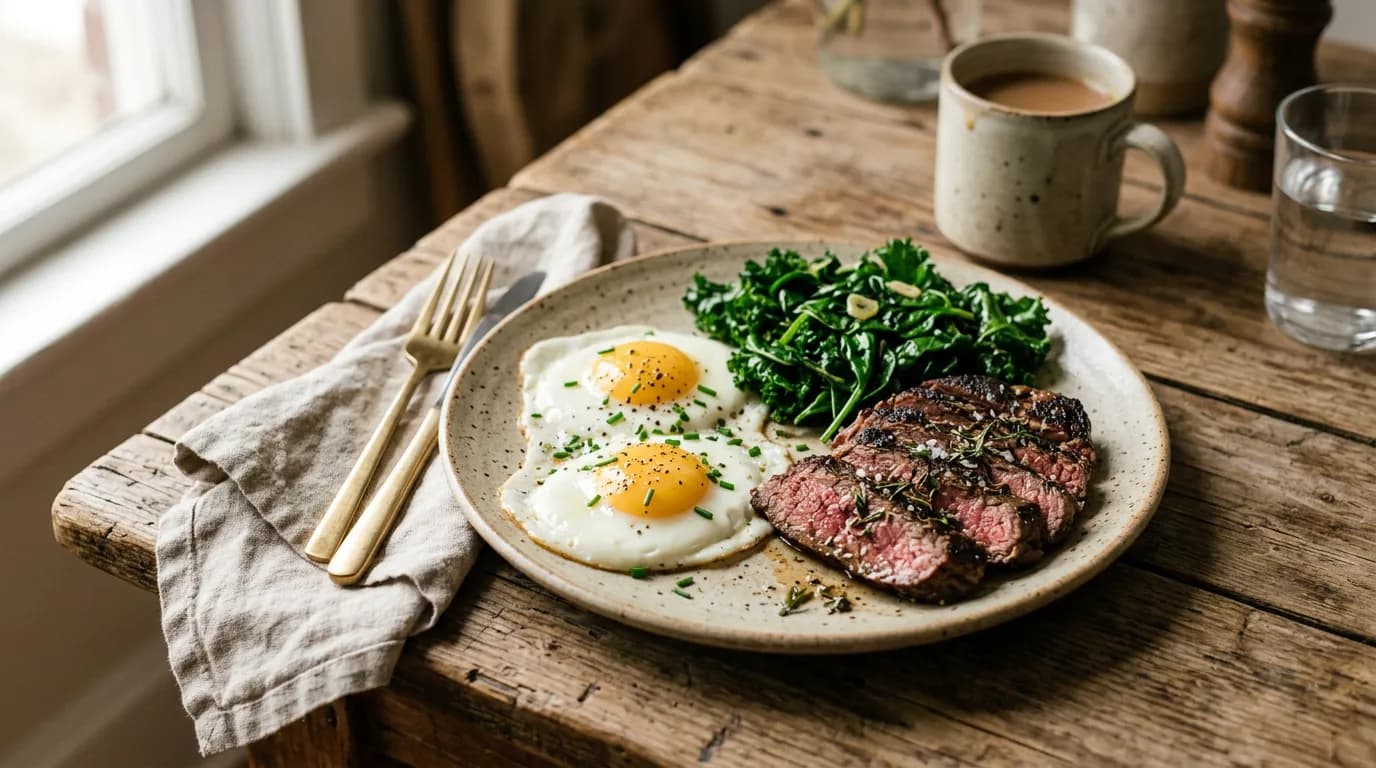
The Foods That Boost Your Testosterone
Oysters, eggs, and pumpkin seeds get all the attention, but sleep, body fat, and alcohol move testosterone more than any single food. Here's what the evidence actually supports, and what's just marketing.
 Damien, founder of HALOIA11 min read
The foods people ask about with testosterone in mind — oysters, eggs, red meat, pumpkin seeds — sit inside a bigger, less flattering picture: for most men, sleep, body fat, and alcohol move testosterone more than any single ingredient does. Diet still matters, mainly through three nutrients where an actual deficiency, not just a normal intake, measurably lowers testosterone: zinc, magnesium, and vitamin D. Supplementing on top of an already-adequate diet doesn't add anything on top; correcting a real shortfall does. This piece walks through what's actually shown to move the needle, what doesn't, and where the evidence runs out, starting with the mechanism, because most "testosterone-boosting food" lists never explain what they're supposedly boosting or by how much.
None of that means diet is irrelevant, and it doesn't mean the whole conversation is a myth. It means the honest version of this topic looks less like a shopping list and more like a short set of levers, some dietary and some not, ranked roughly by how much evidence actually backs each one. That ranking is the part most content on this subject skips, because "eat more zinc" is a much easier headline than "your sleep and drinking habits probably matter more than what's on your plate."
How testosterone actually gets made and released
Testosterone isn't released at a steady drip throughout the day. It comes out in pulses, and the largest of those pulses happen during deep sleep. Cut your sleep time short, night after night, and you're not just tired the next day — you're directly cutting into the window where most of your daily testosterone production actually happens. This is one of the more consistent findings in the hormone literature, and it explains why "eat this food" advice so often underperforms: a food can't compensate for a body that never gets the deep-sleep window it needs to release the hormone in the first place.
Broadly, the process starts in the brain, not the plate: the pituitary gland releases luteinizing hormone, which signals the testes to produce testosterone. That signaling chain is sensitive to sleep architecture, stress, and energy availability, which is part of why lifestyle factors show up so consistently in the research, well before diet composition enters the picture. A food can supply a missing building block, but it can't force a pulse of hormone release that the sleep-and-signaling side of the system isn't set up to deliver.
Body composition is the other half of the mechanism, and it runs in a direction most people don't expect. Free testosterone, the fraction of the hormone that's actually available for your body to use rather than bound up and inactive, is negatively correlated with body fat percentage: the higher the body fat, the lower free testosterone tends to run. Some of that is explained by fat tissue itself, which converts testosterone into estrogen through an enzyme called aromatase — more fat tissue, more conversion, less testosterone left circulating in its free, usable form. None of this means a specific body fat percentage guarantees a specific hormone level; individual variation is real. But it does mean that for a lot of men chasing "testosterone foods," the higher-leverage move is sitting in body composition, not in the grocery cart.
A 2025 study on young men found that free testosterone was negatively correlated with body fat percentage, and that testosterone's largest pulses occur during deep sleep — meaning two of the biggest levers on this hormone are lifestyle factors most diet-focused advice doesn't even mention.
The three nutrients with real evidence behind them
Once sleep and body composition are accounted for, diet's remaining contribution narrows to a short list rather than a long one. Three nutrients show up consistently in the research on testosterone. For zinc and vitamin D the caveat is well documented: they work by correcting an actual deficiency, not by pushing an already-sufficient intake higher. A man who already gets enough zinc and vitamin D from food won't see a further testosterone bump by taking more of either, and for magnesium the intervention evidence in men who aren't short of it is too thin to promise anything in either direction.
- Zinc: involved in multiple steps of testosterone synthesis, and one of the more commonly under-consumed minerals in restrictive or low-variety diets. Found concentrated in oysters and shellfish, and to a lesser degree in red meat, poultry, pumpkin seeds, and cashews.
- Magnesium: plays a supporting role in hormone regulation and is disproportionately low in diets that skip leafy greens, nuts, seeds, and whole grains — a common gap in highly processed eating patterns.
- Vitamin D: functions more like a hormone than a classic vitamin, and deficiency is common in anyone who gets limited sun exposure, especially through darker winter months or indoor-heavy lifestyles. Fatty fish, egg yolks, and fortified foods help, though sunlight remains the dominant source for most people.
Notice what's missing from that list: there's no fourth or fifth nutrient with comparably solid evidence, and for zinc and vitamin D there's no documented "more is better" curve past adequate intake. That's a meaningfully different claim than "eat more of these foods and your testosterone will rise" — it's closer to "don't let yourself run short on these three, and stop expecting anything further once you're not."
A zinc deficiency can lower testosterone, and correcting it brings levels back up: restricting dietary zinc in healthy young men dropped their testosterone, and supplementing marginally deficient older men raised it (Prasad et al., Nutrition, 1996, a small study of 40 men). Topping up when you're not deficient is a different question: in a randomized trial of 98 healthy men, 12 weeks of vitamin D supplementation produced no significant change in total testosterone (Lerchbaum et al., Journal of Clinical Endocrinology & Metabolism, 2017).
The single habit that hurts testosterone more than any missing food
If there's one dietary factor with a bigger, more consistent effect than any "boosting" food, it's the opposite kind of habit: chronic alcohol consumption. This isn't about an occasional drink — the evidence is specific to regular, sustained intake, not a single night out. A large meta-analysis pooling data from more than 10,000 regular male drinkers found both lower total and lower free testosterone compared to non-drinkers, alongside higher estradiol, the reverse of what most men chasing testosterone are trying to achieve. The mechanism runs through several pathways at once: alcohol interferes with the testes' own hormone production, adds strain to the liver's role in hormone metabolism, and — particularly in men who drink heavily and gain weight as a result — compounds the body-fat effect described above.
The useful nuance here, and the one most "alcohol kills your testosterone" headlines skip, is that this effect tracks with chronic consumption, not with an isolated drinking episode. A single evening doesn't meaningfully move the needle the way a sustained, regular pattern does. That distinction matters for anyone trying to figure out which habit is actually worth changing versus which one is just an easy target for a scare headline.
It also means the fix isn't necessarily "zero alcohol forever" for everyone — it's an honest look at frequency and volume over months, not an isolated night. Someone drinking heavily most nights of the week is in a very different position than someone having a couple of drinks at a weekend dinner, even though both would technically show up in the same broad "drinks alcohol" category on a survey.
A meta-analysis of more than 10,000 regular male drinkers found lower total and free testosterone and higher estradiol compared to non-drinkers — an effect tied specifically to chronic drinking, not to occasional alcohol intake.
Your Appearance Score
What's Your Appearance Score?
60 seconds. Get a score based on your habits.
Why training and body composition outweigh any individual food
Resistance training has a documented positive relationship with testosterone, which is one of the more actionable findings here, since it's something you control directly rather than something you're hoping a food will nudge. The flip side matters just as much: chronic overtraining and excessive mental stress push in the opposite direction, largely by driving cortisol up. Cortisol and testosterone have an inverse relationship under sustained stress, which is part of why cramming in more training sessions doesn't reliably translate into more of the hormone you're after — past a certain point, added training volume becomes a stressor rather than a stimulus.
Sleep, physical activity, and weight management don't act as three separate, independent levers on testosterone — they act together, and often in a self-reinforcing loop. Poor sleep makes hard training sessions harder to recover from and easier to skip, and it also makes fat gain easier through its separate effects on appetite and metabolism. That, in turn, feeds back into the body-fat and aromatase pathway described earlier. Someone looking for the single highest-leverage change usually finds it not in a specific food, but in whichever one of these three (sleep, training consistency, or body composition) is currently the weakest link in that loop.
That loop also explains why a single "testosterone workout" or one clean week of eating rarely shows up on a bloodwork panel. Resistance training's positive effect and overtraining's negative one are both built up (or worn down) over months of consistency, the same timescale as the sleep and body-composition factors above — not something a single gym session or a single well-planned meal can meaningfully shift on its own.
An overlooked diet-adjacent factor: what your food comes wrapped in
There's a diet-adjacent factor that rarely makes it onto "foods for testosterone" lists because it isn't a food at all: what your food is packaged, stored, and prepared in. Several human studies have linked exposure to certain environmental endocrine disruptors — parabens, phthalates, and some pesticides, all of which show up in plastics, packaging, and some personal-care products — to lower testosterone levels. The research here is genuinely mixed rather than settled: results are inconsistent across studies, and one commonly cited disruptor, bisphenol A (BPA), sometimes shows an association running the opposite direction in the data. That inconsistency is worth taking seriously in both directions — it's not strong enough evidence to build a strict "avoid all plastic" protocol around, but it's also a reasonable, low-cost reason to prefer glass or stainless steel for food storage and to avoid heating food in plastic containers, given the exposure pathway is plausible even where the outcome data isn't fully settled.
Why "testosterone-boosting" supplements rarely live up to the label
The supplement aisle is full of products marketed with hormone-boosting language, and DHEA is a useful example of why that marketing deserves skepticism. DHEA is a real hormone, made by the adrenal glands, and it does function as a genuine precursor in the body's production of both testosterone and estrogen — its production also declines noticeably with age starting in a person's twenties, which is exactly the kind of biological fact that makes it easy to market. But when DHEA supplementation has actually been tested, a Cochrane review — the kind of rigorous, independent evidence review that supplement marketing rarely cites — found no significant benefit of DHEA supplementation on cognitive function compared to placebo. That specific finding is about cognition, not a direct testosterone-level readout, but it illustrates a pattern worth generalizing: being a biological precursor to a hormone doesn't automatically mean that taking more of it, as a pill, produces the benefit implied on the label. The same logic applies to the zinc, magnesium, and vitamin D story above — the evidence supports correcting a deficiency, not stacking supplements on top of a diet that's already covering the basics. Another popular name in this aisle, ashwagandha, has its own evidence review.
It's the same reason "testosterone-boosting" ingredient lists on supplement labels are worth reading skeptically rather than at face value. A label listing zinc, magnesium, and vitamin D alongside a dozen other compounds isn't automatically more effective than food that already covers the three nutrients with real evidence behind them — the extra ingredients mostly add marketing weight, not established effect. The useful question to ask before buying anything in this category isn't "does this contain a hormone-related nutrient," but "has raising this specific nutrient, in someone not already deficient, actually been shown to raise testosterone" — and for most items on a typical label, the honest answer is that it hasn't been tested well enough to say.
What a realistic, evidence-based plate and routine looks like
Put together, the evidence points to a short, unglamorous list rather than a miracle stack:
- Cover zinc, magnesium, and vitamin D through food first — shellfish, red meat, pumpkin seeds, leafy greens, nuts, and fatty fish — and only consider supplementing if you have an actual reason to suspect a deficiency, ideally checked rather than guessed.
- Protect deep sleep as a non-negotiable, since that's when most daily testosterone release happens.
- Keep chronic, regular alcohol intake in check — this is one of the more consistently documented downward levers, and its effect scales with how sustained the habit is.
- Train with resistance work consistently, but watch for chronic overtraining and unmanaged stress, since both work against you through elevated cortisol.
- Manage body composition as a background variable, since fat tissue's conversion of testosterone into estrogen means body fat and hormone levels move together for many men.
- Treat "testosterone-boosting" supplement marketing, including precursor hormones like DHEA, with the same skepticism you'd apply to any bold claim without a rigorous trial behind it.
None of this is a fast fix, and nothing here promises a dramatic before-and-after — the honest version of this topic is a handful of levers, working together over weeks and months, not a single food unlocking a hormone. That's also exactly the kind of pattern that's hard to track from memory: whether your meals are actually giving you enough zinc and magnesium on a given week, whether your alcohol intake has crept up, whether your sleep has been consistent. HALOIA's meal scoring logs what you're really eating and flags the nutritional gaps that are plausibly relevant, instead of leaving you to guess which lever you're actually missing.
If you want a faster starting point than trial and error, HALOIA's free appearance quiz gives you a baseline read on your diet and habits before you change anything.
Sources
This article is for information only and is not a substitute for medical advice. For any question about your health, a treatment or a supplement, consult a qualified professional.
Improve your appearance by eating better
Build real confidence by tracking your diet. Download HALOIA and start your tracking.

Go further
The Best Breakfast for Clear Skin in Your 20s
Forget "eat clean" advice with no specifics. Here's the exact breakfast structure that keeps blood sugar stable and gives your skin what it needs to repair overnight's damage.
Ashwagandha: Its Real Effect on Stress and Training
Ashwagandha gets credited for almost everything. Two claims actually hold up in controlled trials — stress/cortisol and strength/muscle — and they don't have the same evidence behind them. Here's the honest breakdown.

Who Should Never Fast?
Intermittent fasting is safe for most healthy adults — but not for everyone. Here's exactly who should skip it, and why, according to the research.