
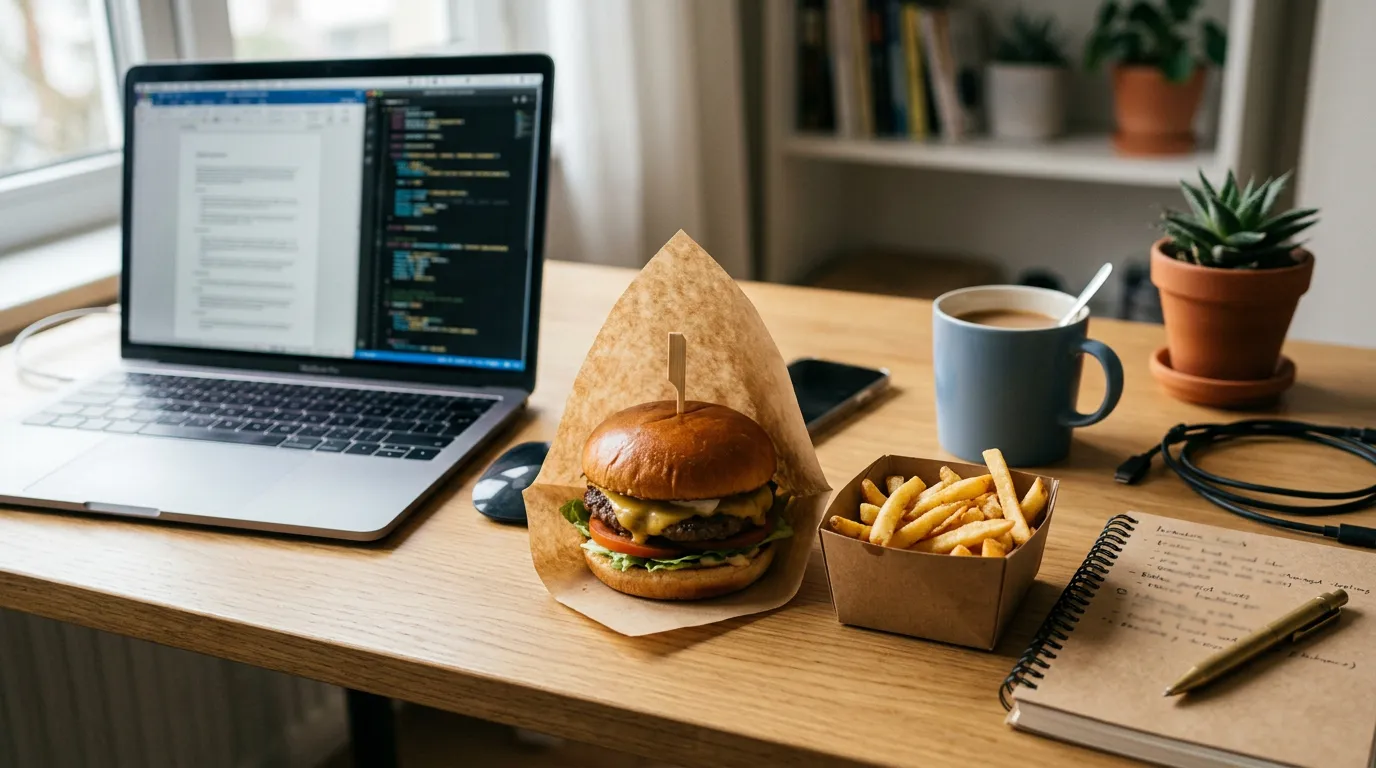
Why a Bad Diet Makes You Lazy
That afternoon slump where cooking, working out, or even answering an email feels impossible isn't a willpower problem. It's a blood sugar problem. Here's the real mechanism and how to break it.
 Damien, founder of HALOIA10 min read
If a rough week of eating leaves you slumped on the couch instead of doing the things you actually planned to do, that's not a discipline problem. It's a blood sugar problem wearing a discipline costume. Ultra-processed meals and sugar-heavy snacks create real, physical energy crashes, and those crashes are what quietly turn into procrastination, canceled workouts, and one more night of takeout instead of cooking. The mechanism behind it is well understood, which is good news: once you see how the loop actually works, breaking it doesn't require a total diet overhaul, just a few specific, well-placed changes. That's what this piece walks through: what's actually happening in your blood sugar when the crash hits, why it snowballs into full-blown procrastination instead of just a bit of tiredness, and the small, specific swaps that break the pattern without demanding more willpower than you actually have on a bad day.
The Glycemic Crash Behind the Fatigue
Here's the physiology in plain terms. When you eat something high in refined carbs or sugar, glucose floods your bloodstream fast. Your pancreas responds with a surge of insulin to bring it back down, and in a lot of people, especially after a meal that's heavy on sugar and light on protein or fiber, that response overshoots. Blood sugar drops below where it started, usually one to three hours after eating. Your brain, which burns through roughly a fifth of your daily energy and runs almost entirely on glucose, feels that drop first and hardest: fog, heaviness, a sudden urge to lie down, irritability. Your body reads the crash as a mild emergency and releases cortisol and adrenaline to compensate, which is part of why a sugar crash can feel jittery and exhausted at the same time. None of this is in your head. It's a measurable swing in the fuel supply to the organ that's supposed to be deciding whether to go to the gym or answer that email.
The part that makes it a loop rather than a one-off dip is what happens next: a low-blood-sugar brain doesn't crave a balanced plate, it craves the fastest possible glucose fix, which is usually more sugar or refined carbs. Eat that, and you set up another spike-and-crash cycle a couple of hours later, often a little steeper than the last one because your body is now reacting to back-to-back insulin surges instead of a single isolated meal. Do this daily for a few weeks and your baseline energy on an average afternoon quietly resets lower, not because you've become lazier, but because your fuel supply has become genuinely less stable.
What a Bad Day Actually Looks Like
Picture a fairly ordinary day: coffee and a pastry on the way out, a quick lunch that's mostly bread, an afternoon energy dip that gets patched with more coffee or a candy bar from the vending machine. Each patch works for about twenty minutes and then hands you back a slightly worse crash than the one before it. By 6 p.m. you're not just tired, you're the specific kind of tired where cooking a real meal feels like a chore you'll definitely get to tomorrow. So dinner becomes something fast and carb-heavy again, which sets up the exact same pattern for the next morning. Nothing about this day involved a lack of willpower. It involved a fuel curve that kept dipping below the point where planning, cooking, and exercising feel achievable.
Why It Hits Some People Harder Than Others
Not everyone feels this the same way, and that's not a discipline gap either. Insulin sensitivity varies a lot between individuals, and it gets worse with poor sleep, high stress, and a run of sedentary days, which is exactly the state a lot of people are already in by the time the diet has slipped too. Someone who slept six hours and skipped a workout will crash harder from the same bagel than someone who slept eight and walked that morning, because their body is already less efficient at handling the glucose load. This is part of why generic "just eat better" advice lands so differently for different people: food is only one input into a system that's also being shaped by sleep debt and stress hormones. It also explains why fixing sleep or adding a short walk sometimes moves the energy needle faster than any single food swap on its own, and why stacking two or three of these levers together tends to work better than betting everything on diet alone.
How This Becomes a Procrastination Loop
The link between low energy and procrastination isn't a metaphor, it's mechanical. Tasks that require planning, sustained attention, or resisting a shortcut, meal prep, a workout, a hard piece of work, all draw on the same limited pool of mental energy that a glucose crash just drained. When that pool is low, your brain defaults to whatever takes the least effort right now, which is almost never the healthy option. Decision-making itself gets more expensive on a crash: choosing what to cook, whether to go to the gym, or how to start a hard task all require the same mental bandwidth that low blood sugar just took offline, so the brain quietly reaches for the option that requires no decision at all, the couch, the delivery app, the scroll. That's how one skipped grocery run turns into a week of delivery apps, and one skipped workout turns into three. Left unmanaged, this becomes something close to autopilot: once the fatigue-crash-shortcut sequence becomes the default context, you stop deciding to procrastinate. You just do it, the same way you'd reach for a light switch without thinking about it.
About 43% of what people do in a given day isn't a conscious decision at all, it's a habit fired automatically by the surrounding context while attention is elsewhere. That's why the low-energy shortcuts you reach for on a bad-food day rarely feel like a choice: once the pattern is set, your brain runs it by default. — Wood, Quinn & Kashy, Journal of Personality and Social Psychology (2002)
Why Willpower Won't Fix It
The instinctive fix is to try harder: more motivation, more discipline, a stricter meal plan starting Monday. This is also the part that reliably fails, and there's a specific reason why. Motivation and willpower are not what makes a habit, good or bad, stick. Repetition inside a stable, predictable context is what does it, which cuts both ways: it's also why the bad pattern is so sticky once it's formed. And when people do manage to eat better for a while and then relapse, it's rarely because a brand-new bad habit appeared. Old habits don't actually disappear when you stop doing them, they go dormant and get re-triggered the moment motivation dips again, usually during exactly the kind of low-energy afternoon this article is about. Simply trying to stop the bad pattern through effort isn't enough. It has to be replaced with something else anchored to the same trigger, or the old one comes right back. This is also why the timing of your willpower matters more than its amount: the moment you have the least of it, right after a crash, is exactly when the old pattern is waiting to take over, so the goal isn't to have more willpower overall, it's to need less of it at that specific moment by having already decided in advance what happens next.
Diet relapse after weight loss usually isn't a new bad habit forming, it's an old one reactivating. Old habits go dormant rather than disappearing, and low motivation is exactly the moment they resurface — which is why replacing a pattern works better than just trying to suppress it. — Gardner & Beeken, Appetite (2021)
Your Appearance Score
What's Your Appearance Score?
60 seconds. Get a score based on your habits.
How to Break the Cycle: Small, Specific Swaps
Because this loop runs on context and triggers, not resolutions, the fixes that actually work are specific and small enough to survive a low-energy day. A vague goal like "I'll eat healthier" has a poor track record on its own. Planning the exact when and where, an approach researchers call implementation intentions, performs far better. In practice, that looks like this:
- Anchor one swap to a fixed trigger: "If it's the 3 p.m. slump, I eat the protein bar I packed" beats "I'll try to snack better" every time.
- Front-load protein and fiber at breakfast, eggs, yogurt, oats with nuts, instead of pastries or cereal alone, to flatten the mid-morning crash before it starts.
- Keep one ready-to-eat real meal in the fridge or freezer for exactly the evenings you're too drained to cook, so the fallback isn't delivery by default.
- Treat the afternoon dip with a 10-minute walk or a glass of water first; a caffeine-and-sugar patch works for 20 minutes and sets up a worse crash after.
Vague resolutions like "eat healthier" consistently underperform specific if-then plans like "if it's 3 p.m., I eat X," by a medium-to-large margin, based on a review spanning over 8,000 people across 94 studies. — Gollwitzer & Sheeran, Advances in Experimental Social Psychology (2006)
Small Wins Beat a Total Overhaul
There's real pressure to fix this all at once: new diet, new gym routine, new sleep schedule, starting Monday. That pressure is working against you. Forming a single new automatic habit takes 66 days on average, but the range across individuals is enormous, from 18 days to 254 days. Stacking five habit changes at once means all five are competing for the same limited willpower while none of them has had time to become automatic yet. It's a large part of why roughly half of people who start a new exercise routine quit within six months: not because the goal was wrong, but because the load was too heavy too soon. Pick the one swap most likely to survive a bad day, let it run until it's boring and automatic, then add the next one. If stress keeps feeding the loop, what ashwagandha can and cannot do is a useful reality check.
New habits take 66 days on average to become automatic, but the individual range runs from 18 to 254 days, and repeating the behavior in the same context speeds it up more than motivation does. — Lally, van Jaarsveld, Potts & Wardle, European Journal of Social Psychology (2010)
Track the One Thing That Predicts Change
If you only measure one thing while you rebuild this, make it what you actually eat, not your weight and not your workouts. In a trial of 1,685 people following a six-month intensive program built around 20 weekly group sessions, participants kept an average of 3.7 daily food records a week and lost 5.8 kg on average; after adjusting for race, gender and starting weight, keeping more food records per week was associated with greater weight loss. The catch is that diet tracking is also the first habit to collapse when things get busy: in a study of people in weight-maintenance, only 21% were still logging their food consistently, compared with 61% still tracking exercise. That gap matters, because food is the lever most directly connected to the glucose swings driving the whole cycle, and it's usually the first one people stop watching right when they'd need it most. The fix isn't trying harder to log everything by hand on your most drained days, it's making the tracking itself low-effort enough to survive them, so it keeps giving you signal on exactly the afternoons your motivation to type it all out is at zero.
In a trial of 1,685 people on a six-month intensive program, participants kept an average of 3.7 daily food records a week and lost 5.8 kg on average; keeping more records per week was associated with greater weight loss, an association measured inside the trial rather than something it set out to prove. Yet diet tracking is also the first habit to drop off under pressure: only 21% of people kept logging food consistently, versus 61% for exercise. — Hollis et al., American Journal of Preventive Medicine (2008); Crane & Butryn, JMIR mHealth and uHealth (2023)
This is exactly the gap HALOIA is built to close. Instead of asking you to manually log every gram on your worst, most drained day, a quick photo of your meal is enough for it to score what you actually ate and flag the pattern before it turns into another week of takeout and skipped plans. You don't need more willpower to break the fatigue-procrastination loop. You need a system that keeps working on the days your energy doesn't.
Sources
This article is for information only and is not a substitute for medical advice. For any question about your health, a treatment or a supplement, consult a qualified professional.
Improve your appearance by eating better
Build real confidence by tracking your diet. Download HALOIA and start your tracking.

Go further
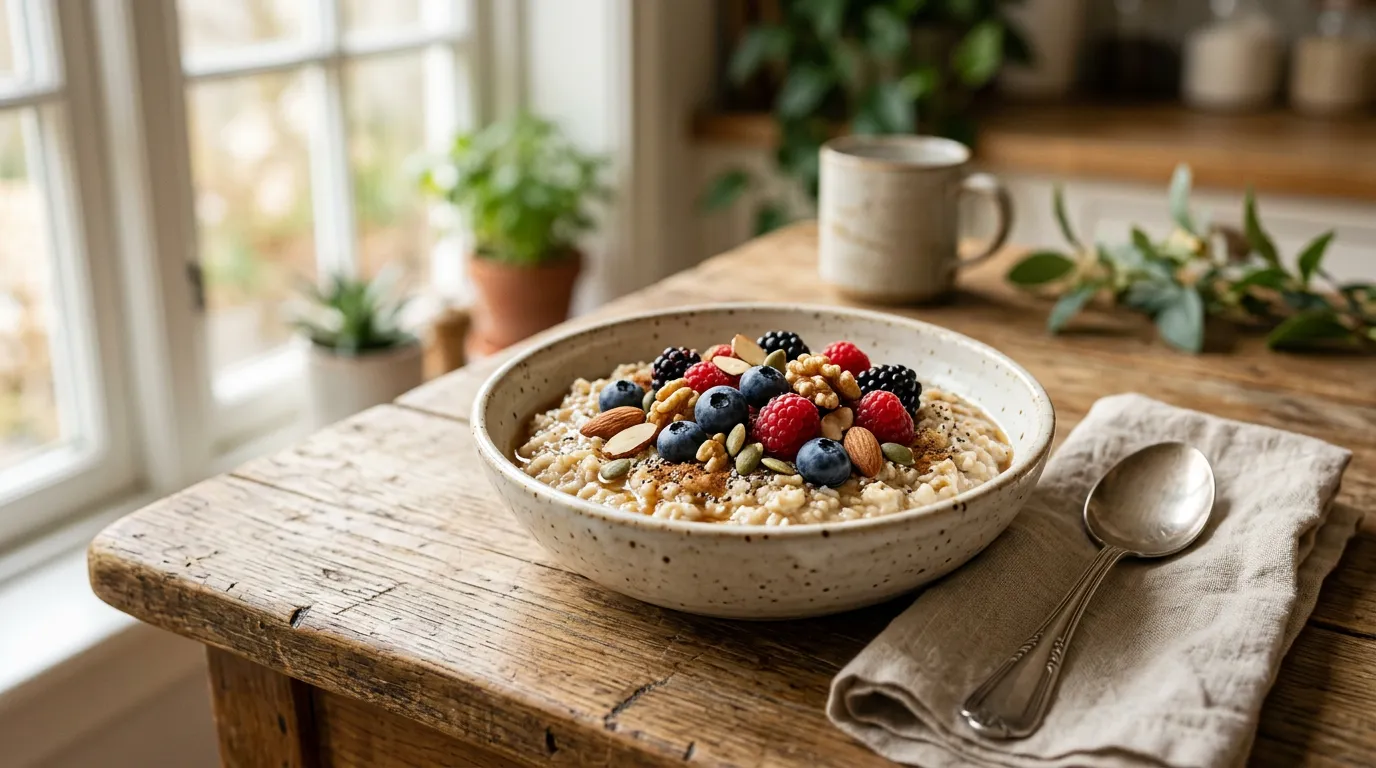
The Best Breakfast for Clear Skin in Your 20s
Forget "eat clean" advice with no specifics. Here's the exact breakfast structure that keeps blood sugar stable and gives your skin what it needs to repair overnight's damage.

Ashwagandha: Its Real Effect on Stress and Training
Ashwagandha gets credited for almost everything. Two claims actually hold up in controlled trials — stress/cortisol and strength/muscle — and they don't have the same evidence behind them. Here's the honest breakdown.

Who Should Never Fast?
Intermittent fasting is safe for most healthy adults — but not for everyone. Here's exactly who should skip it, and why, according to the research.