
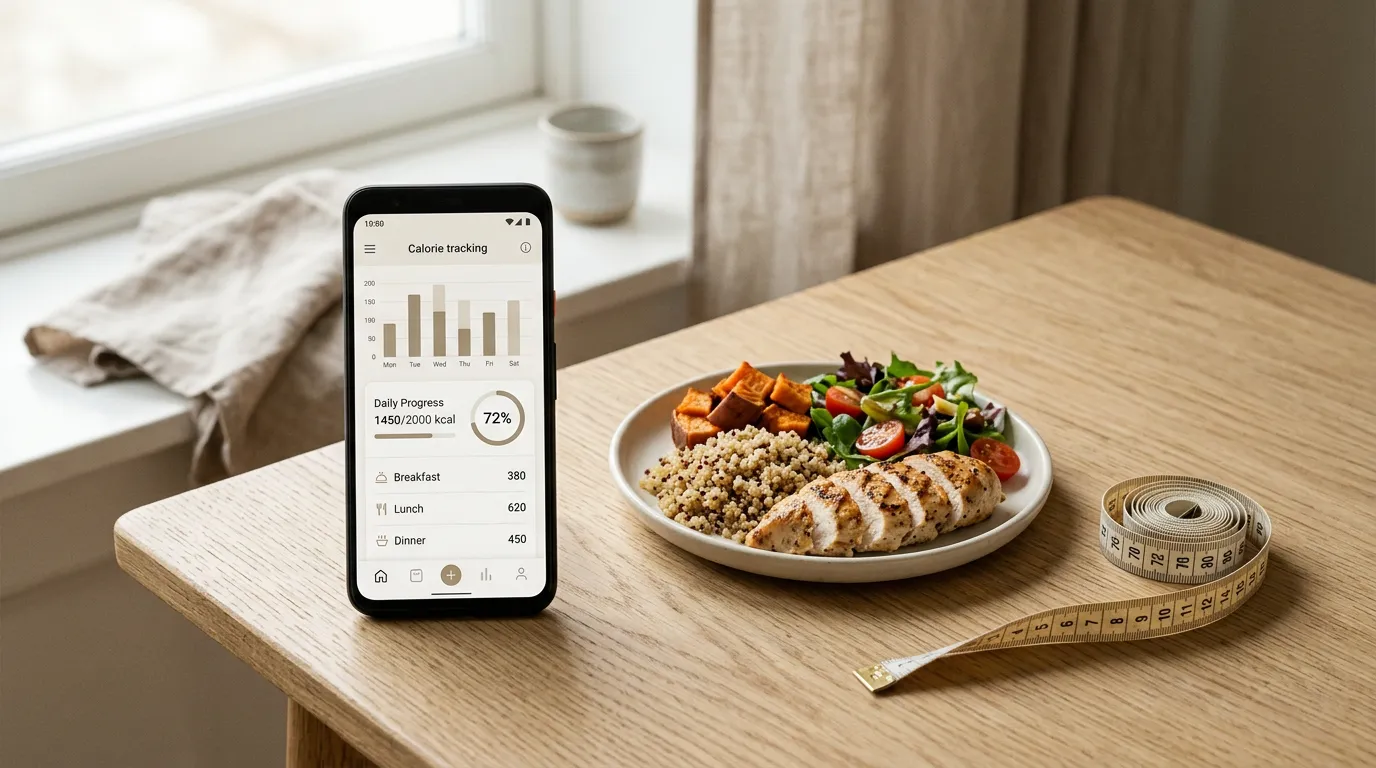
Why Counting Calories Drives You Crazy
Counting calories isn't the problem. Needing the number to be perfect every single day, and feeling like you failed when it isn't, usually is. Here's what happens when tracking turns into obsession, and what to do instead.
 Damien, founder of HALOIA11 min read
Calorie counting itself isn't the enemy. Done loosely, it's one of the better-studied tools for losing weight and keeping it off. The problem starts when the number stops being information and becomes the whole point: when hitting 1,847 instead of 1,850 feels like a small win, when going 200 over ruins the rest of your evening, when you'd rather skip dinner with friends than log a meal you can't verify down to the gram. That shift, from tracking as a tool to tracking as a scoreboard you can never stop playing, is where most of the real damage happens. Research on rigid, number-obsessed tracking, and on the restrictive protocols that lean hardest on it, keeps turning up the same pattern: it works well for a while, it tends to collapse faster than looser approaches, and for a meaningful share of people it opens a door toward something closer to disordered eating than discipline. None of that is an argument against tracking. It's an argument for tracking the right thing, in the right way, and knowing exactly where the line into obsession sits before you cross it without noticing. The rest of this article walks through what the evidence actually supports, where the risk really comes from, and what a version of tracking that doesn't eat you alive looks like in practice.
Why the exact number becomes the whole point
Most tracking apps are built around a single daily digit, and digits are seductive: they're clean, comparable, and easy to turn into a pass/fail grade for your entire day. That's exactly the mechanism that tips useful tracking into something else. A meal stops being "a good, balanced dinner" and becomes "312 calories, acceptable" or "890 calories, a mistake." Foods get sorted into morally loaded categories, good or bad, clean or a cheat, based purely on where they land on the counter. What almost nobody accounts for is that the number itself is an estimate wearing the costume of a fact: restaurant meals, home cooking, and even packaged food labels carry a real margin of error, often in the range of 10 to 20 percent, before you even factor in how imprecisely most people eyeball a portion. Chasing three-digit precision out of a number that was never that precise to begin with is how a flexible tool turns into a rule you're constantly failing to obey exactly. Two people can eat the exact same plate and walk away with completely different experiences of it: one logs it, moves on, and forgets the number by dinner. The other recalculates, second-guesses the portion size, and spends the next hour mentally negotiating whether they can "afford" a snack later. Same meal, same app, same number on the screen, but only one of those is tracking. The other is doing math as a form of anxiety management, and the app has no way to tell the two apart.
Tracking that helps vs. tracking that consumes you
It's worth being precise here, because "calorie counting causes problems" isn't what the evidence actually says. Keeping a food log is genuinely one of the more reliable predictors of successful, sustained weight loss. The nuance that gets lost is what "successful" logging looked like in the research that established that link, and it wasn't obsessive daily perfection.
In a trial of 1,685 people on a six-month intensive program, participants kept an average of 3.7 daily food records a week and lost 5.8 kg on average. Keeping more records per week was associated with greater weight loss, an association measured inside the trial rather than something it was designed to prove. What tracked with success was consistency across most of the week, not flawless logging every single day.
That's the version of tracking that has real evidence behind it: a habit you maintain most of the time, imperfectly, as a way to stay roughly aware of what you're eating. It's a completely different behavior from opening an app after every bite, recalculating a running total three times a day, or treating a day where you didn't log as a day that "doesn't count" toward your progress. The tool is the same. The relationship to it is not.
What the research on numeric restriction and disordered eating actually shows
There isn't a large body of dedicated research isolating calorie-counting apps and eating-disorder onset specifically, so it's worth being honest about what the evidence does and doesn't cover. What does exist is a consistent signal from research on restrictive, number-driven eating protocols more broadly, and it points the same direction.
Clinical guidance published in Clinical Diabetes and Endocrinology (2023) states that restrictive eating protocols can mask or trigger disordered eating behaviors in some individuals, and that clinicians should screen for a history of eating disorders before recommending them, regardless of the specific protocol used.
A 2024 study in Eating Behaviors found that people with impulse-control difficulties showed a notably stronger link between restrictive eating protocols and disordered eating behaviors, a profile the authors flag as worth screening for before recommending highly restrictive windows.
The common thread isn't the specific method, whether it's a fasting window or a calorie target. It's the structure: a hard numeric line that you either meet or fail, applied daily, with no built-in room for a day where the number doesn't matter. For most people that structure is simply a mildly annoying accounting task. For a meaningful minority, especially anyone with a history of restrictive or compulsive eating patterns, that same structure can become the exact mechanism that keeps the disorder fed. If tracking is making food feel more anxious rather than more manageable, that's not a discipline problem to push through, it's a signal to change the method.
Who should be extra careful with strict tracking
The clinical guidance above is specific for a reason: screening matters most for people who already carry some risk, not for everyone equally. A few honest questions do most of that screening work without needing a professional assessment. Is there a personal history of restrictive eating, bingeing, or a diagnosed eating disorder, even one that felt fully resolved years ago? Does missing a log entry or going over a number trigger something closer to panic than mild annoyance? Is the appeal of tracking less "I want to understand my habits" and more "I need to control this or something bad will happen"? A yes to any of those isn't a moral failing, and it doesn't mean tracking is off the table forever. It means the rigid, daily-perfect-number version specifically is a bad fit, and a looser approach, ideally with a doctor or therapist involved in the decision, is the safer starting point. This is also worth saying plainly for parents, coaches, and anyone recommending an app to someone else: handing a teenager or a client a strict calorie target without asking any of these questions first is exactly the scenario the screening research is warning against.
Your Appearance Score
What's Your Appearance Score?
60 seconds. Get a score based on your habits.
Why almost everyone quits tracking right when it gets rigid
Here's the part that rarely gets said out loud: strict, obsessive tracking doesn't just carry a psychological risk, it's also the least durable version of tracking there is. People don't quit gradually because life got busy. They quit because the rigid version is exhausting to sustain, and it's usually the first habit to go.
Self-tracking tends to collapse in a consistent order: diet first, then weight, with exercise tracking holding on the longest. In a study of people in a weight-maintenance phase, only 21 percent kept logging their diet consistently, compared to 61 percent who kept tracking exercise.
That gap is a clue, not a coincidence. Logging exercise is a single, discrete event you record once. Logging diet the way most apps push you to means weighing, estimating, and mentally scoring every single thing you eat, all day, every day, with the app quietly implying that a missed entry is a missed data point rather than a normal Tuesday. That's a much higher cognitive and emotional tax to pay, and it's exactly the kind of tax that pushes people toward an all-or-nothing collapse: perfect logging for three weeks, then nothing at all, rather than a loose habit that just keeps going. There's a name for the mechanism behind that collapse in behavior research: decision fatigue, the way the quality and consistency of a choice degrades the more times you're forced to make a version of it in a single day. Deciding whether a snack "fits" isn't one decision, it's dozens across a week, each one a small withdrawal from the same pool of willpower everything else in your day is also drawing from. A system that demands that many decisions, that precisely, every single day, isn't failing the people who quit it. It was never built to be sustained in the first place.
The alternative: track a visible result, not a perfect number
If rigid precision is both the psychological risk and the reason people quit, the fix isn't "try harder at hitting the exact number." It's shifting what counts as success from a single daily digit to a trend you can actually see. There's decent evidence that this reframe holds up outside of nutrition too.
A 100-day, 10,000-step challenge modestly improved participants' anxiety, stress, and wellbeing, but the researchers specifically noted that simply participating in the process mattered about as much as actually hitting the exact numeric target each day.
Applied to food, that means the useful signal isn't "did I land on exactly 1,850 today," it's "does this week look better than last week." A visible result, whether that's a weekly progress photo, a trend line on the scale, or how your skin and energy are tracking, tells you the same thing a perfect daily number was supposed to tell you, minus the part where a single off day feels like a failure instead of one data point in a longer trend. This isn't just a gentler framing for the sake of feeling better about a slip. A trend line is genuinely more accurate than any single day's number, because it automatically averages out the water retention, the digestion timing, and the estimation errors that make one isolated calorie count noisy in the first place. Judging yourself on a week is judging yourself on better data, not just kinder data.
How to track without letting it take over your head
- Track in ranges, not single numbers: give yourself a window (for example 1,700 to 1,950) instead of one exact target you either hit or miss. This matches the real margin of error in most calorie estimates instead of pretending it doesn't exist.
- Check trends weekly, not daily: one photo, one weigh-in, or one honest gut-check per week is enough to see real direction. Daily numbers are mostly noise, water weight and digestion, not progress or its absence.
- Let a normal day stay normal: a dinner out or a day you didn't log isn't a reset button on your progress. Consistency across most of the week is what the actual evidence supports, not an unbroken streak.
- Take real breaks from tracking on purpose: a planned week or two off the app, especially after a longer stretch of daily logging, reduces the odds that tracking curdles into obsession without you noticing it happening.
- Watch how food makes you feel, not just what it scores: if checking the app before eating causes more anxiety than the meal itself, that's the actual warning sign worth acting on, well before any number does.
None of this is an argument for tracking nothing. It's an argument for building a system where a single off day is just a data point instead of a verdict on your character. That distinction is exactly what HALOIA is built around: instead of a single perfect daily number you either hit or fail, it scores your real meals over time and shows you a visible result, an appearance score and trend, so the thing you're chasing is a direction you can actually see improving, not a three-digit target you have to defend every single evening. And if you wonder whether a chatbot can do the logging for you, here is where ChatGPT falls short.
If you want a starting point that isn't another number to obsess over, HALOIA's free appearance quiz gives you a baseline read on where your habits currently stand, no daily logging required to get it.
Sources
This article is for information only and is not a substitute for medical advice. For any question about your health, a treatment or a supplement, consult a qualified professional.
Improve your appearance by eating better
Build real confidence by tracking your diet. Download HALOIA and start your tracking.

Go further
The Best Breakfast for Clear Skin in Your 20s
Forget "eat clean" advice with no specifics. Here's the exact breakfast structure that keeps blood sugar stable and gives your skin what it needs to repair overnight's damage.

Ashwagandha: Its Real Effect on Stress and Training
Ashwagandha gets credited for almost everything. Two claims actually hold up in controlled trials — stress/cortisol and strength/muscle — and they don't have the same evidence behind them. Here's the honest breakdown.

Who Should Never Fast?
Intermittent fasting is safe for most healthy adults — but not for everyone. Here's exactly who should skip it, and why, according to the research.