
The Right Camera Angle for a More Attractive Photo
There's a specific camera angle proven to make the same face look more attractive, and it's not the one most people assume. Here's the actual mechanism, the exact move, and the two mistakes that quietly cancel it out.
 Damien, founder of HALOIA9 min read
If you want a camera angle that actually makes you look more attractive instead of just different, it comes down to two specific things happening at once: a slightly elevated camera and a turned face. A 2017 study out of the University of Bamberg tested this exact combination and found that shooting from a slight high angle while the face is rotated meaningfully increases how attractive people rate that same face, compared to a flat, straight-on shot — an effect that showed up especially strongly for men. That's the opposite of two pieces of advice you've probably heard: "shoot from below to look powerful" and "face the camera dead-on for an honest photo." Neither one is what the actual research supports. The angle that works is subtle, not dramatic, and it's less about looking confident and more about literally changing the geometry your face presents to the lens. Once you understand what that angle is doing mechanically, you can use it on purpose, for a dating profile, a LinkedIn photo, or just the picture you actually like of yourself, instead of taking twenty shots and hoping one of them happens to land.
Why a slightly different angle can change how attractive a face looks at all
None of this is about lighting tricks or a better phone camera. It's about perspective. A camera is a single fixed point capturing a 3D face onto a flat image, and where that point sits relative to your face changes which parts of your bone structure get emphasized and which parts get compressed. Shot flat-on at eye level, a face reads at close to its true width — cheekbones, jaw corners, and forehead all sit roughly on the same plane, which is exactly what makes a face look wider and flatter in a photo than it does in the mirror. Tilt the camera up slightly and angle the shot down toward the face, and the same face gets a small amount of natural foreshortening: the lower jaw narrows visually, the face reads a touch longer and thinner, and shadow falls differently across the cheekbones. That's not an illusion you're imagining — it's the same principle photographers rely on when they shoot a portrait from slightly above rather than a flat, passport-style straight shot. The trade-off worth knowing upfront is that this angle can quietly change other perceptions too, not just attractiveness, which is why the details matter more than "just tilt the camera up."
The angle itself, in practical terms
"Slight" is the operative word here, and it matters more than people think. The angle in the research isn't a dramatic bird's-eye shot from above your head — it's small: the camera sits a little above eye level, tilted down just enough that you're looking slightly up into the lens rather than straight into it. In practice, that usually means holding your phone a bit higher than you naturally would, roughly at forehead height instead of chin height, and letting your eyes tilt up to meet the lens rather than dropping your chin to meet the camera. Go too far past that and you lose the effect entirely — an extreme high angle shot from directly overhead compresses the face in a way that reads as unflattering, not thinner. There's also a separate finding worth keeping in mind if the photo needs to double as a professional or trust-building shot, not just an attractive one: eye-level shots are rated as more trustworthy than shots taken from noticeably higher or lower positions, even though elevation by itself doesn't move the needle on attractiveness. That's the nuance most "this one angle changes everything" advice skips over — angle alone isn't doing the work. It's the combination of a slight elevation with the second move: turning your face.
A controlled study by Schneider and Carbon, published in Frontiers in Psychology in 2017, tested this exact combination directly: a slight high-angle shot paired with a slight rotation of the face measurably increased how attractive the same face was rated, with the effect especially pronounced for men. The same angle also made faces appear thinner — but it came with a real trade-off: it lowered how "helpful" or approachable the person was perceived to be. Worth knowing if the photo needs to read as warm and open, not just striking.
Turn your face, not just the camera
The elevation is only half of it. The second move, and arguably the more important one, is rotating your face rather than facing the lens dead-on. A straight-on shot shows your face at its widest and flattest — every feature sits in the same plane, with nothing to create depth or contour. Turning your head a partial amount toward a three-quarter angle does the opposite: it lets one side of the jaw lead, brings out the cheekbone on the near side, and gives the lens actual contour to read instead of a flat silhouette. Combine that rotation with the slight upward angle and a small forward tilt of the chin — not tucked, not lifted, just enough to keep the jawline defined instead of compressed against the neck — and you get both effects working together instead of one canceling out the other. A rotated face shot from directly below, or an elevated shot with the face pointed dead-on, both lose most of the benefit. The elevation and the rotation have to happen at the same time to produce the effect the research actually measured.
How to get this angle without a friend, a tripod, or a photographer
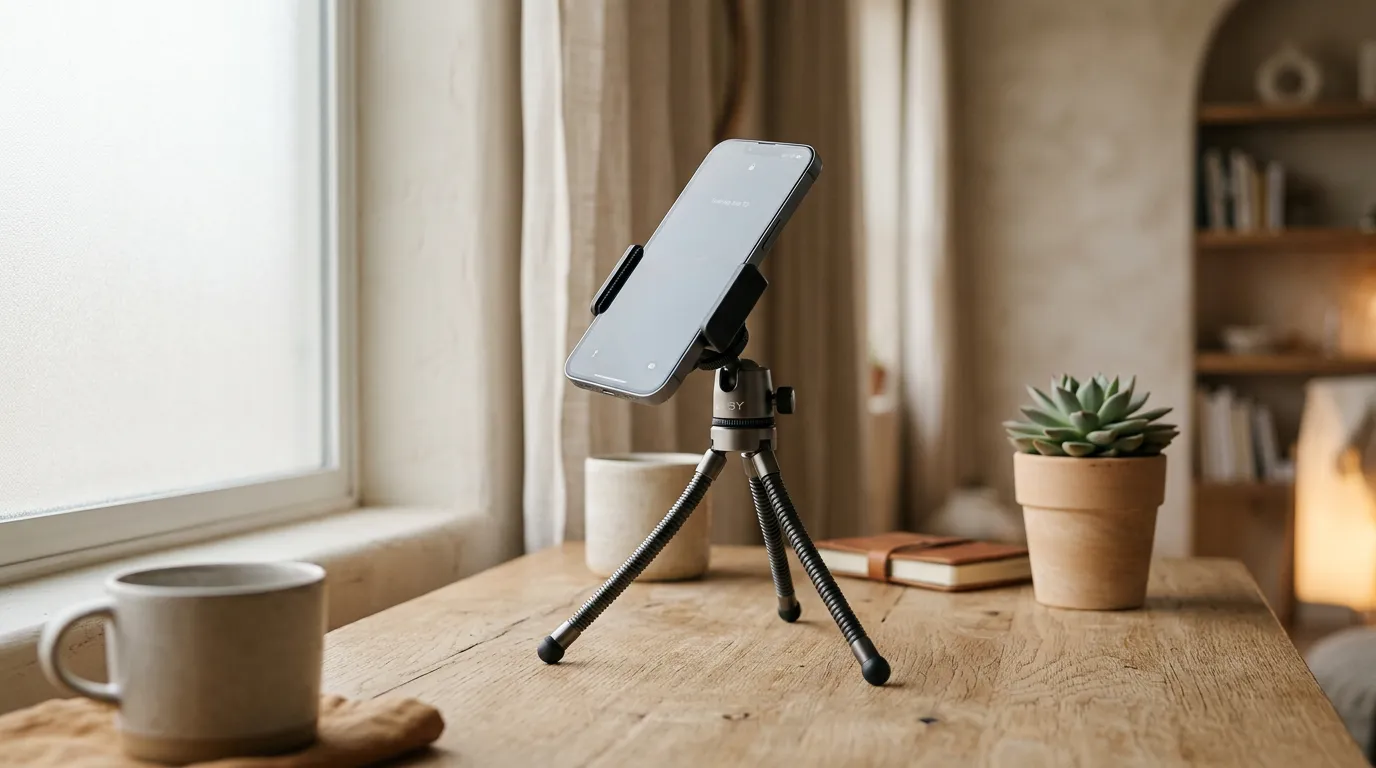
- Prop your phone against something a little taller than eye level, a stack of books, a shelf, a half-open drawer, instead of holding it in your hand, where it naturally drifts down toward chin height without you noticing.
- Use the front camera's grid lines if your phone has them, and aim to keep your eyes in the upper third of the frame rather than dead center.
- Set a timer instead of holding a pose while you tap the shutter. The extra second before the photo fires gives your face time to settle into a natural expression instead of the slightly braced look most people pull right as they press the button.
- Take more than one shot with a slightly different head turn each time. The difference between a three-quarter angle that works and one rotated a touch too far is often only visible once you compare a few side by side.
The two mistakes that quietly cancel the effect
- Shooting from below. This is the reverse of what the research supports: an upward-angled camera pointed up at your face, common in low-held phone selfies, exaggerates the jaw, chin, and nostrils rather than narrowing anything. If your phone or camera sits lower than your eyeline, you're doing the opposite of the flattering angle, not a milder version of it.
- A flat, dead-on face with no rotation. Even with a good camera angle, staring straight into the lens gives up the contour that rotation creates. This is the single most common reason a technically "correct angle" photo still looks flat: the elevation was right, but the face never turned.
Lighting angle matters here too, and the threshold is more specific than most people assume. A 2021 study in Aesthetic Plastic Surgery found no meaningful change in perceived attractiveness between 0° and roughly 30° of light angle relative to the face. Past 30°, and especially around 60°, attractiveness ratings drop and the same face is judged as having a visibly higher facial BMI, because strong side lighting digs shadows into the face in a way that straight-on or gently angled light doesn't. If a photo already has the right camera angle and face rotation but still looks off, check where the light is coming from before blaming the pose.
Your Appearance Score
What's Your Appearance Score?
60 seconds. Get a score based on your habits.
Selfie close-up or someone else's camera at a distance? It depends what the photo is for
There isn't one universally "best" distance either, it depends on what the photo needs to do. Close-up, filtered selfies are consistently rated as more attractive and healthier-looking by observers than photos taken from further away with a proper camera. But those same distanced, DSLR-style photos are rated as more confident, more intelligent, and more competent. That's not a contradiction, it's two different signals doing two different jobs: a close selfie reads as attractive and approachable, a photo taken from a bit further back by someone else reads as credible and put-together. A dating profile photo and a professional headshot are optimizing for genuinely different perceptions, and using the same photo style for both is one of the more common mismatches people make without realizing it.
A 2020 study in Facial Plastic Surgery & Aesthetic Medicine compared close-up filtered selfies against photos taken with a DSLR camera from a normal conversational distance. Observers rated the selfies as more attractive and healthier-looking, but rated the DSLR photos as more confident, intelligent, and competent. The right choice genuinely depends on the goal: closer and warmer for dating or social profiles, a bit more distance and a proper camera for anything meant to signal competence.
Why a video call screenshot sometimes looks better than any posed photo
There's a separate, slightly stranger finding that explains a common complaint: "I never look right in photos, but I look fine in real life." Faces captured from the same video clip are consistently rated as more attractive when shown moving than when frozen as a single still frame, researchers call it the frozen face effect. The likely explanation is that the brain doesn't lock onto one exact position when it watches a moving face, it averages the string of positions a face moves through, and faces that read as more "averaged" get rated as more attractive. A single still frame captures one exact position, sometimes mid-blink or mid-expression, that never quite looked like "you" to begin with. And this isn't unique to faces: the same motion-over-stillness preference shows up when people rate ordinary objects, which suggests it's a broader feature of how the brain processes what it sees, not something specific to vanity or self-image.
Post and colleagues, in Frontiers in Psychology (2012), extracted still frames from video clips of the same faces and found they were consistently rated as less attractive and less flattering than the same faces shown in motion, the frozen face effect. A separate study by McDowell and Haberman in PLOS One (2019) found the same bias applies beyond faces: ordinary objects in motion are rated as more aesthetically pleasing than the identical objects frozen in time, suggesting the brain is generally wired to prefer motion over stills.
Putting it together
None of this requires a professional shoot. Hold the camera a little above eye level instead of at chin height, turn your face partway instead of facing the lens dead-on, keep your chin slightly forward instead of tucked or lifted, and check that the light isn't hitting you hard from one side. If the photo is for a dating profile or anything meant to feel warm, a closer, more filtered selfie style works in your favor; if it needs to read as competent or credible, hand the camera to someone else and step back a bit. And if every posed photo you take looks stiff no matter what you try, grab a frame from a video instead of aiming for the perfect held pose, a caught-mid-motion shot often looks more like you than a held-still one ever will.
It's worth being honest about what a camera angle can and can't do. None of this changes what's actually happening on your face day to day, a puffy jawline from too much sodium the night before, dull skin from a rough stretch of sleep, or the kind of low-grade water retention that no angle fully hides once you know what you're looking for. A good angle photographs what's already there more flatteringly. It doesn't change what's there. That part comes from the plate, the sleep, and the water intake behind the photo, not from where the camera sits.
That's exactly the gap HALOIA is built to close. While a good camera angle makes the most of your face on any given day, HALOIA's meal tracking and skin score are working on the actual input, the sodium, the hydration, the sleep-adjacent habits, that decide whether your face looks like that on a good day or a rough one. If you want a quick read on where your own habits currently stand, HALOIA's free appearance quiz gives you a baseline before you change anything.
This article is for information only and is not a substitute for medical advice. For any question about your health, a treatment or a supplement, consult a qualified professional.
Improve your appearance by eating better
Build real confidence by tracking your diet. Download HALOIA and start your tracking.

Go further
Should You Hire a Photographer for LinkedIn?
A close-up selfie and a professional headshot don't just look different, they make people think different things about you. Here's what the research actually shows, and how to get most of the effect without booking a studio.

Does Building a Non-Smoker Identity Help You Quit?
Willpower treats every cigarette as its own fight to win. Identity skips the fight entirely. Here's what a year-long study of 623 smokers found, and how the same lever works on food and exercise too.
Cold Showers: The Real Effect on Stress
Everyone's doing cold showers for the mental health benefits, but the science is pickier than the trend suggests: the calming effect is real, it just isn't the one you get from a single icy blast.