
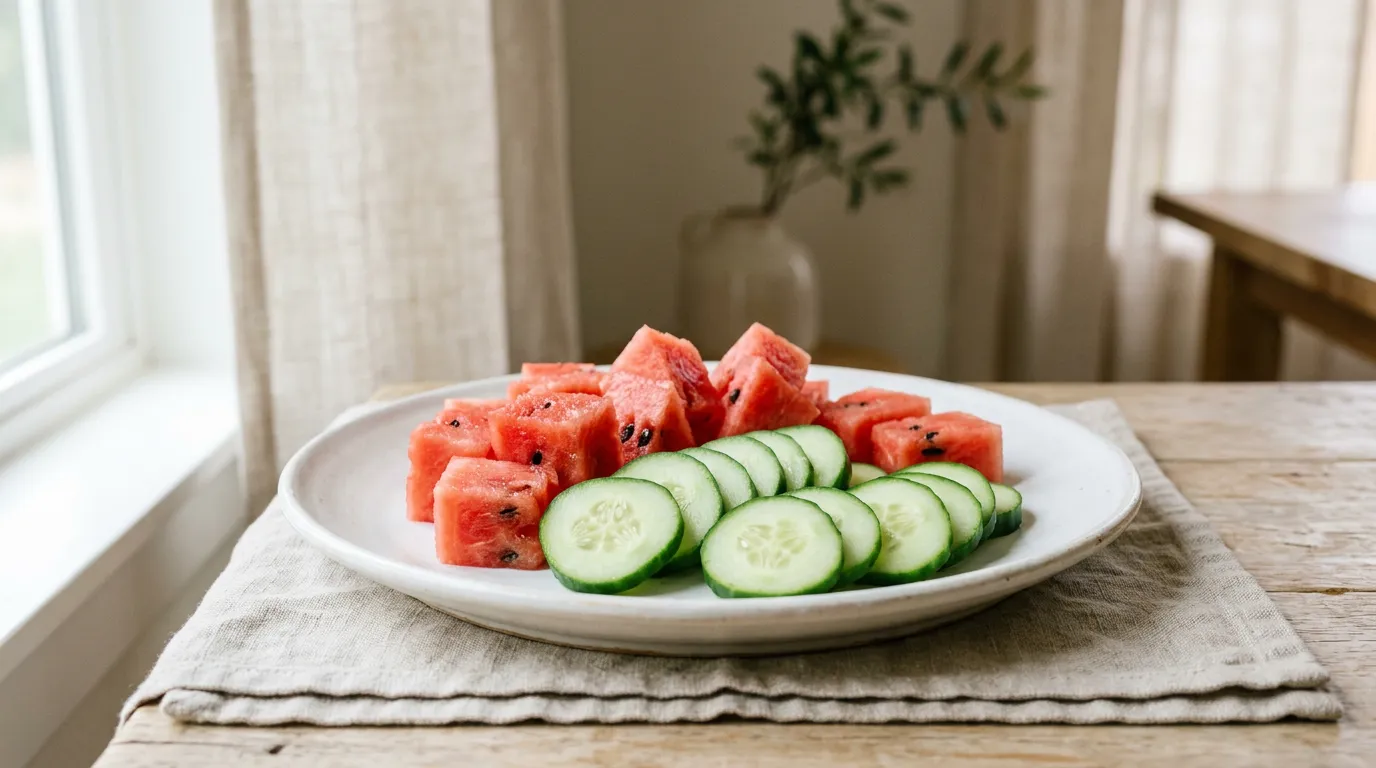
The Foods That Reduce Facial Bloating
That tight, puffy look isn't fixed structure — it's fluid, and fluid responds to what you eat. Here's the actual mechanism, and what to change.
 Damien, founder of HALOIA11 min read
If your face looks puffier by evening, after a salty meal, or first thing after a rough night's sleep, that's not permanently written into your bone structure — it's fluid, and fluid responds to what you eat. The main thing to look at is sodium: higher intake is associated with more fluid outside the cells, even in people without high blood pressure. Potassium-rich foods are often suggested as a counterweight, though the studies cited here did not test that, and refined carbs add a smaller but real water load of their own, and a few habits (posture, alcohol, a late soda) make it worse without you noticing. None of this fixes structural puffiness — the kind from fat distribution or skin laxity, which is a different problem entirely. But for the tight, bloated, "not quite myself" look that shows up and disappears within a day, food is a reasonable place to start.
Why Your Face Bloats Before Anywhere Else
Facial skin is thin, tightly bound to the tissue underneath, and sits directly over a dense network of small blood vessels — which is exactly why fluid shifts show up there first and most visibly, often before you'd notice the same shift in your calf or forearm. The fluid in question lives in the space between your cells, the extracellular compartment, and its volume is controlled largely by sodium: wherever sodium concentration rises, water follows it to dilute things back to balance. Eat a high-sodium meal and your body holds onto extra water to keep that balance — a real, measurable physiological response, not an allergy, an intolerance, or a sign that something's wrong with you.
In a cross-sectional study of 510 adults (normotensive and untreated hypertensive), people with the highest salt intake, measured by 24-hour urinary sodium, had more extracellular water, measured by bioimpedance, without higher blood pressure. The groups were not analyzed separately and no salt-reduction intervention was tested, so this shows an association, not that cutting salt reduces puffiness (Taurio et al., Blood Pressure, 2023).
This kind of bloating is also unusually fast to reverse compared to almost any other visible change diet can produce — most of it resolves within 24 to 48 hours of correcting the trigger, rather than the weeks it typically takes for something like acne or dullness to respond to a diet change. That's useful information on its own: if a "de-bloating" routine hasn't shown anything after two full days of consistently lower sodium and alcohol, the puffiness you're looking at probably isn't fluid-driven at all, and no amount of extra potassium is going to fix it.
The Sodium-Potassium Balance, Explained
Sodium and potassium both take part in how your body regulates fluid, and many people eat a lot of sodium and little potassium. Whether eating more potassium-rich foods changes facial puffiness has not been shown in the studies cited here. The foods below are simply whole foods that are naturally low in sodium and easy to use in place of salted, processed ones.
- Leafy greens (spinach, Swiss chard, kale) — high potassium, low sodium, and easy to add to a meal you're already making rather than a separate dish.
- Bananas and oranges — the go-to example for a reason, but not uniquely powerful; most whole fruit contributes similarly.
- Potatoes and sweet potatoes, skin on — among the most potassium-dense common foods, undone fast if you salt them heavily after cooking.
- Avocado — potassium-dense with healthy fat, and an easy direct swap for sodium-heavy spreads and bottled dressings.
- White beans and lentils — a potassium source most "de-bloating" food lists skip entirely, despite being one of the denser options per serving.
You don't need to hit a specific gram target to notice a difference — for most healthy adults, consistently choosing potassium-rich foods over refined, salted ones across a normal week is a reasonable, low-risk habit. One caveat worth stating plainly: if you have kidney disease or take medication that affects potassium levels (certain blood pressure drugs, for example), more potassium isn't automatically better, and you should check with a doctor before deliberately increasing intake.
The "Puffy After Pasta" Effect: Carbs and Water
If your face — and the rest of you — feels puffier the morning after a carb-heavy dinner, refined carbohydrates deserve some of the blame, for a specific mechanism, not just guilt. Carbohydrate you don't burn immediately gets stored as glycogen in your muscles and liver, and glycogen is stored bound to water, at a ratio of roughly 3 to 4 grams of water for every gram of glycogen. Eat a large refined-carb meal, restock those glycogen stores, and you're carrying measurably more water the next morning than you were the day before — nothing to do with fat gain, everything to do with storage chemistry running its normal course.
The idea that refined carbs cause visible water retention via glycogen-bound water (roughly 3-4g of water per gram stored) is classic physiology, but a recent review notes the relationship remains poorly quantified in humans — the effect is likely real, just more modest than commonly claimed (Shiose et al., Nutrients, 2022).
This is genuinely water, not fat, and the distinction matters for how you respond to it: cutting calories aggressively in reaction to a puffy morning solves the wrong problem, since it does very little to the glycogen-bound water already sitting there, and can leave you worse off a few days later once those glycogen stores get restocked all at once. The fastest way to lose that specific water weight is simply time and normal activity, not further restriction.
Morning Puffiness Isn't Always About What You Ate
Not every puffy morning traces back to last night's dinner. Lying flat for 7-8 hours removes the gravity that normally keeps fluid moving toward your legs during the day, so some of it redistributes toward your face and eyes overnight — which is also why puffiness from a genuinely benign cause tends to fade within an hour or two of being upright and moving. The same fluid-shift mechanism is well documented elsewhere in the body: one study found that simply sitting still for 10 hours increased fluid volume in the calf by roughly 145 ml, fully reversible once movement resumed. Your face runs on the same physics, just on a smaller, faster scale, overnight instead of over a workday.
In a study of 12 healthy volunteers who sat for 10 hours in an airplane seat (oxygen-depleted air), the volume of the leg below the knee increased by up to 145 ml and returned to normal the next day (Mittermayr et al., Thrombosis Research, 2007).
Sleep position adds a smaller, related variable: sleeping face-down or with your face pressed into a pillow traps fluid against the skin in one spot for hours, which is why puffiness is often lopsided — worse on whichever side you slept on. Elevating your head slightly, even with one extra pillow, gives gravity a small head start before you're even upright, and it's a low-effort adjustment that stacks with everything else here rather than replacing it.
Your Appearance Score
What's Your Appearance Score?
60 seconds. Get a score based on your habits.
What to Limit If Your Face Runs Puffy
You don't need to eliminate anything outright — sodium and refined carbs aren't the enemy; overloading on both at once, regularly, is what keeps the fluid-retention cycle running. The foods actually worth watching are the ones that deliver a large sodium load without you registering it as "salty." That's less about the saltshaker on your table and almost entirely about what's already mixed into packaged and restaurant food before it reaches you.
- Processed and deli meats — among the highest sodium-per-bite foods in a normal diet, often 400-700mg of sodium in a small serving.
- Restaurant and packaged sauces (soy sauce, salad dressing, pasta sauce) — where a large share of daily sodium hides without tasting overtly salty.
- Instant noodles, canned soups, and frozen ready meals — engineered for shelf life and flavor, and both lean heavily on sodium to get there.
- Alcohol — dehydrates you first, which prompts your body to hold onto extra fluid once you rehydrate, compounding the next day's puffiness.
- Sparkling water or soda in large volumes right before bed — not a sodium issue, just added fluid load at the exact time your body is least able to process and clear it before you lie down.
None of this means memorizing sodium content off a label every time you eat. The more reliable habit is noticing which meals in your week are pre-made by someone else — a restaurant, a packaging line, a delivery app — since that's almost always where the bulk of hidden sodium is sitting, regardless of how salty the dish actually tastes on the tongue.
Myths Worth Retiring: PMS Bloat and "Lymphatic Drainage"
Two popular explanations for facial puffiness don't hold up well under actual research. The first is that premenstrual bloating comes from the body retaining sodium — it doesn't. A controlled study found women actually excrete more sodium during the luteal phase, and restricting salt intake didn't reduce the bloating at all, which points to a hormonal fluid shift, not a salt problem you can eat your way out of.
Contrary to popular belief, premenstrual bloating doesn't appear to be caused by sodium retention: in a small prospective study of 13 women, sodium excretion was higher in the luteal phase, and restricting salt did not reduce the symptoms (Olson et al., Annals of Internal Medicine, 1996).
The second myth is "lymphatic drainage" as a beauty routine. Gua sha and facial rollers do have a measurable effect — a randomized trial found real improvements in facial contour (a 2-3mm reduction) and muscle tone after 8 weeks of consistent use — but that's a mechanical, local effect on tissue and muscle, not fluid being "drained" anywhere. Searches of the medical literature turn up almost no studies on cosmetic facial lymphatic drainage for everyday puffiness at all; nearly everything published on the topic concerns actual post-surgical or post-cancer lymphedema, a different condition entirely. If gua sha feels good and looks like it helps, keep doing it — just don't expect it to undo what a sodium-heavy dinner did the night before.
A One-Week De-Puffing Routine You Can Actually Follow
None of this requires an overhaul. Give it one week, change a handful of specific things, and take a same-lighting, same-angle photo each morning so you're comparing data instead of memory — day-to-day fluctuation is normal, and without a record it will convince you nothing's working even when it is.
- Days 1-2: swap one processed or restaurant meal a day for a home-cooked one, and add a potassium-rich food (leafy greens, potatoes, beans) to at least one meal daily.
- Days 3-4: cut sauces and dressings roughly in half, or make your own — this is where most hidden sodium actually comes from, more than the saltshaker ever will.
- Day 5: skip alcohol for one night and check the next morning; it's usually the single most visible change on this list.
- Days 6-7: keep dinner earlier and lighter on refined carbs, and get up and move within 30 minutes of waking to help redistribute overnight fluid faster.
- Every morning: same lighting, same angle, one photo. Comparing week 1 to week 2 is the only way to actually know it's working, instead of guessing from how you feel.
One realistic expectation to set going in: this routine won't touch bone structure, fat distribution, or skin laxity, because none of that is fluid-driven in the first place. What it will do, reliably, is take the edge off the tight, waterlogged look that comes and goes with what you ate and how you slept — which, for most people, is the actual complaint behind "why does my face look puffy."
The genuinely hard part isn't knowing that sodium and refined carbs affect how your face looks — it's noticing the pattern in your own meals, since hidden sodium in sauces and packaged food is nearly impossible to track from memory alone. That's exactly what HALOIA's meal logging is built for: log what you actually eat, and it flags your real sodium and carb load against how your skin and puffiness scores move week to week, instead of leaving you to guess which dinner did it.
If you want a faster starting point than a week of trial and error, HALOIA's free appearance quiz gives you a baseline read on your current diet and habits before you change anything.
Sources
This article is for information only and is not a substitute for medical advice. For any question about your health, a treatment or a supplement, consult a qualified professional.
Improve your appearance by eating better
Build real confidence by tracking your diet. Download HALOIA and start your tracking.

Go further
The Best Breakfast for Clear Skin in Your 20s
Forget "eat clean" advice with no specifics. Here's the exact breakfast structure that keeps blood sugar stable and gives your skin what it needs to repair overnight's damage.
Ashwagandha: Its Real Effect on Stress and Training
Ashwagandha gets credited for almost everything. Two claims actually hold up in controlled trials — stress/cortisol and strength/muscle — and they don't have the same evidence behind them. Here's the honest breakdown.
Who Should Never Fast?
Intermittent fasting is safe for most healthy adults — but not for everyone. Here's exactly who should skip it, and why, according to the research.