
Sodium and Water Retention: The Real Link
Salty food really does make your face puffier — but not through the mechanism, or the culprit, you probably assume. Here's what actually drives it, and what doesn't.
 Damien, founder of HALOIA11 min read
Water retention from sodium is real, but it's not what most people blame it for. It's driven almost entirely by extracellular fluid shifting to match how much salt is circulating in your bloodstream — not by muscle glycogen, not by your period, and not by drinking too much water. A 2023 study confirmed that high sodium intake directly raises extracellular water volume even in healthy people with completely normal blood pressure, which means the puffiness you're chasing isn't some vague metabolic mystery — it's simple osmosis responding to what's actually on your plate. The fix isn't dramatic either: most of the damage comes from four or five specific categories of food, not the salt shaker, and the visible effect usually shows up within a day, not weeks. Here's the actual mechanism, where the sodium is really coming from, how long it takes to show on your face, and how to tell ordinary daily puffiness from something that needs a doctor instead of a diet change.
The Mechanism: Why Salt Pulls Water Into Your Face
Your body works hard to keep the concentration of sodium in your blood inside a narrow range, because too much or too little disrupts nearly every cell in your body. When you eat more salt than usual, sodium concentration in your bloodstream rises, and water follows it by osmosis — moving out of cells and into the extracellular space, the fluid that sits between cells and around blood vessels, to dilute that excess sodium back down toward normal. This isn't a slow metabolic adaptation; it's a direct physical response, and a 2023 study in Blood Pressure confirmed it happens even in people with no underlying blood pressure issue at all: high sodium intake directly raises extracellular water volume in healthy participants, independent of any effect on hypertension. That distinction matters, because it means you don't need to be "salt-sensitive" in the clinical sense, or have any diagnosed condition, to visibly retain water after a salty meal — the mechanism applies to ordinary, healthy physiology.
In a cross-sectional study of 510 adults (normotensive and untreated hypertensive), people with the highest salt intake, measured by 24-hour urinary sodium, had more extracellular water, measured by bioimpedance, without higher blood pressure. The groups were not analyzed separately and no salt-reduction intervention was tested, so this shows an association, not that cutting salt reduces puffiness (Taurio et al., Blood Pressure, 2023).
Layered on top of that immediate osmotic shift is a slower hormonal one. When your kidneys sense a drop in blood volume — which can happen for reasons that have nothing to do with salt, like mild dehydration or standing for long periods — they trigger the release of aldosterone, a hormone that tells the kidneys' tubules to reabsorb sodium instead of excreting it, and water follows the sodium right back into the bloodstream. This is the actual mechanism behind why one very salty meal, a bag of chips, a plate of restaurant pasta, a fast-food combo, can leave your face visibly puffier the next morning: your kidneys are actively holding onto both the sodium and the water bound to it, on top of the osmotic shift that already happened at the cellular level. Given a day or two without another sodium spike, healthy kidneys typically bring both back down, which is a big part of why this kind of retention resolves on its own once intake normalizes, rather than compounding indefinitely. It's also worth knowing this response isn't identical from person to person: some people are more "salt-sensitive" than others, meaning their fluid balance shifts more sharply in response to the same sodium load, while others show a much flatter response. If a friend eats the same salty dinner as you and wakes up looking unaffected, that's not proof the mechanism above is wrong for you — it's a documented difference in individual physiology, not a sign you're imagining your own reaction.
Where the Sodium Actually Comes From (It's Not Your Salt Shaker)
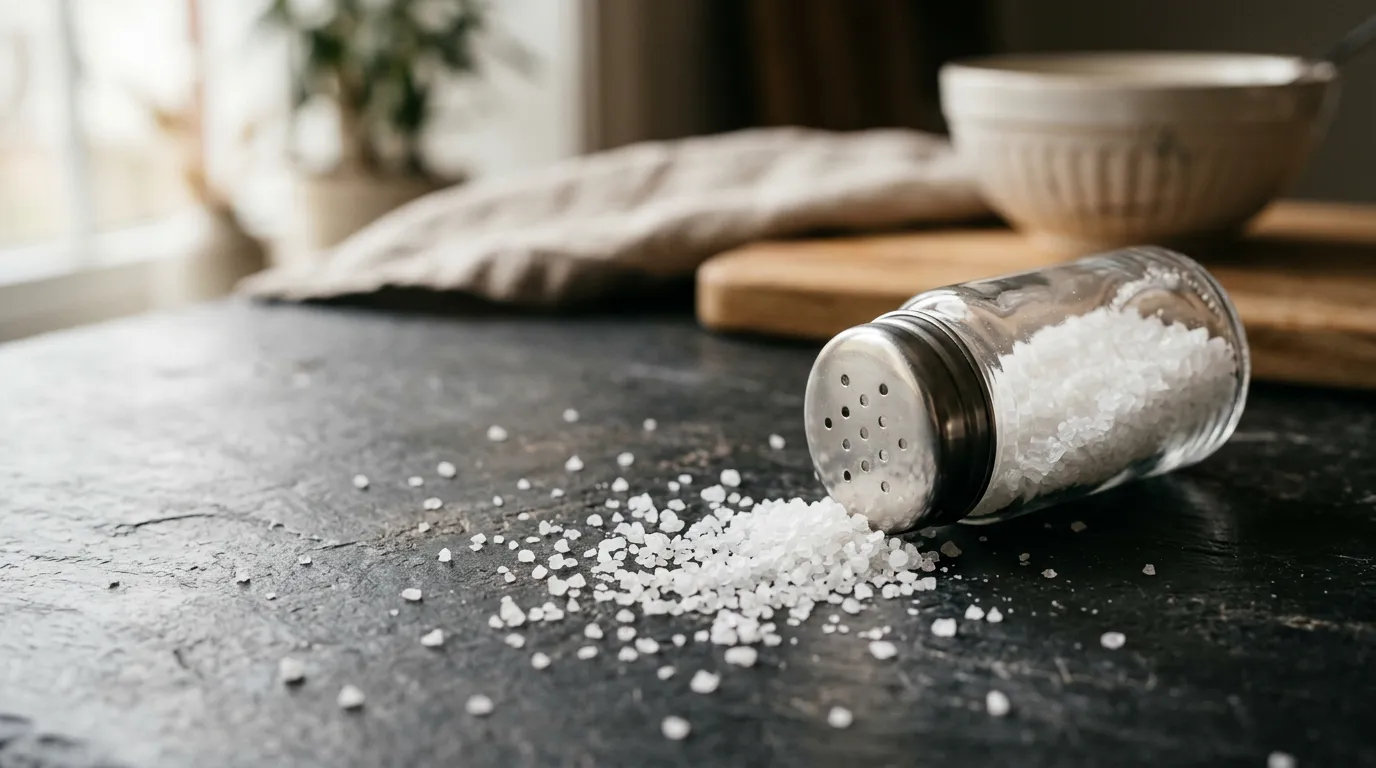
The instinct is to blame the salt shaker, but for most people it barely moves the needle. The overwhelming majority of dietary sodium comes from food that's already salted before it reaches your plate. Processed and pre-packaged meals, sauces and condiments, and cured or deli meats are the three categories that show up again and again in the research connecting sodium intake to fluid retention — and none of them taste as aggressively salty as a handful of fries, which is exactly why they're so easy to underestimate. A jar of pasta sauce, a splash of soy sauce or teriyaki glaze, a couple of slices of deli turkey, a can of soup, a frozen dinner: these deliver meaningful sodium without ever prompting the "this is salty" reaction that would make you second-guess it. Restaurant and takeout food sits in its own category on top of that. Kitchens season for immediate flavor impact, not for your extracellular fluid volume, and a single restaurant meal can easily carry more sodium than what you'd add cooking the same three meals yourself at home.
- Processed and pre-packaged meals — frozen dinners, canned soups, boxed pasta or rice mixes, salted for shelf life and flavor, not for a "salty" taste.
- Sauces and condiments — soy sauce, teriyaki, ketchup, salad dressing, pasta sauce, added in volumes people almost never measure.
- Cured and deli meats — bacon, salami, deli turkey, ham, salted primarily as a preservation method, not as seasoning.
- Restaurant and takeout meals — seasoned for taste impact, and typically carrying far more sodium than a home-cooked equivalent of the same dish.
- Bread and cheese — individually moderate in sodium, but eaten in high enough daily volume that the totals add up fast.
How Fast You'll Actually See It
The osmotic shift itself starts within hours of a high-sodium meal — that's simple physics, not biology that needs time to catch up. But visible puffiness, especially in areas with thin skin and loose underlying tissue like the face and under the eyes, usually takes a bit longer to actually show, because it depends on where that extra fluid settles and how your kidneys respond as you sleep. Alcohol offers one of the clearest documented examples of exactly this lag. Research on alcohol's hormonal effects found that it initially suppresses vasopressin, the hormone that helps your body hold onto water, which is why you get dehydrated and need to urinate frequently during a night of drinking. But once your blood alcohol level drops, often while you're asleep, vasopressin rebounds and your body starts retaining water again — a documented contributor to that swollen, puffy-face feeling the next morning.
Alcohol first suppresses vasopressin, explaining dehydration during a night out; but once blood alcohol drops, often the next morning, vasopressin rebounds and triggers water retention, contributing to that puffy-face feeling — Taivainen et al., Alcohol Clin Exp Res (1995).
The same basic pattern applies to a sodium-heavy meal on its own, alcohol or not: the shift starts fast at the cellular level, but the version you actually see in the mirror is usually a next-day effect, not an instant one. That's a useful thing to know if you're trying to connect cause and effect — the puffiness you notice on a Tuesday morning is more likely explained by Monday night's dinner than by anything you ate that same morning. One more piece worth knowing: staying adequately hydrated actually helps your kidneys excrete the excess sodium faster, not slower — the common fear that drinking water while already retaining water will make it worse has it backwards. Chronic under-hydration, if anything, makes your kidneys hold onto whatever sodium and water they can, which can drag the whole process out longer than it needs to.
Your Appearance Score
What's Your Appearance Score?
60 seconds. Get a score based on your habits.
What Doesn't Cause It (Even Though You've Probably Blamed It)
Premenstrual bloating gets blamed on sodium constantly, but a controlled study found close to the opposite of what people assume: women actually excrete more sodium during the luteal phase, not less, and restricting salt intake during that window did not reduce bloating symptoms. Whatever is actually driving premenstrual bloating, it isn't the mechanism described above — it's a separate hormonal process entirely, and treating it with a low-sodium diet is treating the wrong variable.
Contrary to popular belief, premenstrual bloating doesn't appear to be caused by sodium retention: in a small prospective study of 13 women, sodium excretion was higher in the luteal phase, and restricting salt did not reduce the symptoms (Olson et al., Annals of Internal Medicine, 1996).
Refined carbs get blamed too, through the idea that glycogen, the stored form of carbohydrate in your muscles, binds roughly 3 to 4 grams of water for every gram stored. That physiology is real and well established, but a recent review notes the actual size of this effect in humans remains poorly documented — probably a genuine contributor to how "puffy" you feel after a carb-heavy meal, but more modest than the claim usually implies, and mechanistically distinct from the sodium-driven extracellular retention covered above. Creatine supplementation causes a related but separate confusion. An analysis covering 684 randomized trials and more than 12,800 participants found creatine's only common, real side effect is mild-to-moderate water retention — but that water is pulled into muscle cells, not into the extracellular space the way sodium retention works. If you're taking creatine and also eating a high-sodium diet, both mechanisms can run at the same time, which is exactly why it's worth isolating sodium specifically instead of treating "water retention" as one single-cause phenomenon.
Across an analysis of 684 randomized trials and over 12,800 participants, creatine's only real, common side effect was mild-to-moderate water retention — pulled into muscle cells, a different mechanism than sodium-driven extracellular retention — Gonzalez et al., Sports (Basel) (2026).
How Much to Actually Cut
Public health guidelines don't ask you to eliminate sodium, only to keep it within a range: the WHO recommends under 2,000 mg of sodium a day, and the FDA's benchmark sits at 2,300 mg, roughly one teaspoon of salt total, counting every source combined, not just what you add at the table. Most people overshoot that not through dramatic overeating but through the categories covered above quietly stacking up across a normal day — cereal or bread at breakfast, a sandwich with deli meat and condiments at lunch, a sauce-heavy dinner, a handful of salted snacks in between. A practical move isn't cutting salt at the table, since that's rarely where most of it comes from; it's swapping one or two of the categories above (the deli meat, the jarred sauce, the frozen meal) for a version made from ingredients you can actually name, and checking labels on the ones you keep, since sodium content varies enormously between near-identical products sitting on the same shelf. For context on why this is worth the effort beyond puffiness: a meta-analysis of 30 randomized trials found that a lower-sodium, higher-produce eating pattern (the DASH diet) lowered systolic blood pressure by an average of 3.2 mmHg, with a stronger effect in people already eating a high-sodium diet to begin with — that eating pattern is linked to a marker that matters far more than appearance, though the studies cited here don't show that it changes how puffy you look.
Normal Puffiness vs. Something That Needs a Doctor
Not every version of "puffy" traces back to sodium, and it's worth being precise about that instead of assuming every morning of swelling is diet-related. Under-eye bags, for instance, are largely anatomical rather than fluid-driven: research combining imaging and clinical assessment attributes them mainly to fat volume loss, skin laxity, and structural changes in the bone beneath the eye, not simply water sitting there. That's also part of why massage and "lymphatic drainage" routines have almost no dedicated research behind them for everyday, benign puffiness — most of what's actually been studied on facial lymphatic drainage concerns post-surgical or post-cancer lymphedema, a genuinely different medical condition, not the kind of puffiness a salty dinner causes.
The retention covered in this article is the ordinary kind: it fluctuates with what you ate the day before, it's roughly symmetrical, it resolves within a day or two once intake normalizes, and it doesn't come with pain, redness, or swelling concentrated on one side. If puffiness or swelling is persistent regardless of what you eat, concentrated on one side of your body, painful, or shows up alongside symptoms like shortness of breath or unusual fatigue, that's outside the scope of a dietary fix and worth a real conversation with a doctor — it can point to kidney, thyroid, heart, or venous issues that a sodium swap won't touch, no matter how well you execute it.
Tracking sodium by hand is genuinely tedious — it means reading nutrition labels on everything from bread to salad dressing and running a mental tally most people abandon within a week. That's exactly the kind of pattern HALOIA's meal logging is built to surface automatically: log what you actually eat, and it flags when sodium is the more likely explanation for how your face looks that morning, instead of leaving you to guess between salt, hormones, carbs, or something else entirely.
If you want a faster starting point than trial and error, HALOIA's free appearance quiz gives you a baseline read on your current diet and habits before you change anything.
Sources
This article is for information only and is not a substitute for medical advice. For any question about your health, a treatment or a supplement, consult a qualified professional.
Improve your appearance by eating better
Build real confidence by tracking your diet. Download HALOIA and start your tracking.

Go further
The Best Breakfast for Clear Skin in Your 20s
Forget "eat clean" advice with no specifics. Here's the exact breakfast structure that keeps blood sugar stable and gives your skin what it needs to repair overnight's damage.

Ashwagandha: Its Real Effect on Stress and Training
Ashwagandha gets credited for almost everything. Two claims actually hold up in controlled trials — stress/cortisol and strength/muscle — and they don't have the same evidence behind them. Here's the honest breakdown.

Who Should Never Fast?
Intermittent fasting is safe for most healthy adults — but not for everyone. Here's exactly who should skip it, and why, according to the research.