
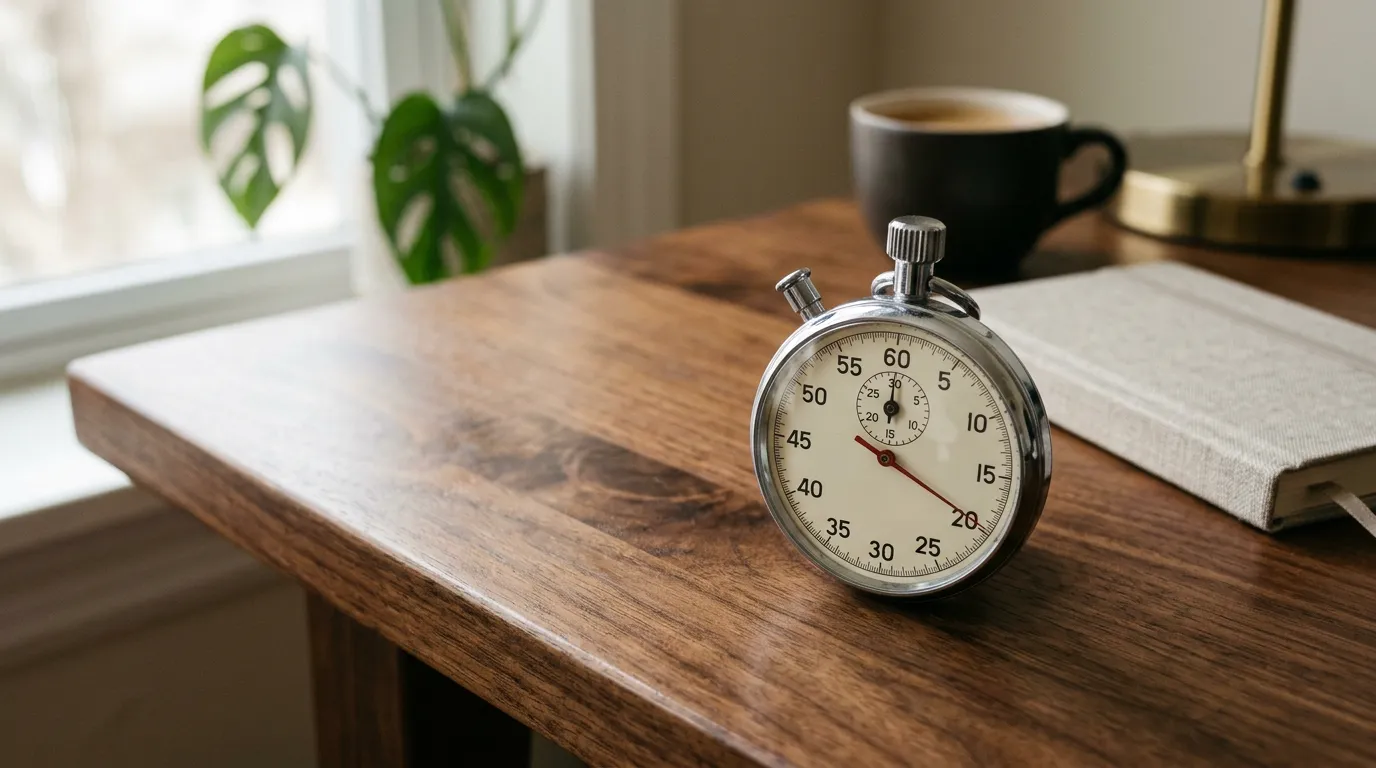
23 Seconds of Video Is Enough to Judge Confidence
A stranger can guess how confident you really are before you've said a single meaningful word. Here's what your voice, eyes, and posture are actually giving away in that window, and why you can't fake it for long.
 Damien, founder of HALOIA10 min read
Researchers once handed strangers nothing but a single unedited clip: someone introducing themselves on camera for 23 seconds, no script, no retakes, no do-overs. From that alone, the strangers guessed the person's real, previously measured self-esteem with accuracy too consistent to be chance. Not how confident the person tried to sound. Their actual baseline. The strangers weren't parsing the words at all — they were picking up on warmth in the voice, how steady the eye contact was, how the body carried itself. That's the uncomfortable part worth sitting with: most of what reads as confidence to another person isn't something you say. It's something you can barely control on the spot, which is exactly why so much confidence advice quietly fails.
What the 23-second video study actually found
Here's how the setup worked. Participants first filled out a validated self-esteem questionnaire in private, with no social pressure to perform for anyone. Then each of them recorded a short, unscripted self-introduction on camera, the kind you'd do meeting someone new for the first time. Strangers who had never met them watched only that 23-second clip and guessed how the person had scored on the private questionnaire. Their guesses lined up with the real scores at a rate too consistent to be luck. What makes this more than a fun fact is what the strangers were actually using to guess: not confidence rhetoric, not life achievements, not even how impressive the introduction sounded on paper. Accuracy tracked mainly with nonverbal and vocal warmth — tone, ease, how naturally someone held themselves, almost none of it tied to the content of what they said.
Strangers can detect a person's actual self-esteem level with statistically significant accuracy from a single 23-second self-introduction video, relying mainly on nonverbal and vocal warmth cues, not the content of what's said. (Hirschmüller et al., Journal of Personality, 2018)
The signals people are reading without realizing it
None of this happens through conscious analysis. Nobody sits there scoring your eye contact on a scale. But several of the specific channels being weighed have been isolated well enough in research to know roughly what's picked up, often within the first couple of seconds of meeting someone or a few sentences into hearing them talk.
- Eye contact and pupil response: how much eye contact feels comfortable varies a lot person to person, but it's linked to something you can't fake on purpose — people who naturally prefer longer eye contact show their pupils dilating faster when looking at another person, a physiological reflex that sits outside conscious control.
- Voice pitch: both men and women rate lower-pitched voices as more leader-like, for male and female speakers alike. In a real-world test covering the 796 candidates measured in the 2012 U.S. House elections, lower-pitched candidates won a larger vote share against male opponents, though the advantage reversed against female opponents.
- Articulation: speaking with clearer, more distinct pronunciation, not necessarily louder or slower, reads as higher social status to other listeners, and as more attractive for a long-term relationship specifically.
- Speech rate: a faster, more fluent pace increases how credible and persuasive a message sounds, independent of how strong the actual argument is underneath it.
- Gestures: using hand movements that concretely illustrate what you're saying, instead of random filler motion, makes a speaker sound more competent and more persuasive — confirmed across more than two thousand recorded talks and repeated in controlled experiments.
- Posture: facing someone with an open, expansive posture tends to pull a more relaxed, less guarded posture out of the other person, and vice versa. This "complementary" back-and-forth is part of what makes an interaction feel comfortable, or slightly off, before either person consciously notices why.
Both men and women prefer lower-pitched voices in leaders, for both male and female candidates; an analysis of the 796 candidates measured in the 2012 U.S. House elections found lower-pitched voices won a larger vote share against male opponents, with the effect reversing against female opponents. (Klofstad, Political Psychology, 2016)
Why your face already tilts the score before you say a word
There's a less fair layer sitting underneath all of this. Attractiveness distorts the reading before any of the signals above even get a real chance to register. In trust research, a face seen straight-on with a direct gaze is rated as the most trustworthy option available — but attractiveness overrides almost all of that nuance: a highly attractive face gets rated as trustworthy nearly regardless of where it's actually looking. This isn't a new phenomenon dressed up in new language. It's a version of the halo effect, first documented back in 1920, when a researcher noticed that expert evaluators rating people on supposedly unrelated traits kept producing suspiciously high correlations between them, essentially judging the whole person off one strong impression instead of each trait on its own. The classic demonstration of it is blunt: shown nothing but a photo and zero real information, people rate physically attractive strangers as having better personalities and a brighter future ahead of them.
The appearance-based halo effect persists in the digital era: across nearly 2,750 raters judging 462 faces, the same people received significantly higher perceived intelligence and trustworthiness ratings once a beauty filter was applied to their photo, compared to the unmodified version. (Gulati et al., Royal Society Open Science, 2024)
It also doesn't run symmetrically in your favor just because you're average-looking on a given day. Some research suggests the bias functions more as an "ugly is bad" penalty than a "beautiful is good" bonus, meaning the real risk isn't missing out on an unearned boost, it's getting unfairly marked down when you look tired, puffy, or run-down, independent of anything you actually said or did. Which is one more reason paying attention to how rested and healthy your face looks isn't vanity dressed up as self-improvement. It's removing a penalty you never agreed to in the first place.
Why you can't fake it for more than a few minutes
The obvious next move, once you know which signals are being read, is to try to perform them: strike a wider stance, deepen your voice on purpose, force steady eye contact through sheer will. This is close to the actual pitch behind "power posing", the idea that holding an expansive, open posture for two minutes changes your hormones and how powerful you actually feel from the inside. It went viral for a reason, it's a satisfying two-minute shortcut with a clean story attached. It also hasn't held up under scrutiny. A rigorous replication with 82 men found no effect of expansive versus constricted posture on testosterone, cortisol, or progesterone. A separate study pushed the test further, into a setting where it would matter most: real winners and losers of a genuine physical competition, 247 people total, not a lab role-play. Posing had no meaningful effect on testosterone, cortisol, risk-taking, or how powerful people actually reported feeling. A more recent replication confirmed the same null result on testosterone and felt power.
In a real competitive context (247 participants, winners and losers of a physical competition), posture type had no meaningful effect on testosterone, cortisol, risk-taking, or felt power. A separate rigorous replication with 82 men found no effect of expansive vs. constricted postures on testosterone, cortisol, or progesterone either. (Smith & Apicella, Hormones and Behavior, 2017; Metzler & Grèzes, PeerJ, 2019)
There's a reason the trick doesn't transfer to how people actually experience you. Telling apart genuine confidence from arrogance, based on a nonverbal display alone, is genuinely difficult, even for trained observers, who mostly figure it out from context rather than from posture or tone in isolation. Two minutes alone before you walk into a room doesn't give anyone that context. It might buy you a slightly steadier first few seconds. But the moment an interaction runs longer than 23 seconds, the performance has nothing real behind it to sustain it, and that gap tends to show up as soon as something unscripted happens.
Your Appearance Score
What's Your Appearance Score?
60 seconds. Get a score based on your habits.
What real charisma is actually built from
If posturing doesn't work, what does? Research on perceived charisma gives a cleaner answer than "just be yourself". People read as charismatic when they combine two genuinely separate signals: receptivity, meaning warmth, approachability, feeling easy to be around, and formidability, meaning real competence and capability that comes across as substantial. Interestingly, trustworthiness and authenticity on their own turn out to be weak predictors of perceived charisma, being liked isn't the same thing as being read as capable, and the two need to show up together. That maps cleanly onto everything above. Warmth is carried mostly by the involuntary channels — voice, eye contact, posture — which are hard to fake precisely because they're downstream of how you actually feel in the moment. Formidability is carried by competence that people can sense fairly quickly once you start doing or explaining something you're genuinely good at.
Leaders perceived as charismatic combine two distinct nonverbal signals: "receptivity" (warmth, approachability) and "formidability" (competence, power); perceived trustworthiness or authenticity, by contrast, is a weak or negligible predictor of perceived charisma on its own. (Keating, Frontiers in Psychology, 2020)
What actually builds it, slowly but for real
None of the involuntary channels above respond to a one-time trick. They respond to your actual state, which is exactly why the fix is slower than a two-minute pose but far more durable. A voice sounds steadier, and its pitch drops slightly, when you're not running on adrenaline and exhaustion. Eye contact feels less effortful when you're not depleted. Posture reads as open rather than defensive when you're not quietly bracing against how tired, puffy, or off you feel that particular day, something that shows on the face well before it shows in a mirror check. Formidability, the other half of charisma, only comes from putting in the actual repetitions that make you genuinely competent at the thing you're walking into, whether that's an interview, a pitch, a first date, or a room full of people. There's no real shortcut for either half. But there's also nothing mystical about them: rested, well-fed, and reasonably prepared consistently outperforms posed and rehearsed, because the first version is what the involuntary signals people are reading are actually built on.
Putting it to work: interviews, dating, presentations
- Job interviews: prioritize clear, distinct articulation over speed. It reads as more competent and more trustworthy for anything long-term, which is exactly the frame an interviewer is running in their head. Direct, front-facing eye contact while you're actually speaking, not a fixed stare, does more for perceived trust than any rehearsed line ever will.
- A first date or first meeting: don't close the physical distance too fast. A comfortable "personal" distance between people who aren't close yet sits around 90 centimeters across a wide range of cultures worldwide. Crowding that space early reads as a red flag, not confidence.
- A presentation or pitch: use your hands to actually illustrate what you're saying instead of generic, repetitive gesturing. It's one of the few signals with real evidence behind it for raising perceived competence in a room, not just perceived warmth.
- Across all three: the first seconds of any interaction are doing more work than most people assume, so the highest-leverage move isn't a trick to deploy inside them. It's showing up rested and prepared enough that your involuntary signals aren't quietly working against you before you've said a word.
A cross-cultural study of nearly 9,000 participants across 42 countries measured preferred interpersonal distances: about 92 centimeters for "personal" distance between close acquaintances who aren't yet intimate. (Sorokowska et al., Journal of Cross-Cultural Psychology, 2017)
None of this is really about the 23 seconds themselves. It's about the fact that most of what reads as confidence to a stranger, an interviewer, or a date is downstream of things you actually have some control over: whether you're rested enough to hold eye contact without forcing it, whether your face looks like you slept instead of like you're fighting fatigue and inflammation, whether you're running on real fuel instead of stress and a skipped lunch. HALOIA doesn't coach your posture or your voice directly. But logging what you actually eat and sleep against how your face and energy respond is exactly the layer sitting underneath all of it, the one that quietly decides whether you walk into that room already working against yourself or not. If you want a starting read on where you stand, HALOIA's free appearance quiz takes a few minutes and shows you what's working against you right now, before you change anything.
This article is for information only and is not a substitute for medical advice. For any question about your health, a treatment or a supplement, consult a qualified professional.
Improve your appearance by eating better
Build real confidence by tracking your diet. Download HALOIA and start your tracking.

Go further
Should You Hire a Photographer for LinkedIn?
A close-up selfie and a professional headshot don't just look different, they make people think different things about you. Here's what the research actually shows, and how to get most of the effect without booking a studio.

Does Building a Non-Smoker Identity Help You Quit?
Willpower treats every cigarette as its own fight to win. Identity skips the fight entirely. Here's what a year-long study of 623 smokers found, and how the same lever works on food and exercise too.
Cold Showers: The Real Effect on Stress
Everyone's doing cold showers for the mental health benefits, but the science is pickier than the trend suggests: the calming effect is real, it just isn't the one you get from a single icy blast.