
Why You Look Worse in Photos Than in Person
It's not a bad angle and it's not your imagination. Two well-documented psychological effects explain why the person in the photo never quite matches the one you expect to see.
 Damien, founder of HALOIA11 min read
You look worse in photos than in person mostly because of two things that have nothing to do with your actual face: a still frame captures a single, often unflattering moment your brain would normally average out over motion (the "frozen face effect"), and you're comparing that photo to a mirror image you've been staring at your whole life, which is reversed left-to-right from how everyone else, and every camera, actually sees you. Both effects are measurable in controlled studies, both are involuntary, and neither one means the photo is lying about how you look to other people. What it does mean is that you are, structurally, the worst-positioned person in the room to judge your own photo — which is oddly good news, because it means the fix isn't about changing your face at all.
The frozen-face effect: a still frame is a rigged sample
When you talk, laugh, or just exist on video, your face moves through dozens of micro-expressions a second: brows lifting slightly, mouth corners shifting, eyes narrowing and opening. Your brain doesn't process that as a slideshow of individual positions — it processes it as a continuous, moving average. A photo interrupts that average at one arbitrary instant, and that instant is picked essentially at random by whoever pressed the shutter (often mid-blink, mid-word, or mid-transition between two expressions).
Researchers extracted still frames from the exact same video clips of the same people and had independent observers rate them. The still frames were consistently rated as less attractive and less flattering than the moving footage they came from — a reproducible pattern researchers call the "frozen face effect." The likely mechanism: the brain mentally averages a moving face's successive positions, and averaged faces are perceived as more attractive than any single extreme position within that range.
This is also why a burst of 10 photos from the same five seconds can contain both the "worst photo of you ever taken" and one you'd actually post — same lighting, same outfit, same face, radically different verdict. You didn't change. The frame the shutter happened to catch changed.
It's worth sitting with how counterintuitive that is: we tend to treat a photo as evidence, a neutral record of what someone looked like at that moment. But a still frame is closer to a single word pulled out of a sentence and judged on its own — technically accurate, contextually misleading. The camera didn't capture "you." It captured the 1/125th of a second your face happened to be in when the shutter fired, which could have landed on the rising half of a laugh, the settling half of a blink, or the split-second before a smile fully forms. None of those are wrong, exactly. They're just incomplete on their own, in a way your brain automatically completes when it's watching you move in real time.
It's not just faces — brains are wired to prefer motion
If the frozen-face effect were unique to human faces, you could argue it's some kind of social vanity bias. It isn't. The preference for motion over stillness shows up even with ordinary objects that have nothing to do with self-image.
A 2019 study published in PLOS One found that objects in motion are rated as aesthetically more pleasing than the exact same objects frozen in time — confirming the effect isn't about faces, vanity, or self-consciousness specifically. It's a general property of how the human visual system evaluates what it sees: continuous motion reads as more pleasant than any single static sample pulled from it.
That's the first half of the answer to "why do photos feel unfair." They genuinely are, in a measurable, structural sense — not because you're being paranoid, but because a photo asks your face to be judged on a format (a frozen instant) that human perception isn't built to evaluate favorably. It also explains why video calls, mirrors, and passing glances in a shop window rarely trigger the same reaction as a bad photo: in every one of those, you're seen in motion, which is the format your face was, in a sense, built to be judged in.
The mirror-reversal habit: you've never actually seen your real face
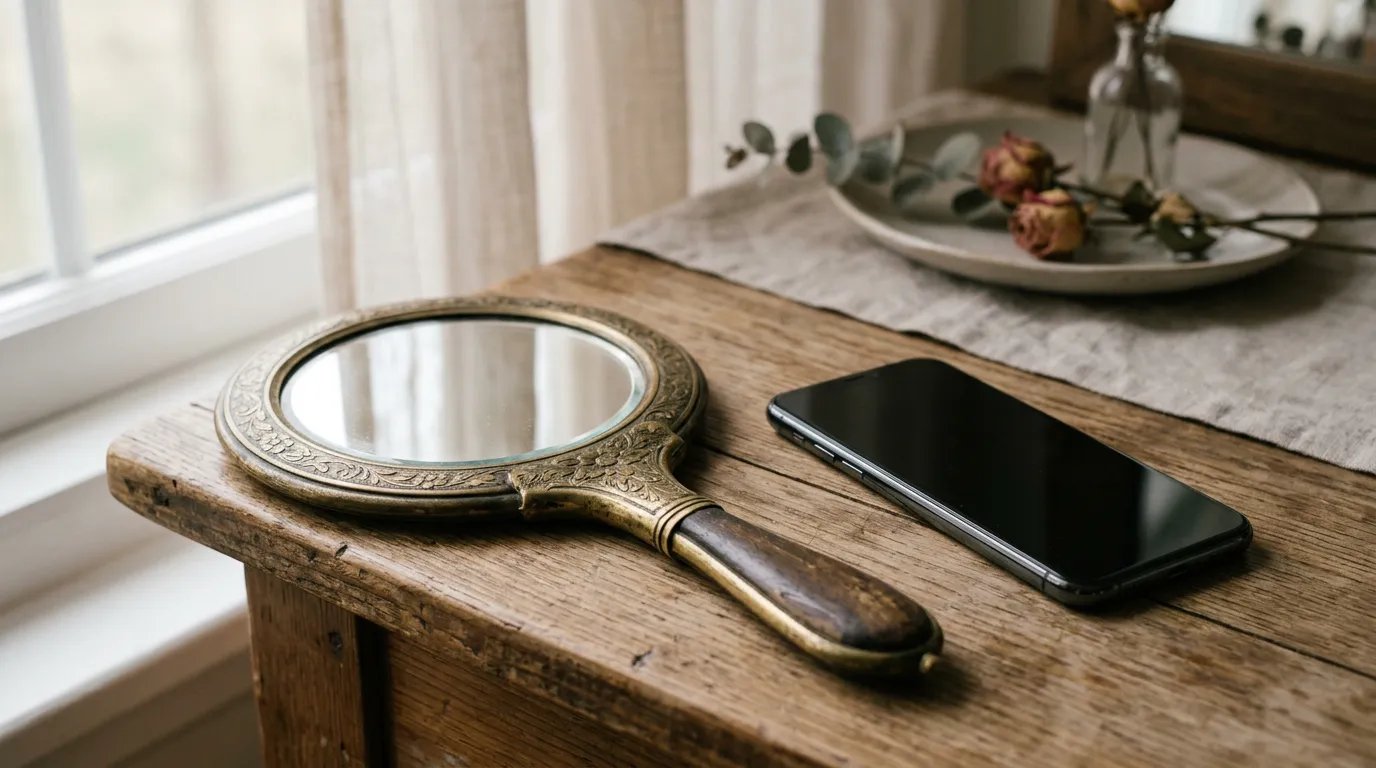
The second effect is less about the photo and more about you. Every mirror you've ever looked into — bathroom, gym, car visor, phone camera in selfie mode — shows you a left-right flipped version of your face. If you have even a slightly asymmetric feature (almost everyone does: a nose that leans a degree or two, one eyebrow set marginally higher, a smile that pulls a bit more to one side), the mirror version and the true version are technically two different images.
There's a classic demonstration of this in social psychology: show people two prints of the same photo of themselves — one true, one mirror-flipped — and ask which one they prefer. People routinely pick the flipped version. Show the same two prints to their close friends or partner, and they routinely pick the true, unflipped one instead. Nobody is wrong here. You're each rating a different photo as "correct," because you've each been exposed to a different version of that face thousands of times.
You've seen the mirrored version thousands of times — arguably more than any other image in your life. Familiarity itself makes something feel more correct and more pleasant to look at; psychologists call this the mere-exposure effect, and it applies to faces as much as to songs or logos. Your brain has quietly decided the mirrored version is "you." A regular photo, or anyone else's phone camera, shows the un-flipped, true version — which is accurate, but unfamiliar, and unfamiliar reads as "off" even when nothing is actually wrong.
This is also why a photo of yourself can look fine one day and jarring the next with no real change: it's not always about the photo, it's about how far it drifts from the mirrored self-image you're used to comparing it against.
Why everyone else thinks the photo looks totally normal
This is usually the most reassuring part once it clicks: the frozen-face effect and the mirror-reversal habit are both self-referential. They only distort your own judgment of your own face. Someone else looking at the same photo has never memorized your mirror image, has no internal "correct" reversed template to compare it against, and isn't running a frame-by-frame comparison against how you look mid-motion in daily life. They just see a face, evaluate it in a fraction of a second, and move on — without either bias in play.
That fraction of a second isn't an exaggeration, either. Research on how people form first impressions from a single photo — including studies of split-second swipe decisions on dating apps — shows those judgments are made holistically and almost instantly, well before there's time for the kind of feature-by-feature scrutiny you apply to your own face. A stranger isn't cataloguing your nose, your jaw, and your left eyebrow the way you might in a bad moment. They're processing the whole face at once, quickly, and moving on to whatever comes next.
That gap compounds over time in a specific way: the more often you see a heavily filtered or selectively chosen version of your own face, the more that version — rather than your actual, unedited face — becomes the internal reference point you unconsciously judge every new photo against.
Dermatologists have documented and named this drift: "Snapchat dysmorphia" describes patients requesting cosmetic procedures specifically to resemble their own filtered selfie, not a celebrity or influencer ideal. It's clinical evidence that the comparison point can shift away from your real face entirely — which is the mirror-familiarity effect taken to its logical extreme.
Your Appearance Score
What's Your Appearance Score?
60 seconds. Get a score based on your habits.
Selfies raise the stakes even further
Selfies deserve a specific mention because they stack a third factor on top of the two above: choice. A selfie is a photo you personally selected out of several attempts, framed the way you wanted, sometimes lightly edited before anyone else sees it — which means every selfie you post has already survived your own harshest filter before it ever meets the frozen-face and mirror-reversal biases. That extra layer of control doesn't cancel the biases out. It tends to amplify them, because the more control you exert over your own image, the more your internal standard for "good enough" quietly ratchets upward.
A study on adult men found that it wasn't simply the frequency of posting selfies that correlated with body dissatisfaction — it was specifically how often those selfies were edited or manipulated before posting. Taking selfies wasn't the problem; the editing step, and the comparison habit it feeds, was the stronger predictor.
That's a useful distinction if you take a lot of photos of yourself: the issue usually isn't the camera, and it isn't even the selfie format itself. It's the loop of shooting several, discarding most, lightly touching up the survivor, and then unconsciously treating that survivor as your true baseline face for every future comparison.
How to actually close the gap
You can't switch off either effect — they're both automatic and involuntary, and no amount of willpower changes how your visual system processes motion versus stillness or familiarity versus novelty. What you can do is stop letting them run unchecked, with a few concrete habits that work with the biases instead of against them:
- Take bursts, not single shots. Since the frozen-face effect is about which random instant got captured, giving yourself 5-10 frames to choose from — instead of judging the one photo someone happened to take — removes most of the bad luck from the sample.
- Look at video of yourself occasionally, not just photos. A few seconds of casual video (a voice memo you filmed, a call recording) resets your expectation toward the "averaged," more flattering version your brain naturally prefers, rather than only comparing against frozen frames.
- Deliberately look at un-flipped photos more often. The more you're exposed to the true, non-mirrored version of your face in low-stakes settings, the less jarring it becomes — that's the mere-exposure effect working in your favor instead of against it.
- Aim for a genuine smile, not a posed one. A real smile engages the muscles around the eyes, not just the mouth, and it's a signal people read as more attractive and sincere almost instantly — and it's much harder to consciously fake well, so stop trying to "perform" the smile and think of something that actually amuses you right before the shot.
- Separate the two questions before you spiral: "is this a bad photo" and "is this a bad face" are almost never the same question. Most of the time, it's the format, not the features.
None of these habits change your actual appearance. What they change is the sample size and the reference point you're judging it against — swapping one unlucky frozen frame and one mirror-flipped memory for something closer to how your face actually reads to the people around you.
When it actually is the photo, not just psychology
None of this means every unflattering photo is purely a perception glitch. Lighting angle, camera elevation, and lens distance are real, physical variables that change how a face reads in a still image — a phone held too close will distort proportions, harsh side lighting genuinely exaggerates shadows, and camera height genuinely changes the read on trustworthiness and jaw definition. That's a separate, more technical topic with its own fixes, worth its own read if you suspect your setup (not your face) is the actual issue. What this article covers is the part that has nothing to do with your setup: the two perceptual biases that make you judge your own face more harshly than anyone else does, in any lighting, at any angle.
A simple way to tell which one you're dealing with: if a specific photo looks off in a way that's consistent across strangers too (multiple people unprompted mention the lighting, the angle, or ask "was that taken from below?"), that's the technical side. If it's just you who recoils and everyone else shrugs and says it looks fine, that's almost certainly the frozen-face and mirror-reversal effects doing what they always do.
The takeaway
The unflattering photo is rarely lying about your face — it's usually just an unlucky frozen frame compared against a mirror image nobody else has ever seen. Once you know both mechanisms are working against you specifically (not against how others perceive you), it gets a lot easier to stop treating a single bad photo as data about your appearance, and a lot easier to stop re-taking the same selfie fifteen times looking for the one frame that finally matches a reflection nobody else is comparing you to.
If you want an actual, consistent read on your appearance instead of guessing from whichever photo you happen to be staring at today, HALOIA's free appearance quiz gives you a real baseline — and its progress tracking is built around the same lighting and angle each time specifically so you're comparing real change, not the frozen-face lottery.
This article is for information only and is not a substitute for medical advice. For any question about your health, a treatment or a supplement, consult a qualified professional.
Improve your appearance by eating better
Build real confidence by tracking your diet. Download HALOIA and start your tracking.

Go further
Should You Hire a Photographer for LinkedIn?
A close-up selfie and a professional headshot don't just look different, they make people think different things about you. Here's what the research actually shows, and how to get most of the effect without booking a studio.
Does Building a Non-Smoker Identity Help You Quit?
Willpower treats every cigarette as its own fight to win. Identity skips the fight entirely. Here's what a year-long study of 623 smokers found, and how the same lever works on food and exercise too.
Cold Showers: The Real Effect on Stress
Everyone's doing cold showers for the mental health benefits, but the science is pickier than the trend suggests: the calming effect is real, it just isn't the one you get from a single icy blast.