
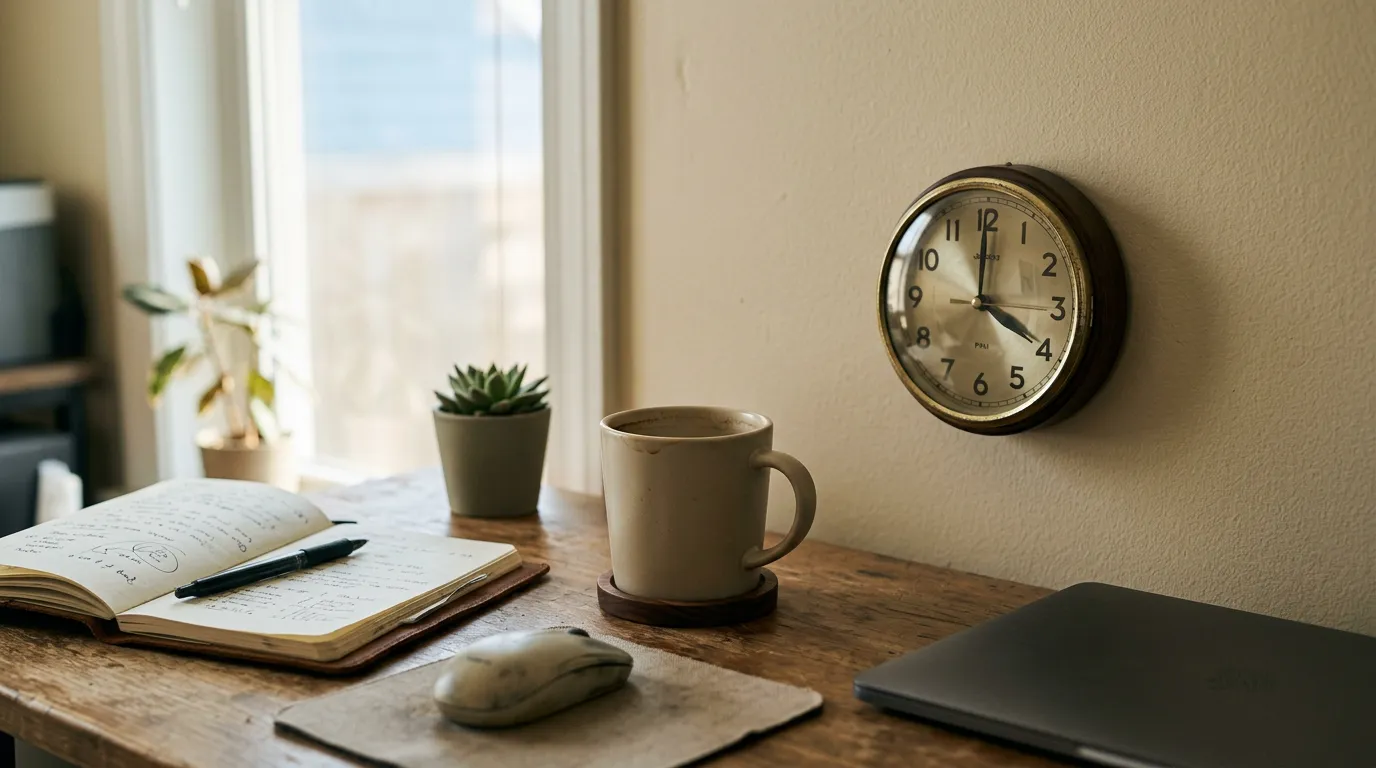
The Real Reason for Your 3PM Energy Crash
It's not laziness and it's not a willpower problem. The 3pm wall has a biological cause, usually a stack of three or four small ones, and it's fixable once you know which lever to pull.
 Damien, founder of HALOIA11 min read
The afternoon energy crash has a real, mostly predictable cause: a natural dip in your circadian rhythm around early-to-mid afternoon, made worse by what you ate at lunch, how hydrated you actually are, and how much sleep debt you're carrying from the night before. None of that is a character flaw. It's four physiological levers stacking on top of each other at the same time of day, which is exactly why the crash feels so consistent. Fix even two of the four and the wall gets noticeably smaller.
Most advice on this topic picks one culprit — "you're not drinking enough water," or "cut the sugar" — and stops there. That's part of why so much of it doesn't actually fix anything: it treats one lever as the whole explanation, when the crash you feel most days is almost always two or three of these stacking on top of each other at once, not a single cause you can solve in isolation.
Your body clock is built for this dip
Alertness isn't a flat line that only drops when you're tired. It runs on a biphasic rhythm set by your circadian clock: a strong dip in core body temperature and alertness in the early-to-mid afternoon, roughly 6 to 8 hours after you wake up, independent of whether you ate lunch or slept well the night before. Sleep researchers have documented this "post-lunch dip" since the 1980s, and it shows up even in people who skip lunch entirely, which is the clearest sign it's driven by the clock, not the meal.
That doesn't mean lunch is irrelevant, it means the crash you feel has a baseline you can't fully train away, plus a variable layer on top that you absolutely can control. The goal isn't to eliminate the circadian dip. It's to stop stacking avoidable fatigue on top of it.
The exact timing shifts a bit by chronotype — early risers tend to dip earlier, closer to 1pm, while night owls often crash closer to 4pm — but the underlying mechanism is the same for almost everyone: a temporary drop in core body temperature and cortisol that naturally reverses on its own within an hour or two, even if you do nothing at all.
What your lunch just did to your blood sugar
A lunch built mostly around refined carbs — white bread, pasta, fries, a sugary drink — spikes blood glucose fast, which triggers a sharp insulin response to bring it back down. That correction frequently overshoots, dropping blood sugar below where it started about 90 minutes to 2 hours later. The timing lines up almost exactly with a 1pm lunch and a 2:30-3:30pm crash. It isn't a coincidence you can "push through" with willpower; it's a glucose curve doing what glucose curves do.
This effect is stronger in people with any degree of insulin resistance, which is far more common than most people realize and doesn't require a diabetes diagnosis to matter. If the crash feels disproportionate to what you ate, or shows up even after a moderate lunch, that's a signal worth paying attention to rather than pushing through with more caffeine.
- Anchor lunch around protein and fiber first: a source of protein (chicken, fish, eggs, tofu, legumes) plus vegetables slows the glucose spike that a carb-only lunch causes.
- Don't cut carbs to zero: pairing carbs with protein and fat blunts the spike far more effectively than skipping them, and going too low can trigger its own afternoon fatigue.
- Watch liquid calories at lunch: a soda or sweetened iced coffee adds a second, faster glucose spike on top of the meal itself.
- Eat lunch at a consistent time: an erratic lunch window (sometimes noon, sometimes 2pm) makes the crash harder to predict and plan around.
The hydration piece almost nobody checks
Mild dehydration, the kind that doesn't make you feel thirsty, measurably reduces alertness, working memory, and mood before it produces any obvious physical symptom. Most people under-drink steadily through the morning, then add coffee, which is a mild diuretic, without replacing the water lost. By early afternoon you're running a small but real fluid deficit at the exact moment your circadian dip is already working against you. A practical check: pale yellow urine by mid-morning. Darker means you started the crash before lunch even happened.
The mechanism is fairly direct: even a 1-2% drop in body water slightly reduces blood volume, which means less efficient oxygen and glucose delivery to the brain — the two things it needs most to stay alert. Coffee and tea aren't the enemy here, but they don't count toward that baseline the way plain water does, and relying on them as your main fluid source through the morning is one of the quietest contributors to the crash.
Last night's sleep is still cashing checks today
Sleep debt doesn't average out the way people assume. A short night doesn't just make you a little tired all day, it specifically deepens the afternoon dip, because you're layering acute sleep loss on top of a circadian low point that already exists. This is the lever people manage worst, because it's the one where the cost shows up a full day later, disconnected from the decision that caused it (a late Netflix episode, one more scroll, a nightcap).
Sleep debt also compounds across the week in a way single nights don't fully explain. Losing 45 minutes a night from Monday to Thursday adds up to roughly the same deficit as one genuinely bad night, except it's spread out and easy to dismiss because no single night felt disastrous. A weekend "catch-up" sleep helps, but research on sleep debt consistently shows it doesn't fully reverse the accumulated deficit — part of why Thursday and Friday afternoons often feel like the worst crashes of the week.
A 2021 umbrella review of sleep research found that health outcomes are best at 7 to 8 hours a night, and that below 7 hours, every additional hour lost raises the risk of cardiovascular disease and type 2 diabetes by 3 to 11%. Oversleeping (9 hours or more) isn't automatically better either — it's frequently a sign of poor sleep quality, not extra rest.
There's also a feedback loop worth knowing about: the coffee you reach for to survive today's crash can quietly sabotage tonight's sleep, which sets up tomorrow's crash.
A 2025 study published in the journal Sleep found that a normal dose of coffee (about 100mg, roughly one cup) taken up to 4 hours before bed doesn't meaningfully disrupt sleep. A high dose (about 400mg, roughly four cups) within 12 hours of bedtime clearly does, cutting perceived sleep quality by 34% when taken just 4 hours before sleep. The 3pm latte that gets you through today can be the reason tomorrow's crash is worse.
Your Appearance Score
What's Your Appearance Score?
60 seconds. Get a score based on your habits.
What makes it worse, and what actually helps
Some common afternoon habits treat the symptom and quietly make the underlying dip worse. Others actually address one of the four levers above. Knowing which is which is most of the fix.
- Makes it worse: a second large coffee after 2pm (borrows energy from tonight's sleep), a sugary snack (adds a second glucose spike-and-crash on top of lunch's), staying seated for hours (reduced blood flow and stimulation lower alertness further), skipping water because you're not thirsty.
- Actually helps: 5-10 minutes of movement or a short walk (raises heart rate and alertness without touching blood sugar or sleep), natural light exposure (reinforces the circadian signal that it's still daytime), a glass of water before reaching for coffee, a small protein-forward snack instead of something sugary if lunch was hours ago.
Picture a fairly typical office day: coffee before 9am, a sandwich and a soda at your desk around 1pm, the water bottle forgotten by the sink since lunch, and a second coffee at 2:45pm to "push through" the meeting that's about to start. Every one of those choices independently nudges the crash deeper — the glucose spike-and-crash from the sandwich and soda, the dehydration from skipping water, a second coffee timed close enough to dinner to chip away at tonight's sleep. None of it looks dramatic in the moment. Stacked together, it's basically a recipe for the exact wall you're trying to explain.
None of these fixes require a dramatic overhaul. The point isn't to add five new things to your afternoon, it's to swap the one or two habits that are quietly making the circadian dip deeper for ones that don't.
Should you nap? The short answer
A short nap, 10 to 20 minutes, taken during the natural circadian dip, can measurably restore alertness without leaving you groggy. Longer naps (30-90 minutes) risk pulling you into deeper sleep stages, so you wake up in the middle of a sleep cycle, which produces sleep inertia: a worse, foggier feeling than the crash you started with. If a nap isn't realistic (most workdays), the same 10-20 minute window spent on a short walk outside produces a similar alertness bump without the risk of waking up groggier than you started.
Timing matters as much as length: a nap taken past 3-3:30pm starts eating into the sleep pressure that's supposed to carry you to bedtime, which risks making it harder to fall asleep that night — feeding right back into the sleep-debt problem from the section above.
Making the fix actually stick
Knowing the four levers is the easy part. The reason most people know all of this and still crash at 3pm every day is that they never turn it into a routine, they rely on remembering to make a better choice in the moment, at the exact time of day their alertness is lowest.
About 43% of what you do in a normal day isn't a conscious decision — it's habit, the same action repeated in the same context while your mind is on something else. That's actually good news here: you don't need to consciously win the 3pm decision every single day, you need to build the context once.
Forget the "21 days" myth: a study tracking 96 people over 12 weeks found it took 66 days on average for a new behavior to become automatic, with huge individual variation (18 to 254 days). The single biggest accelerator wasn't motivation, it was repeating the same action in the same context — same time, same place — until it stopped requiring a decision.
In practice, that means picking one lever, not four, and attaching it to something that already happens every day: a glass of water the moment you sit back down after lunch, a 10-minute walk booked in your calendar right where the crash usually hits, a protein-forward lunch on the same two or three rotating meals instead of reinventing it daily. A vague goal like "drink more water" performs far worse than a specific if-then plan like "if it's 1pm and I'm back at my desk, I refill my bottle before opening my laptop." Once the first lever runs on autopilot, add the second.
Precise if-then planning ("if it's 1pm and I'm at my desk, I refill my bottle before opening my laptop") consistently outperforms vague goals ("drink more water"). A meta-analysis across more than 8,000 people and 94 studies found the effect size was medium to large — one of the more reliable findings in behavior-change research.
This is also exactly where guessing gets expensive. If you can't tell whether today's crash came from what you ate at lunch, how much water you drank, or last night's short sleep, you end up trying to fix all three at once and never learning which one actually mattered. HALOIA's meal logging exists for this: it tracks what you actually ate against how you report feeling, so instead of guessing at 3pm which lever failed today, you start seeing the pattern after a week or two.
If you want a faster starting point than trial and error, HALOIA's free appearance quiz gives you a baseline read on your current habits, sleep, and diet before you change anything.
This article is for information only and is not a substitute for medical advice. For any question about your health, a treatment or a supplement, consult a qualified professional.
Improve your appearance by eating better
Build real confidence by tracking your diet. Download HALOIA and start your tracking.

Go further

Should You Hire a Photographer for LinkedIn?
A close-up selfie and a professional headshot don't just look different, they make people think different things about you. Here's what the research actually shows, and how to get most of the effect without booking a studio.

Does Building a Non-Smoker Identity Help You Quit?
Willpower treats every cigarette as its own fight to win. Identity skips the fight entirely. Here's what a year-long study of 623 smokers found, and how the same lever works on food and exercise too.

Cold Showers: The Real Effect on Stress
Everyone's doing cold showers for the mental health benefits, but the science is pickier than the trend suggests: the calming effect is real, it just isn't the one you get from a single icy blast.