
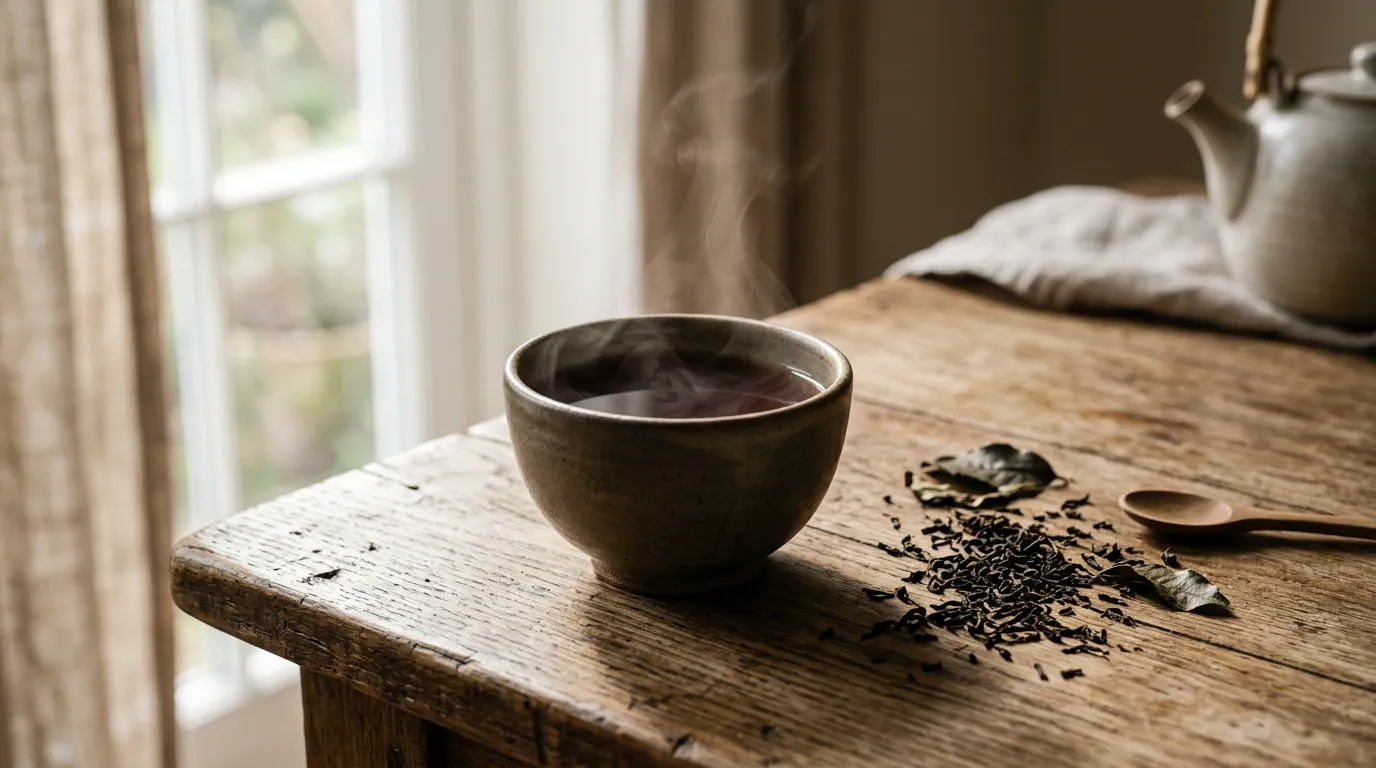
Your Lunchtime Tea Is Sabotaging Your Iron
That cup of tea with lunch might be quietly undoing your iron intake. Here's exactly why, who needs to worry, and the one-hour fix that solves it.
 Damien, founder of HALOIA11 min read
Why does tea block iron absorption? Because of tannins — plant compounds naturally present in tea that bind to iron in your gut and form a complex your intestinal lining simply can't pull through into your bloodstream. Drink tea with, or right after, an iron-rich meal, and you can lose a meaningful share of that iron before it's ever used — research on this exact pairing found drops as high as 60-70%. This isn't a vague "food combining" myth with no real backing; it's one of the more reproducible findings in nutrition science, first documented in a controlled study back in 1975 and echoed by reviews since. The good news: the fix isn't quitting tea. It's timing it correctly. Here's the mechanism, who actually needs to care, and exactly how long to wait.
The tannin mechanism: why tea actually blocks iron absorption
Tea — black and green especially, and to a lesser extent herbal blends high in polyphenols — is rich in tannins, the same compounds that give tea its slightly bitter, astringent taste. When tannins meet iron in your digestive tract, they bind to it and form an insoluble complex. Insoluble means your intestinal lining can't pull it through into your blood — it just passes through and leaves with everything else your body doesn't use. This isn't a marginal effect. A controlled study on iron absorption found that drinking tea alongside an iron-rich meal cut absorption by up to 60-70% compared to drinking water instead. That's not a rounding error — it's the difference between a meal that meaningfully restocks your iron stores and one that barely moves the needle.
This matters more with black and green tea than with most herbal infusions, since tannin concentration is what drives the effect — the stronger and more astringent the brew, the more binding capacity it has. It's also a mechanical, chemistry-level interaction, not something that depends on your metabolism, your gut bacteria, or how "sensitive" you personally are to certain foods. That's part of why it shows up so consistently across studies: give the same cup of tea alongside the same iron-rich meal to different people, and you'll see roughly the same blocking effect every time. It isn't a myth that varies from person to person — it's closer to a fixed rule of chemistry.
It's worth being precise about which iron is affected, because it sets up almost everything else in this article: your body absorbs two forms of dietary iron differently. Heme iron, from meat, poultry, and fish, is absorbed relatively efficiently and isn't affected much by other foods around it. Non-heme iron, from plants, eggs, and fortified foods, is absorbed far less efficiently to begin with, and it's the form that's most sensitive to what else is on the plate — tannins block it hard, vitamin C boosts it, and the two effects can roughly cancel out or compound depending on what you pair it with.
A 1975 study published in Gut found that tea drunk during an iron-rich meal reduced iron absorption by up to 60-70% — one of the largest food-pairing effects ever measured in nutrition science, and still the reference figure researchers cite today. — Disler et al., Gut (1975)
Who this actually affects (and who can mostly ignore it)
Not everyone needs to rearrange their tea habit around this. If your iron stores are solid — you eat meat or fish regularly, your last blood test was normal, and you're not losing extra iron through heavy periods, pregnancy, or heavy endurance training — an occasional cup of tea with lunch isn't going to tip you into deficiency. Your body has some buffer. The people who should actually pay attention are the ones already operating close to the edge, where a 60-70% cut on top of an already tight iron budget adds up fast.
- Menstruating women, especially with heavy periods — the single biggest driver of iron deficiency risk in otherwise healthy adults.
- Pregnant women, whose iron needs roughly double to support increased blood volume and the baby's development.
- Vegetarians and vegans, who rely entirely on non-heme (plant) iron, which the body already absorbs less efficiently than the iron in meat.
- Endurance athletes, who lose iron through sweat and through the mechanical breakdown of red blood cells during hard training.
- Anyone with a tea-with-every-meal habit, where the effect compounds three times a day instead of once.
None of this means tea is dangerous or that you need to track every cup obsessively. Your body regulates iron absorption dynamically — when your stores run low, your gut actually absorbs a higher percentage of the iron you eat, as a built-in compensation mechanism. The tannin effect layers on top of that baseline, which is why it matters more for someone already running close to empty than for someone with healthy reserves and an otherwise varied diet.
A useful way to think about it: the effect is real and well-documented, but it's a multiplier on your existing risk, not a risk on its own. Someone with strong iron stores who drinks tea with lunch every day is applying that multiplier to a large number and still landing somewhere comfortable. Someone already borderline is applying the same multiplier to a small number and landing in deficiency territory. Same cup of tea, very different consequence — which is exactly why "is tea bad for iron" doesn't have one universal answer.
How long you actually need to wait between tea and a meal
The fix here is almost embarrassingly simple: timing, not elimination. The tannin-iron interaction only matters while both are sitting in your gut at the same time. Shift your tea to roughly an hour before or after an iron-rich meal, and the overlap largely disappears — your iron gets absorbed on its own schedule, and your tea does its thing separately. You don't need to give up your afternoon cup; you need to stop pairing it with the meal that's supposed to be restocking your iron. In practice, that means an iron-rich lunch first, tea an hour later — not tea poured alongside the plate.
- Right before or during a meal: worst timing — full tannin-iron overlap.
- Within 30 minutes after eating: still meaningfully reduces absorption.
- About 1 hour before or after: tannins and iron are no longer in the gut together, so the effect is largely gone.
In practice, this usually means restructuring one habit, not adding a new one. If lunch is your main protein-and-iron meal, save your tea for the mid-afternoon slump instead of pouring it alongside your plate. If you're someone who drinks tea first thing with breakfast, that's actually the lower-stakes slot, since most breakfasts (cereal aside) aren't especially iron-dense. The goal isn't a rigid stopwatch — it's noticing which of your meals is actually carrying your iron for the day, and keeping tea out of that hour.
Take a typical case: a bowl of chili with kidney beans and ground beef at lunch, followed immediately by a mug of black tea at the desk. On paper, that's a solid iron-rich meal. In practice, the tea poured right alongside it can undercut a meaningful share of what the beans and beef were supposed to deliver. Push that same mug to 2pm instead, once digestion has moved the meal along, and the meal gets to do its job the way it looked like it would on paper.
Your Appearance Score
What's Your Appearance Score?
60 seconds. Get a score based on your habits.
Coffee: same problem, smaller offender
Coffee contains its own set of polyphenols and can produce a similar, though generally smaller, drop in iron absorption. A review of the evidence identified tea as one of the most potent dietary inhibitors of iron absorption on record, with coffee showing a related but comparatively milder effect. If you reach for coffee instead of tea at lunch, the same one-hour spacing rule still applies — it's just that tea is the bigger lever to manage first.
A review of the evidence in Critical Reviews in Food Science and Nutrition identified tea as one of the most powerful dietary inhibitors of iron absorption on record, acting through its polyphenol content, with coffee showing a similar but comparatively smaller effect. — Zijp et al., Critical Reviews in Food Science and Nutrition (2000)
Herbal infusions — chamomile, peppermint, rooibos — generally contain far fewer tannins than black or green tea and cause a much smaller version of this effect, though "far fewer" isn't "zero." If iron is a genuine concern for you, treating any tea or coffee the same way — an hour's buffer around iron-rich meals — is the simplest rule to actually remember and stick to, rather than trying to rank every beverage by its exact tannin content.
Vegetarians and vegans: why this hits harder
If most of your iron comes from plants — beans, lentils, spinach, fortified cereals — you're already working with a form of iron (non-heme) that your body absorbs less efficiently than the iron in meat, fish, and poultry (heme iron). That's why the tannin effect matters more here: you're starting from a lower baseline, so losing another 60-70% of an already-harder-to-absorb nutrient adds up faster. And the effect isn't limited to plant iron either — polyphenols have also been shown to reduce absorption of heme iron from meat, in a dose-dependent way, so pairing a steak with a big pot of tea doesn't fully dodge the problem.
Research on human intestinal cells found that dietary polyphenols inhibit not just plant (non-heme) iron absorption but heme iron from meat too, in a dose-dependent manner — meaning the tannin effect isn't a vegetarian-only concern. — Ma et al., Journal of Food Science (2011)
The most reliable counter-move for vegetarians and vegans isn't avoiding tea altogether — it's pairing your iron-rich meal with vitamin C instead. Vitamin C converts non-heme iron into a form your gut absorbs far more easily, and that boosting effect is one of the best-established food-pairing interactions in nutrition science, holding up in research for decades. A squeeze of lemon on lentils, or bell peppers alongside a bean chili, does more for your iron absorption than cutting tea alone ever will.
Vitamin C consumed in the same meal significantly increases absorption of non-heme iron by converting it into a form the gut absorbs more easily — the best-established food-pairing effect in nutrition science. — Teucher et al., International Journal for Vitamin and Nutrition Research (2004)
- Lentils or chickpeas with a squeeze of lemon juice or a side of bell peppers.
- Spinach salad with orange segments instead of croutons and dressing alone.
- Fortified cereal with a glass of orange juice, tea saved for an hour later.
How to know if it's actually affecting you
The honest answer is you can't tell from symptoms alone — fatigue, brain fog, and pale skin tend to show up well after iron stores have already dropped, not as an early warning. The only way to know for sure is a blood test (ferritin, specifically) if you suspect an issue. But in the meantime, the more useful question isn't "am I deficient" — it's "is my actual eating pattern working against me," which is a lot easier to fix once you can actually see it.
This is exactly the kind of blind spot HALOIA's meal logging is built to catch: it doesn't just tally calories, it looks at your real logged meals and flags patterns like tea or coffee showing up right alongside your main iron sources, day after day, so you can fix the timing without giving up either one.
If you want to see where your own diet stands before changing anything, HALOIA's free appearance and nutrition quiz gives you a baseline read on your current habits, blind spots like this one included, in about two minutes.
Sources
This article is for information only and is not a substitute for medical advice. For any question about your health, a treatment or a supplement, consult a qualified professional.
Improve your appearance by eating better
Build real confidence by tracking your diet. Download HALOIA and start your tracking.

Go further
The Best Breakfast for Clear Skin in Your 20s
Forget "eat clean" advice with no specifics. Here's the exact breakfast structure that keeps blood sugar stable and gives your skin what it needs to repair overnight's damage.
Ashwagandha: Its Real Effect on Stress and Training
Ashwagandha gets credited for almost everything. Two claims actually hold up in controlled trials — stress/cortisol and strength/muscle — and they don't have the same evidence behind them. Here's the honest breakdown.

Who Should Never Fast?
Intermittent fasting is safe for most healthy adults — but not for everyone. Here's exactly who should skip it, and why, according to the research.