
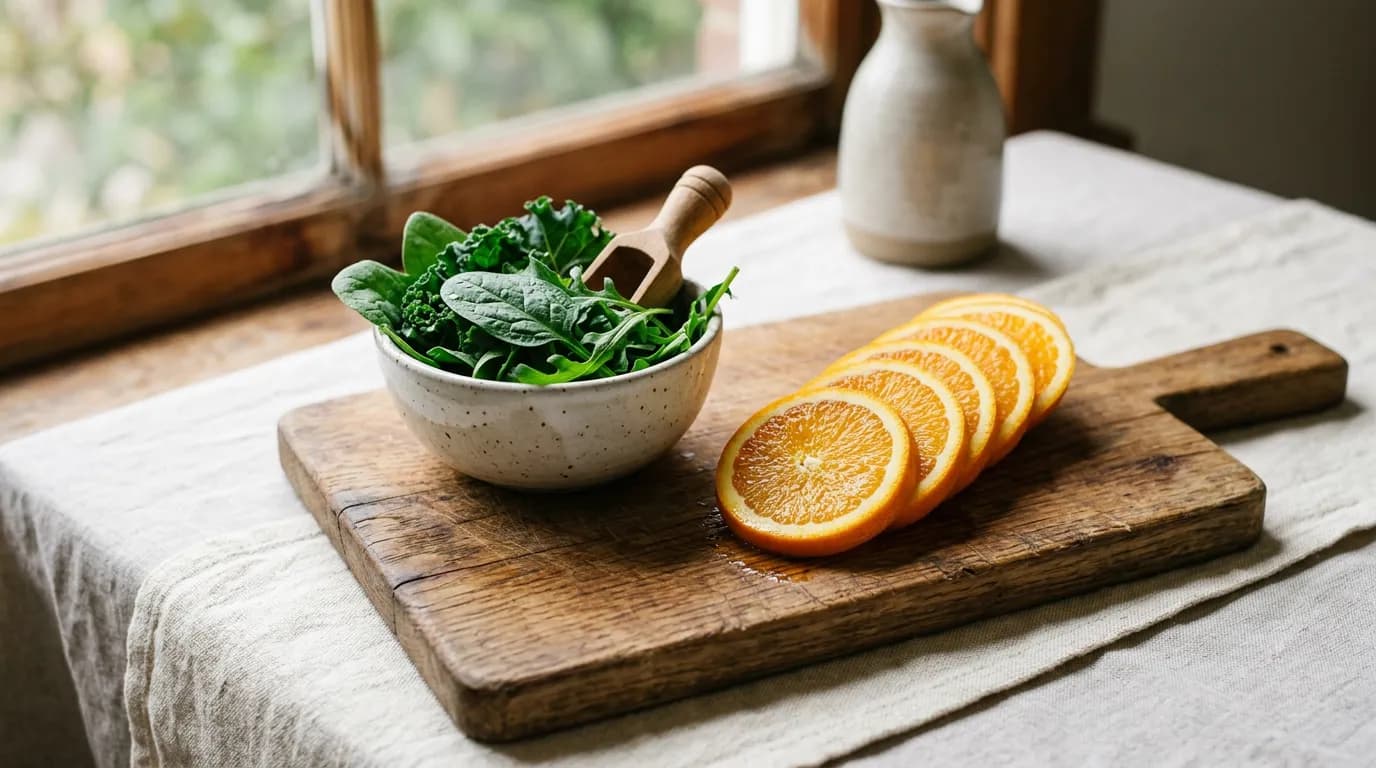
Vitamin C and Iron: The Winning Combo
That squeeze of lemon on your lentils isn't a garnish, it's chemistry. Here's why vitamin C is one of the best-proven ways to get more iron out of a meal.
 Damien, founder of HALOIA11 min read
Does vitamin C actually help you absorb more iron, or is that just something people repeat without checking? It holds up. Pairing a vitamin C source with an iron-rich food is considered one of the best-established food-pairing effects in nutrition science — not a wellness trend, a mechanism that's been documented since the 1980s and keeps replicating in newer research. The catch is that most people who've heard "vitamin C helps iron" don't know why it works, which iron it works on, or how to actually build a meal around it — so the advice gets applied randomly, or ignored entirely because it sounds like folk wisdom. It isn't. Here's the real mechanism, why it matters more for some people than others, and exactly how to put it to use without overthinking every plate.
The iron problem this pairing is actually solving
Before vitamin C enters the picture, it helps to know there are two completely different kinds of dietary iron, and your body treats them nothing alike. Heme iron comes from animal sources — meat, poultry, fish — and your intestine absorbs it fairly efficiently on its own, generally somewhere in the range of 15-35%, without needing much help from anything else on the plate. Non-heme iron comes from plants, eggs, and fortified foods — lentils, spinach, beans, tofu, fortified cereal — and it's absorbed far less efficiently to start with, often in the single digits, because it has to go through an extra chemical conversion step before your gut can actually pull it through the intestinal wall.
That conversion step is exactly where vitamin C does its work, which is why this pairing matters so much more for non-heme iron than for heme iron. If most of your iron already comes from meat and fish, vitamin C is a nice bonus, not a fix for a real gap. If most of your iron comes from plants — which is the case for a huge share of people, vegetarian or not, given how much of a typical Western diet is grains, legumes, and vegetables rather than red meat — this pairing is doing real, measurable work every time you use it.
Why vitamin C actually fixes the absorption gap
Non-heme iron in food mostly exists in a chemical form (ferric iron, Fe3+) that doesn't dissolve well and struggles to cross into your bloodstream through the intestinal wall. Vitamin C (ascorbic acid) converts it into a different form (ferrous iron, Fe2+) that's far more soluble and moves through the same transporter your gut already uses to absorb heme iron. Vitamin C also binds loosely to the converted iron in a way that keeps it stable and available in the gut instead of reacting with other compounds in the meal and dropping out of solution before it ever gets absorbed. Put simply: vitamin C isn't adding iron to your meal, and it isn't a supplement trick — it's changing the chemical shape of the iron that's already there so your intestine can actually use more of it.
Vitamin C consumed in the same meal significantly increases absorption of non-heme iron by converting it into a form the gut absorbs more easily — considered the best-established food-pairing effect in nutrition science. — Teucher et al., International Journal for Vitamin and Nutrition Research (2004)
What makes this pairing unusually trustworthy compared to most nutrition advice is how long it's held up. This isn't a single study that made headlines and never got confirmed. The enhancing effect of vitamin C on iron absorption has been documented since research in the 1980s, and it remains one of the most reproducible mechanisms in nutritional physiology — meaning researchers running the same kind of test decades apart, on different populations, keep landing on the same result. That's rare in nutrition science, where plenty of pairing claims fall apart under closer scrutiny (more on one of those, food combining, later). This one doesn't.
Vitamin C's enhancing effect on iron absorption has been demonstrated since the 1980s and remains one of the most reproducible mechanisms in nutritional physiology. — Lynch & Cook, Annals of the New York Academy of Sciences (1980)
How much vitamin C do you actually need
This is the part where it would be easy to hand you a precise milligram number and make it sound scientific, but the honest answer is that the research behind this pairing establishes the effect, not a strict minimum dose you need to hit before it kicks in. There's no single verified threshold below which the boost disappears entirely. What the evidence consistently shows is that the effect shows up with realistic food amounts — the vitamin C naturally present in a normal serving of citrus, peppers, or leafy greens eaten in the same sitting as your iron source — not a mega-dose supplement washed down next to your lentils.
That's actually good news, because it means the fix isn't buying a supplement or tracking milligrams meal by meal. It's simpler and less precise than that: don't eat your iron-rich meal completely stripped of any fresh produce. A plain bowl of lentils with nothing else on the plate is missing an easy upgrade. The same bowl of lentils with a squeeze of lemon, a side salad with tomato, or a handful of bell pepper strips is doing meaningfully more for your iron, without needing to calculate anything.
It also helps to think about this over days, not single meals. Iron stores don't move on the timeline of one lunch — they build up or draw down over weeks, so the goal isn't to nail every single plate perfectly, it's to make the pairing the default often enough that it shows up in most of your iron-rich meals across a normal week. One well-paired meal in a week of bare ones barely moves the needle. A habit where citrus, peppers, or tomato routinely show up alongside your lentils, beans, or fortified cereal is what actually compounds into a measurable difference over time.
Real meal pairings that actually use this
The easiest way to apply this isn't a supplement schedule, it's a short list of pairings you can default to without thinking twice. None of these require cooking two separate things — it's usually one small addition to a meal you were already making.
- Lentils or chickpeas with a squeeze of lemon juice, or a side of roasted bell peppers.
- Spinach salad with orange segments or strawberries instead of croutons and dressing alone.
- Fortified cereal or oatmeal with a glass of orange juice or a handful of kiwi on the side.
- Bean chili or tofu stir-fry with tomatoes worked into the sauce, plus a side of broccoli.
- A steak or chicken meal with a side salad including bell peppers — not necessary for the heme iron itself, but useful if the same plate also has beans or grains contributing non-heme iron.
Notice none of these are exotic. Citrus, peppers, tomatoes, strawberries, and leafy greens are already common in most kitchens — the shift isn't buying new ingredients, it's making sure one of them lands on the same plate as your iron source instead of showing up at a different meal entirely, where it does nothing for that specific iron.
Your Appearance Score
What's Your Appearance Score?
60 seconds. Get a score based on your habits.
What quietly cancels the effect out
Pairing vitamin C with iron is only half the picture, because a few very common foods do the opposite: they block iron absorption at the same intestinal doorway vitamin C is trying to open wider. Calcium is the biggest one. It competes with iron for the same transport pathway in the gut, and the effect is strongest with supplements or a large glass of milk taken right alongside an iron-rich meal — spacing calcium and iron by about two hours limits the impact meaningfully. This matters in a very specific, easy-to-miss way: a glass of milk with dinner, or a calcium supplement taken with your multivitamin at mealtime, can undercut some of what your vitamin C pairing was just trying to accomplish.
Calcium taken alongside iron reduces its intestinal absorption by competing for a shared transporter. The effect is most pronounced with supplements; spacing intake by about 2 hours limits the impact. — Lönnerdal, International Journal for Vitamin and Nutrition Research (2010)
A separate trial in women of childbearing age confirmed the same pattern across different calcium sources, not just dairy — various calcium salts reduced non-heme iron bioavailability when eaten in the same meal. And this isn't only an adult concern: excessive cow's milk intake in young children is a recognized, documented cause of iron deficiency, precisely because milk is high in both calcium and casein, both of which work against iron absorption at the same time.
- Calcium supplements or a large glass of milk taken at the same time as your iron-rich meal — space them by roughly 2 hours instead.
- Tea and coffee drunk during or right after an iron-rich meal — tannins can cut absorption by up to 60-70% in that window; push the cup to an hour before or after instead.
- Calcium-fortified plant milk poured over an iron-fortified cereal — the calcium fortification quietly works against the iron fortification in the same bowl.
None of this means avoiding calcium or dairy altogether, any more than the tea effect means quitting tea. It means the same meal that's supposed to be restocking your iron isn't the moment to also load up on calcium or pour a cup of tea — save those for an hour on either side, and let the vitamin C pairing do its job without a competing signal working against it in the same window.
Why this matters more if you're vegetarian or vegan
If your iron comes almost entirely from plants, you're already starting from the less efficient absorption pathway described earlier, with no heme iron in the mix to fall back on. That's exactly why this pairing carries more weight for vegetarians and vegans than for anyone eating a mixed diet: there's no buffer from a more efficiently absorbed source sitting alongside the harder-to-absorb one. A vegetarian who consistently pairs iron-rich plant meals with a vitamin C source is closing a real, measurable gap. A vegetarian who never does is leaving a well-documented, easy fix on the table, meal after meal.
In practice, this usually means the pairing habit matters less as an occasional bonus and more as a default setting on most meals — beans and lentils showing up with tomato-based sauces rather than plain, greens dressed with something citrus-based rather than bare, fortified cereal eaten alongside juice rather than milk alone. None of it requires tracking anything precisely. It requires making the pairing the normal version of the meal instead of the exception.
It's also worth remembering this cuts both ways for vegetarians and vegans specifically: the same meals that are easiest to leave iron-poor are often the ones where a vitamin C pairing is easiest to add, since plant-based cooking already leans on vegetables, citrus, and tomato-based sauces far more than a meat-and-potatoes plate does. The ingredients for the fix are usually already in the kitchen — the only thing missing is routing them onto the same plate as the iron source instead of a separate one.
How to know if it's actually working for you
The honest limitation here is the same as with most nutrition mechanisms: you can't feel absorption improving meal to meal, and low energy or pale skin tend to show up only after iron stores have already dropped, not as an early signal. If you suspect a real deficiency, a blood test (ferritin specifically) is the only way to know for sure, not a pairing habit alone. But short of an actual deficiency, the more useful everyday question isn't "am I deficient" — it's whether your actual eating pattern is working with or against the iron you're already eating, which is a lot easier to see and fix once you can look at it clearly.
That's exactly the kind of pattern that's nearly impossible to track by memory but easy to miss for months without noticing: iron-rich meals eaten without a vitamin C source in sight, or consistently paired with a glass of milk or a cup of tea that's quietly working against them. HALOIA's meal logging looks at what you actually eat, not what you meant to eat, and flags exactly these kinds of blind spots — pairings that help, and pairings that cancel each other out — so you can fix the pattern instead of guessing at it.
If you want a quick read on where your own habits stand before changing anything, HALOIA's free appearance and nutrition quiz gives you a baseline in about two minutes, blind spots like this one included.
Sources
This article is for information only and is not a substitute for medical advice. For any question about your health, a treatment or a supplement, consult a qualified professional.
Improve your appearance by eating better
Build real confidence by tracking your diet. Download HALOIA and start your tracking.

Go further
The Best Breakfast for Clear Skin in Your 20s
Forget "eat clean" advice with no specifics. Here's the exact breakfast structure that keeps blood sugar stable and gives your skin what it needs to repair overnight's damage.
Ashwagandha: Its Real Effect on Stress and Training
Ashwagandha gets credited for almost everything. Two claims actually hold up in controlled trials — stress/cortisol and strength/muscle — and they don't have the same evidence behind them. Here's the honest breakdown.

Who Should Never Fast?
Intermittent fasting is safe for most healthy adults — but not for everyone. Here's exactly who should skip it, and why, according to the research.