
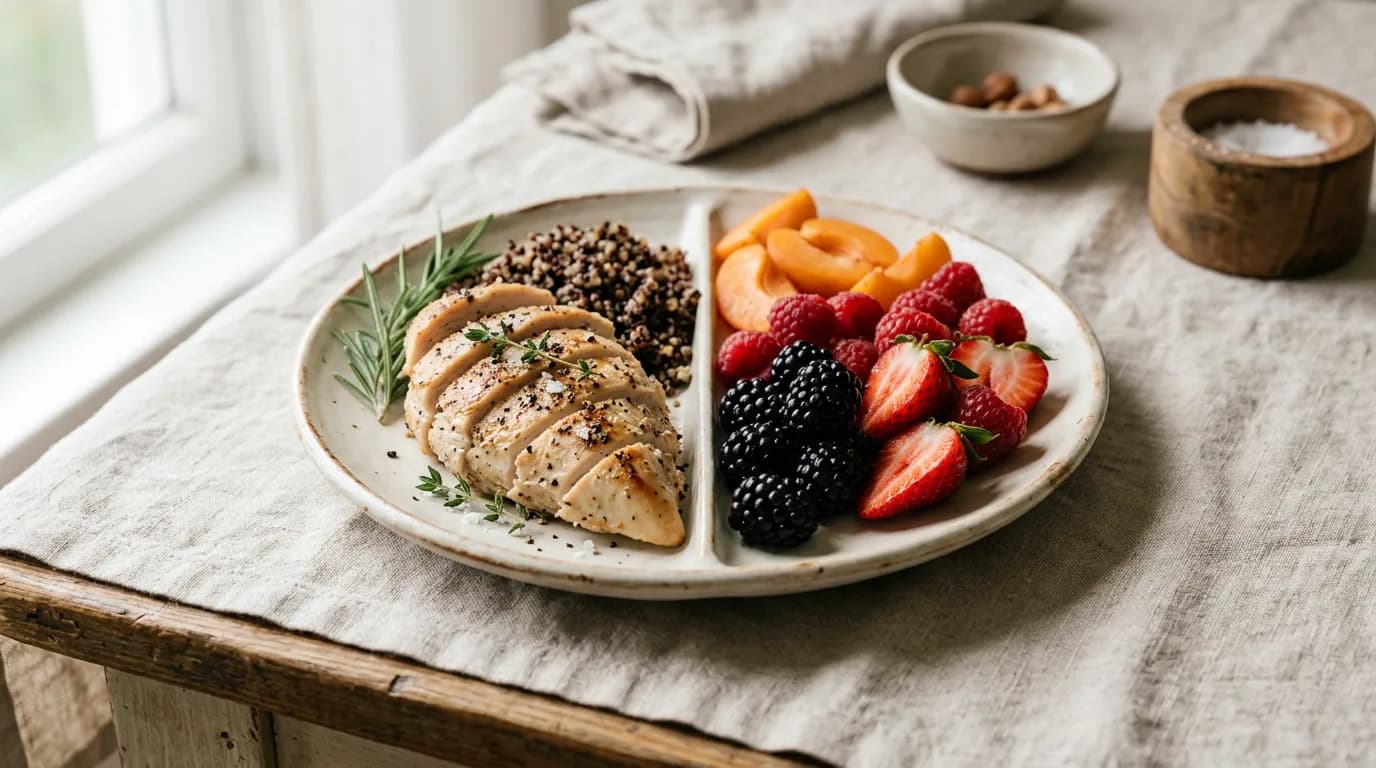
Food Combining: The Method That Proves Nothing
Separate your proteins from your carbs and your digestion will supposedly fix itself. The one controlled trial that actually tested that claim found no difference at all. Here's what's really going on when people say it worked for them.
 Damien, founder of HALOIA11 min read
Food combining sounds like real, specific nutrition science: eat proteins and starches at separate meals because your body supposedly can't digest the two together, and you'll get better digestion, less bloating, and easier weight loss as a result. It's one of the oldest wellness ideas still circulating today, dressed up in new packaging every decade or so since a physician named William Howard Hay first published it in the 1920s. It's also, according to the one randomized controlled trial anyone has actually run on the method, wrong on its central weight-loss claim. Researchers put a strict food-combining diet head-to-head against a standard balanced diet, matched for calories, over six weeks — and weight loss came out identical in both groups. Not close, not a trend in one direction, identical. So why has the method kept a loyal following for a century, and why do some people insist it genuinely worked for them? Both questions have real answers, and neither one requires believing your stomach can't handle a chicken breast and a baked potato at the same sitting. The diet itself isn't dangerous, it's just solving a problem that was never real — and once you see why it feels like it works, you can get the actual result without the fictional science attached to it.
Where the food combining idea actually came from
The modern version traces back to William Howard Hay, an American physician who published his "Hay diet" in the 1920s after crediting a complete overhaul of his own eating habits with reversing his kidney and heart problems. His central claim was that protein digestion needs a strongly acidic stomach environment while starch digestion needs an alkaline one, and that eating both together forces your digestive system into a compromised middle state where nothing digests properly. The undigested food, in his telling, sits and ferments, produces toxins, and shows up later as bloating, fatigue, and stored fat. Over the following century the same core idea got repackaged repeatedly: as "trophology" in nutrition-adjacent circles, as a pillar of the Beverly Hills Diet in the 1980s, and now as a recurring claim on wellness apps and short-form video, rarely with any citation attached. Today it shows up less as "the Hay diet" by name and more as vague advice to eat protein and carbs separately for better digestion — the packaging updates every decade, the underlying claim doesn't. That's a long run for an idea that, as far as anyone has been able to test directly, doesn't hold up.
The logic that makes it sound convincing
Food combining survives because its premise borrows real biochemistry before it goes wrong. It's genuinely true that pepsin, the enzyme that starts breaking down protein, needs a strongly acidic environment to work, and that carbohydrate digestion gets a head start from an enzyme in saliva that prefers something closer to neutral. Take those two accurate facts, skip the part where your gut actually reconciles them, and you land on a plausible-sounding conclusion: combine the two macronutrients and you create some kind of digestive standoff. It's the same rhetorical move behind a lot of nutrition myths that outlive their evidence: start from something a biology textbook would actually agree with, then quietly extend it two steps further than the textbook does. That plausibility is exactly why the idea spreads so easily — a real fact plus a confident leap reads a lot more convincing than an accurate but boring explanation of how digestion actually works. What the story skips over is that the human digestive system was never built around pH purity. It evolved to process exactly what people have eaten for the entire span of human history: mixed meals, protein and starch and fat together, in essentially every traditional cuisine on the planet. If separating them were actually a physiological requirement, meat and potatoes, rice and beans, and bread and cheese would have been making people sick for millennia before anyone wrote the theory down.
What a real randomized trial found when it was tested
Theories are cheap to state and expensive to test, which is exactly why it matters that this one actually got tested. In a randomized controlled trial published in the International Journal of Obesity and Related Metabolic Disorders, Golay and colleagues assigned participants to one of two calorie-matched diets for six weeks: a strict food-combining plan that separated protein and carbohydrate by meal, or a standard balanced diet with no such separation. If Hay's central claim were correct, the separated-diet group should have pulled ahead on weight loss, digestion, or both. It didn't.
A randomized controlled trial published in the International Journal of Obesity and Related Metabolic Disorders (2000) compared a strict food-combining diet, protein and carbohydrate separated by meal, to a standard balanced diet over six weeks: weight loss was identical in both groups, with no digestive advantage and no metabolic edge for the separated diet on any measure tracked.
That outcome tracks with basic digestive physiology rather than contradicting it. Your stomach and small intestine release protein-digesting, carbohydrate-digesting, and fat-digesting enzymes into the same space, more or less simultaneously, regardless of what's actually on the plate — there's no separate holding chamber where one macronutrient waits its turn while another gets processed first. When the one study built specifically to test food combining's own claim ran the numbers, the calories decided the outcome and the combining rule didn't move it at all.
Why the fermentation story doesn't survive contact with your stomach
Food combining's second big claim is about bloating and "toxins": mix the wrong food groups and they supposedly ferment and rot inside you instead of digesting cleanly. This one is easier to check directly, because we know exactly what conditions exist inside a human stomach, and those conditions are harsh for most microorganisms.
On an empty stomach, gastric acidity is very high (median pH 1.7), and it rises only briefly after a meal (median peak pH 6.7) before dropping back in under two hours (Dressman et al., Pharmaceutical Research, 1990). That acidity inactivates many of the microorganisms we swallow (Martinsen et al., Basic & Clinical Pharmacology & Toxicology, 2005). Meal order doesn't change this, and none of the sources cited here shows that combining food groups causes fermentation or bloating.
That acidity isn't a minor detail: on an empty stomach it sits around pH 1.7, enough to inactivate many of the microorganisms that get swallowed. It isn't fixed, either: it climbs for a short time after eating and then falls back, which is ordinary digestion rather than a sign that food groups are clashing. What actually blends your meal together isn't some biochemical sorting process at all, it's peristalsis, the physical churning of the stomach wall. The bloating people genuinely feel after certain meals is real, but its usual causes are things like eating too fast, swallowing air while talking or drinking, a very high-fat or high-fiber load, or an individual sensitivity to one specific food — not an incompatibility between the protein and the starch sitting next to each other on the same plate. In other words, the "toxins" food combining blames for that discomfort were never really there to begin with — what's there is ordinary digestion working exactly as intestinal physiology says it should.
Your Appearance Score
What's Your Appearance Score?
60 seconds. Get a score based on your habits.
Real food interactions do exist — just not this one
None of this means every claim about food pairings is wellness folklore. There are specific, well-documented interactions where one nutrient genuinely changes how much of another your body absorbs, or how a food interacts with medication you're taking, and it's worth knowing the difference between those and the food-combining myth, because the real ones are actually useful and the fake one isn't.
- Vitamin C eaten in the same meal significantly boosts absorption of plant-based iron, by converting it into a form your gut absorbs more easily — the best-established food-pairing effect in nutrition science (Teucher et al., International Journal for Vitamin and Nutrition Research, 2004).
- Calcium eaten alongside iron reduces how much iron you absorb, because the two compete for the same intestinal transporter — mainly relevant with supplements, and easy to work around by spacing intake by about two hours (Lönnerdal, International Journal for Vitamin and Nutrition Research, 2010).
- Tea's tannins bind to iron and can cut its absorption by 60 to 70 percent when drunk during an iron-rich meal — shift your tea or coffee to an hour before or after eating if you're managing low iron (Disler et al., Gut, 1975).
- Fat-soluble vitamins A, D, E, and K are absorbed together with dietary fat (Stevens, Nursing Clinics of North America, 2021). The best-measured case is carotenoids (provitamin A): in a study of seven people, a salad with a fat-free dressing led to almost no carotenoid absorption, and 28 g of oil in the dressing gave higher absorption than 6 g (Brown et al., American Journal of Clinical Nutrition, 2004). That result concerns carotenoids, not vitamins D, E, or K.
- Grapefruit juice doesn't interact with other foods, but it does interact with real medication: it blocks an intestinal enzyme that metabolizes many common drugs, sometimes raising their blood concentration to dangerous levels. Unlike food-combining folklore, this is a documented, clinically significant interaction — check with a doctor or pharmacist if you're on medication (Kane & Lipsky, Mayo Clinic Proceedings, 2000).
Notice the pattern across all five of these: they're specific and mechanistic, one nutrient or compound affecting the absorption or metabolism of another, not a sweeping rule that proteins and carbohydrates are broadly incompatible. They also cut in different directions — some pairings help, some hurt, one is dangerous with medication — which is the opposite of a single tidy law you can apply to every plate. That specificity is exactly what's missing from food combining, and exactly why the real interactions survive scientific scrutiny while the fake one collapsed the one time someone actually tested it.
So why do some people still lose weight on it
If the underlying mechanism is fiction, why do some people genuinely report losing weight and feeling better once they switch to food combining? The honest answer has nothing to do with stomach pH and everything to do with what the rules quietly force you to change. A strict food-combining plan eliminates a huge share of the ultra-processed foods that make overeating effortless, because most of them are built specifically on the protein-carbohydrate-fat combination the method forbids outright: pizza, burgers, most fast food, pastries, and most packaged snacks. Cut those out and you've cut a lot of easy, dense calories, entirely independent of any digestive theory. The rules also force planning. You can't grab whatever's closest when you first have to check it against a chart, and that added friction alone tends to reduce the kind of mindless, low-awareness eating that drives a lot of unplanned weight gain. There's a simpler behavioral layer on top of both of those: following any structured plan you actually stick to tends to raise your general food awareness, and that awareness is one of the more reliable levers for weight loss regardless of which specific rule the structure happens to be built around. None of that requires Hay's underlying theory to be true. A rule can produce a real result for a completely different reason than the one its inventor claimed — and food combining is about as clean an example of that gap as nutrition has to offer.
There's also a simpler explanation that has nothing to do with biology at all: selective reporting. People who try food combining, don't see results, and quietly go back to eating normally rarely write a testimonial about it — there's no dramatic before-and-after to post. The people who do stick with it long enough to see a real result, usually because the mechanisms above were doing the actual work, are the ones whose stories you end up reading. That's not a knock on anyone's honesty, it's just how anecdote naturally filters itself online, and it's exactly why a single controlled trial that tracks everyone in a study, including the people who didn't see results, tells you something a feed full of success stories never can.
What actually works instead
If you liked the structure and discipline food combining gave you but want that effort pointed at something that's actually been shown to matter, the swap is straightforward and doesn't require a chart on your fridge.
- Total calorie balance over macronutrient timing: across diet research generally, and in the Golay trial specifically, this is the variable that actually predicted the outcome, not which macronutrients shared a plate.
- Whole, minimally processed meals over separated ones: you don't need to keep protein away from starch, you need fewer of the ultra-processed combinations, sugar, refined carbs, and fat together, that make overeating effortless in the first place.
- Eating slower and stopping around 80 percent full: this targets the actual, well-documented causes of post-meal bloating and discomfort that food combining gets credit for solving.
- A consistent pattern you can sustain for months, not weeks: any rule that's exhausting to maintain long-term will eventually lose to a simpler one you'll actually keep doing.
- Tracking what you actually eat, not just what you intend to eat: awareness is the real mechanism behind most successful diet changes, food combining included — the rule was incidental, the awareness wasn't.
The through-line across all of this is that structure genuinely helps — food combining's loyal following isn't imagining that something worked for them. The problem was never the discipline, it was the theory the discipline got attached to. That's the gap HALOIA is built to close: instead of a chart of forbidden food combinations to memorize, it scores your real meals as you actually eat them, all together, no separating required, and shows you which habits are genuinely moving your results, so the effort you're putting in is pointed at something with evidence behind it, not a hundred-year-old guess about stomach pH.
If you're not sure where your current habits actually stand before changing anything, HALOIA's free appearance quiz gives you that baseline in a couple of minutes — no macronutrient chart, no separating your dinner plate required.
Sources
- Golay et al., Int J Obes Relat Metab Disord, 2000
- Dressman et al., Pharm Res, 1990
- Martinsen et al., Basic Clin Pharmacol Toxicol, 2005
- Teucher et al., Int J Vitam Nutr Res, 2004
- Lönnerdal, Int J Vitam Nutr Res, 2010
- Stevens, Nurs Clin North Am, 2021
- Brown et al., Am J Clin Nutr, 2004
- Kane & Lipsky, Mayo Clin Proc, 2000
This article is for information only and is not a substitute for medical advice. For any question about your health, a treatment or a supplement, consult a qualified professional.
Improve your appearance by eating better
Build real confidence by tracking your diet. Download HALOIA and start your tracking.

Go further
The Best Breakfast for Clear Skin in Your 20s
Forget "eat clean" advice with no specifics. Here's the exact breakfast structure that keeps blood sugar stable and gives your skin what it needs to repair overnight's damage.
Ashwagandha: Its Real Effect on Stress and Training
Ashwagandha gets credited for almost everything. Two claims actually hold up in controlled trials — stress/cortisol and strength/muscle — and they don't have the same evidence behind them. Here's the honest breakdown.

Who Should Never Fast?
Intermittent fasting is safe for most healthy adults — but not for everyone. Here's exactly who should skip it, and why, according to the research.