
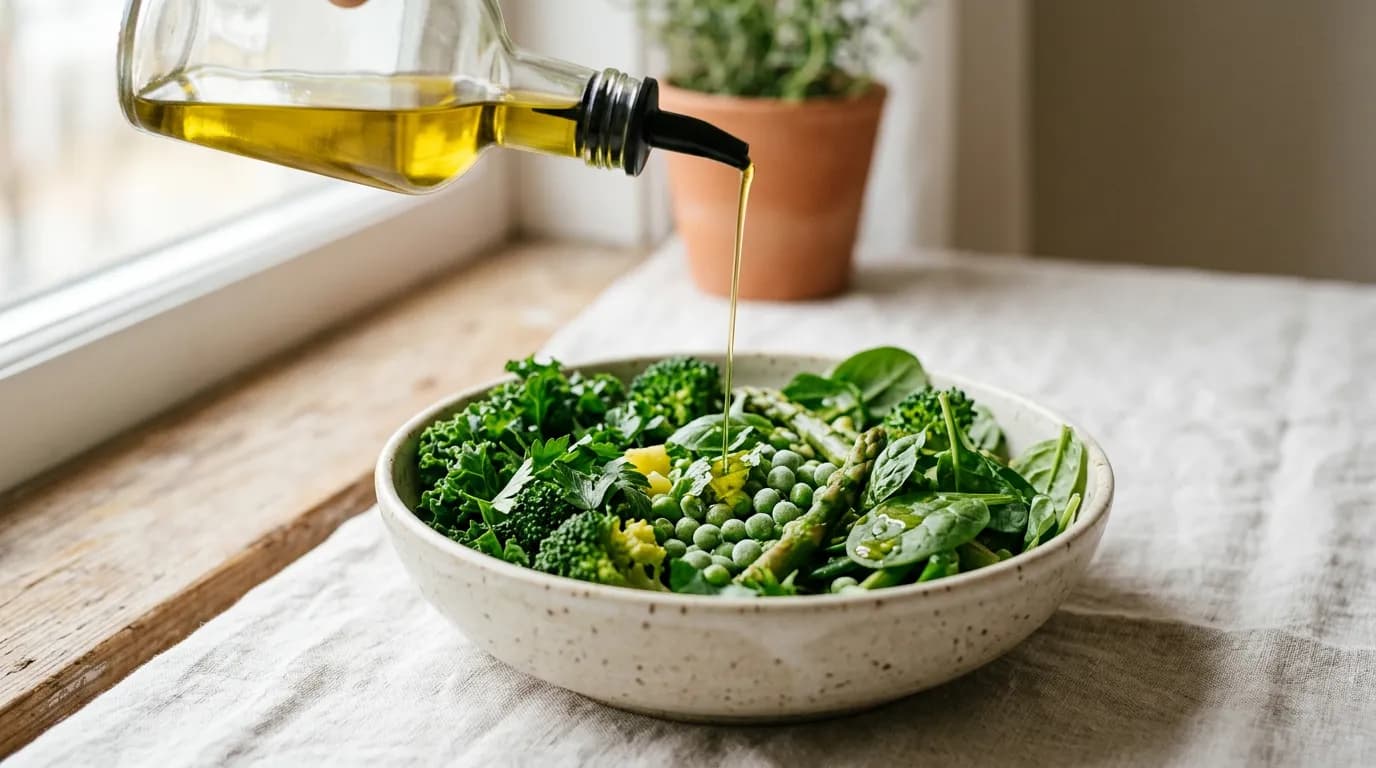
Why Your Vegetables Need Fat
A raw salad with no dressing looks like the healthy choice. It's quietly wasting most of the vitamin A, D, E, and K sitting in it. Here's the fix, and the actual mechanism behind it.
 Damien, founder of HALOIA11 min read
Eating a plate of raw spinach, shredded carrots, and bell peppers with absolutely nothing on it feels like the single healthiest move on the menu. In one specific, well-documented way, it isn't. Four vitamins your body actually needs — A, D, E, and K — are fat-soluble, which means they cannot cross from your gut into your bloodstream without fat physically present in the same meal. Skip the fat, and a meaningful share of those vitamins passes straight through your digestive system unused, no matter how many servings of vegetables you technically ate that day. This isn't a wellness trend, a supplement company's talking point, or a "clean eating" rule — it's basic digestive physiology, documented for decades in clinical nutrition literature. The fix costs almost nothing and takes seconds: a real dressing instead of a fat-free one, a few slices of avocado, a drizzle of olive oil before roasting. What trips most people up isn't the concept, which is simple once you hear it, it's the specifics — exactly which vitamins are at stake, how much fat actually changes anything, which of your current habits are quietly wasting the vegetables you're already eating, and where the line is between this real mechanism and the food-combining myths that get lumped in with it online. Here's what the research actually supports.
Why Fat-Soluble Vitamins Can't Absorb Without Fat
Your gut doesn't treat every vitamin the same way. Water-soluble vitamins — vitamin C, the B-complex — dissolve directly into the watery environment of your small intestine and pass into your bloodstream more or less regardless of what else is on your plate. That's why you can take a vitamin C supplement on an empty stomach and still absorb it fine. Fat-soluble vitamins don't get that shortcut, because they're chemically incompatible with the mostly-water environment your intestine absorbs things through. Before vitamins A, D, E, and K can cross into your bloodstream, they need to be packaged into micelles — tiny, fat-based transport structures your intestine is built to absorb — and that packaging can only happen in the presence of dietary fat. Without fat in the meal, that packaging is far less efficient, and much of the vitamin can pass through unabsorbed, regardless of how much of it was actually sitting in the food you ate. The best-measured example concerns carotenoids (provitamin A): in a small study of seven people, a salad with a fat-free dressing led to almost no carotenoid absorption. That finding doesn't extend automatically to vitamins D, E, or K. It isn't a minor efficiency loss you can round down and ignore. It's the difference between a nutrient your body can genuinely use and one that was, functionally, nutritional decoration: present in the food, invisible to your bloodstream. The mechanism also explains something that trips people up — why a multivitamin taken with black coffee on an empty stomach can underperform the same vitamins eaten as part of a meal that actually contains some fat. The vitamin itself doesn't change. What changes is whether your gut has the raw material to package it for absorption.
Vitamins A, D, E, and K are fat-soluble, so dietary fat plays a role in their absorption (Stevens, Nursing Clinics of North America, 2021.) For carotenoids (provitamin A), in a study of seven people, a salad with a fat-free dressing led to almost no absorption, while a dressing with 28 g of oil gave higher absorption than one with 6 g (Brown et al., American Journal of Clinical Nutrition, 2004). That result concerns carotenoids, not vitamins D, E, or K.
The Four Vitamins at Stake, and What Each One Actually Does
Not every vitamin needs this workaround, which is exactly why it's worth knowing which four actually do, and why losing them specifically is worth caring about. Between them, they cover eyesight, bone density, cell repair, immune function, and blood clotting — not a niche corner of your health, but some of its more foundational mechanics.
- Vitamin A, as beta-carotene in carrots, sweet potatoes, spinach, kale, and red peppers: supports vision (especially low-light adaptation), immune function, and the turnover of skin cells. Beta-carotene specifically has to be packaged with fat before your gut absorbs and converts it — one of the better-studied examples of this mechanism.
- Vitamin D, found in smaller amounts in mushrooms and fortified plant milks often eaten alongside vegetables: regulates how much calcium your body absorbs and uses for bone density, and low levels are consistently linked to weaker immune response and mood.
- Vitamin E, present in leafy greens and concentrated further in the nuts and seeds people often pair with them: an antioxidant that protects cell membranes, including skin cells, from oxidative damage — one of the more direct nutritional links to skin condition on this list.
- Vitamin K, abundant in leafy greens — kale, spinach, broccoli, Brussels sprouts, and swiss chard: essential for normal blood clotting, and increasingly studied for its role in bone density and cardiovascular health.
How Much Fat Actually Moves the Needle
You don't need to drown your vegetables in oil to get this benefit, but more fat does not mean a plateau right away: in a study of 29 people, a meal with 20 g of fat gave higher absorption of all the carotenoids measured than meals with 3 g or 8 g (Goltz et al., Molecular Nutrition & Food Research, 2012). In practice, some fat in the same meal is what helps: a tablespoon or two of an olive oil–based dressing on a salad, a quarter of an avocado sliced over roasted vegetables, a handful of nuts or seeds tossed into a grain bowl, or vegetables sautéed in a little oil instead of steamed completely plain. Pairing them in the same meal is the setup the studies cited here measured (Brown et al., 2004, with salad meals); whether fat eaten at a later meal changes anything was not tested. Cooking method quietly follows the same rule: vegetables steamed, boiled, or air-fried with zero added fat lose this advantage almost entirely, even though the vitamin content of the vegetable itself is unchanged by cooking. The same vegetables roasted in a little oil, finished with butter, or served alongside a fat-based sauce keep it. This is also why fat-free versions of dressings, marinades, and dips — built to save calories — quietly undercut the specific reason you're eating the vegetables they're sitting on.
What This Actually Looks Like on a Plate
The easiest way to apply this isn't a rule to memorize, it's a habit: never plate raw or steamed vegetables completely bare. A few pairings that work well because they put a vegetable genuinely rich in A, D, E, or K in the same bite as a real fat source:
- Spinach or kale salad with an olive oil–based dressing, not a fat-free vinaigrette — the single most common fix, since leafy greens are one of the densest vegetable sources of vitamin K and E on any plate.
- Roasted carrots or sweet potatoes finished with a drizzle of olive oil or a pat of butter, rather than roasted plain with nothing but salt and pepper.
- Sautéed broccoli or Brussels sprouts cooked in oil, rather than steamed and served dry alongside the rest of the meal.
- A green smoothie with spinach or kale blended alongside avocado, nut butter, or full-fat yogurt, instead of only fruit and water.
- A vegetable-heavy grain bowl finished with a scoop of tahini, a few slices of avocado, or a handful of pumpkin seeds, rather than left dry.
The Classic Mistake: The Fat-Free Salad
The single most common way this goes wrong is also the most well-intentioned one: ordering a salad, asking for dressing on the side, and then barely using it — or skipping it entirely to cut calories. It's an understandable instinct. Dressing is genuinely where a lot of the added calories in a salad hide, and cutting it feels like the disciplined choice. But it quietly defeats a real part of the reason you're eating the salad in the first place. A bowl of spinach, kale, and carrots dressed with a fat-free vinaigrette, or nothing at all, is still a legitimate source of fiber and water-soluble nutrients. It's a considerably weaker source of the vitamin A, E, and K it looks like it should be delivering, because the fat needed to actually absorb them isn't there. The fix isn't more dressing for its own sake, it's not skipping it. A tablespoon or two of an olive oil–based dressing adds a modest, predictable amount of calories and, in exchange, unlocks a meaningfully larger share of the fat-soluble vitamins already sitting in the bowl — a better trade, nutrient for calorie, than eating the same salad dry and absorbing only a fraction of what it actually contains. The same logic applies to the fat-free ranch, the oil-free stir-fry, and the plain-steamed vegetable side that shows up next to dinner out of habit rather than any real reasoning.
Your Appearance Score
What's Your Appearance Score?
60 seconds. Get a score based on your habits.
Real Food Science vs. Food-Combining Myths
It's worth being precise about what this is and isn't, because online nutrition advice is thick with "food combining" claims that sound similar to this but aren't backed by anywhere near the same evidence. The idea that you should never eat protein and carbohydrates in the same meal because your body "can't digest both at once," or that fruit eaten after a meal ferments in your stomach and causes bloating, are two of the most persistent examples — and neither one is backed by trial evidence. The fat-and-fat-soluble-vitamins mechanism covered above is a different category entirely. It isn't a theory about digestion order, meal sequencing, or which foods you're "allowed" to combine — it's a specific, well-documented absorption pathway with a testable chemical mechanism behind it, published in mainstream clinical nutrition literature rather than wellness blogs. That distinction is exactly why it's worth taking seriously, while the food-combining claims sitting right next to it in your feed usually aren't.
A randomized clinical trial compared a strict food-combining diet (separating proteins and carbs) to a standard balanced diet over six weeks and found identical weight loss in both groups — digestive enzymes act on protein, carbs, and fat simultaneously, regardless of meal order. (Golay et al., International Journal of Obesity and Related Metabolic Disorders, 2000.)
On an empty stomach, gastric acidity is very high (median pH 1.7), and it rises only briefly after a meal before dropping back in under two hours (Dressman et al., Pharmaceutical Research, 1990). That acidity inactivates many of the microorganisms we swallow (Martinsen et al., Basic & Clinical Pharmacology & Toxicology, 2005). None of the sources cited here shows that fruit eaten after a meal ferments and causes bloating.
Who Should Pay the Closest Attention
This matters for everyone eating vegetables, but the stakes are higher for a few specific groups. Anyone following a genuinely low-fat diet, whether for weight loss, a medical condition, or a fat-restriction protocol, is at real risk of under-absorbing A, D, E, and K even while eating plenty of vegetables on paper. The same goes for anyone on medication or managing a condition known to interfere with fat digestion or absorption, where checking with a doctor about vitamin status specifically is worth doing rather than assuming vegetables alone are covering it. Older adults, who on average produce less bile — the substance responsible for emulsifying fat in the gut in the first place — may also be quietly under-absorbing these vitamins even on a diet that looks fat-adequate on paper. None of this means these groups need to eat more vegetables. It means the fat sitting next to the vegetables matters more for them, not less, and it's the detail most likely to get cut first when someone is deliberately eating "lighter."
How to Build the Habit
None of this requires a meal plan, a supplement stack, or tracking a single gram. It requires one standing rule: never serve raw or steamed vegetables completely bare. A few ways to make that automatic:
- Default to a real, oil-based dressing on salads, used generously enough to actually coat the leaves — not a token drizzle you barely taste.
- Roast or sauté vegetables in a bit of oil instead of steaming them plain, especially anything from the vitamin A and K list: kale, spinach, carrots, sweet potatoes, broccoli.
- Add a fat source to smoothies and juices — avocado, nut butter, or full-fat yogurt — since blending vegetables without any fat runs into the same absorption problem as eating them raw.
- Treat "fat-free" as a warning label on dressings, marinades, and sauces meant to go with vegetables, not a selling point — you're usually trading a real nutritional loss for roughly a hundred calories saved.
The tricky part isn't knowing that fat matters here — it's noticing the actual pattern in your own meals. How many of your vegetable servings this week came with a real fat source attached, versus how many were steamed plain, eaten raw, or dressed with something fat-free to save calories? That's the kind of detail that's easy to lose track of meal by meal but adds up over weeks into a real, measurable gap in vitamin absorption. HALOIA's meal logging tracks what you actually eat, pairing by pairing, and flags when your vegetable intake is running short on the fat it needs to actually count — instead of leaving you to guess whether that spinach salad did anything beyond filling you up.
If you want a quick read on where your current habits stand before changing anything, HALOIA's free appearance quiz gives you a baseline on your diet and habits in a couple of minutes.
Sources
This article is for information only and is not a substitute for medical advice. For any question about your health, a treatment or a supplement, consult a qualified professional.
Improve your appearance by eating better
Build real confidence by tracking your diet. Download HALOIA and start your tracking.

Go further
The Best Breakfast for Clear Skin in Your 20s
Forget "eat clean" advice with no specifics. Here's the exact breakfast structure that keeps blood sugar stable and gives your skin what it needs to repair overnight's damage.
Ashwagandha: Its Real Effect on Stress and Training
Ashwagandha gets credited for almost everything. Two claims actually hold up in controlled trials — stress/cortisol and strength/muscle — and they don't have the same evidence behind them. Here's the honest breakdown.

Who Should Never Fast?
Intermittent fasting is safe for most healthy adults — but not for everyone. Here's exactly who should skip it, and why, according to the research.